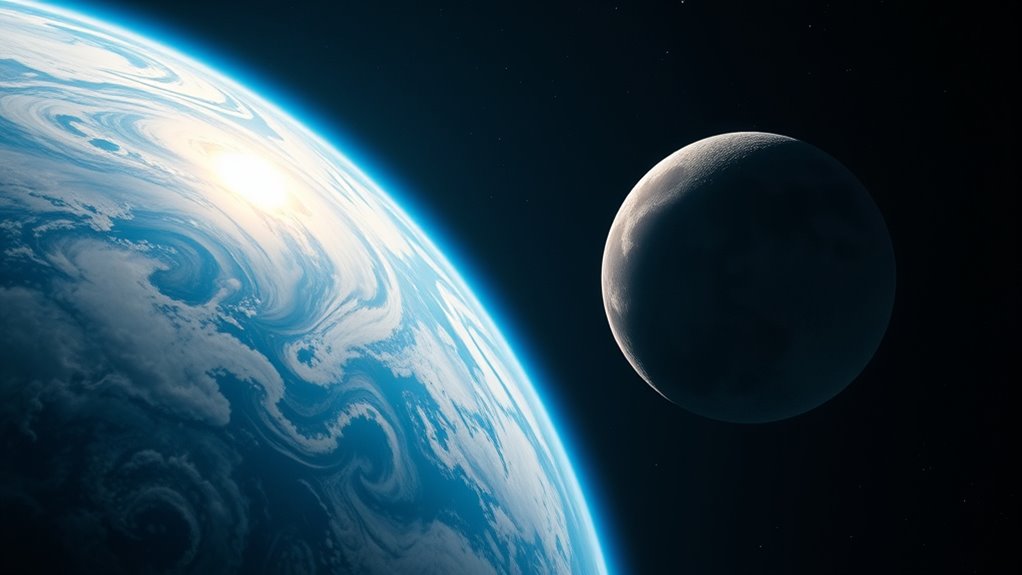

Earth’s moon formed from a massive impact early in its history when a Mars-sized object, named Theia, collided with our planet. The collision ejected a huge amount of debris into space, which eventually gathered to create the moon. This impact explained the moon’s size, composition, and features, and supports the idea that Earth and the moon share a common origin. To understand how this event shaped our world, keep exploring this enthralling story.
Key Takeaways
- The Moon formed from debris caused by a giant impact between Earth and a Mars-sized body named Theia.
- The collision released debris that eventually coalesced into the Moon over millions of years.
- The impact explains the Moon’s size, composition, and the small size of its core.
- Earth’s features and orbit were shaped by the massive collision, linking their origins.
- Computer simulations support the impact hypothesis as the most plausible explanation for the Moon’s formation.
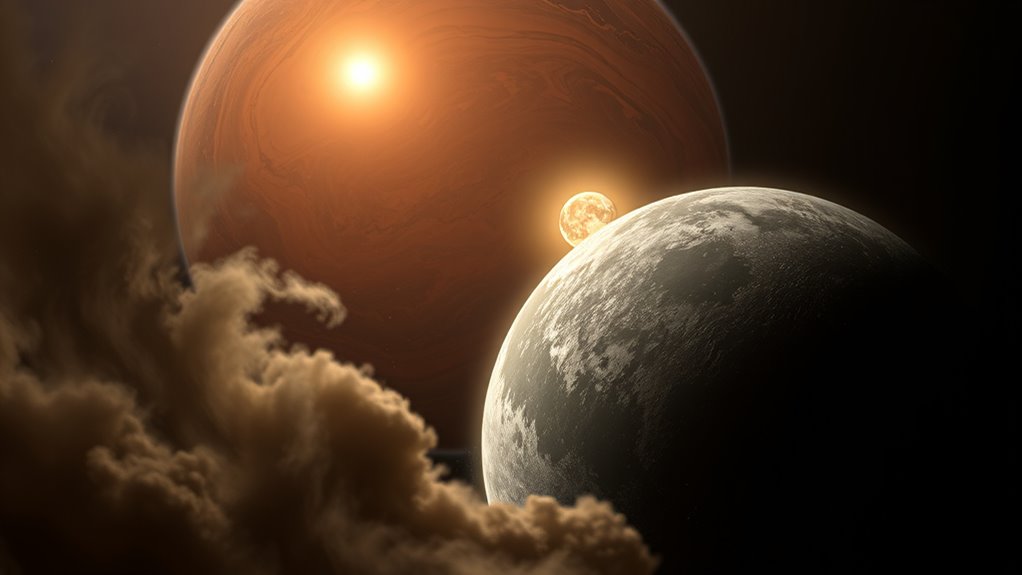
The origin of Earth’s moon has fascinated scientists for centuries, and recent research suggests it was formed through a colossal impact event. This idea, known as the impact hypothesis, has gained widespread support because it explains many features of the moon and Earth’s relationship. You might wonder how a giant collision could create a moon, but the evidence points strongly in this direction. About 4.5 billion years ago, shortly after Earth formed, a Mars-sized body named Theia collided with our planet. The immense energy from this impact ejected vast amounts of debris into space, which eventually coalesced to form the moon. This collision didn’t just knock material loose; it fundamentally shaped Earth’s composition and orbit as well.
Understanding moon formation through the impact hypothesis helps clarify why the moon is so different from other celestial bodies in the solar system. Unlike moons captured by gravity or formed in situ, the moon’s composition closely matches Earth’s outer layers, indicating a shared origin. The impact would have melted and mixed material from both bodies, creating a debris disk around Earth. Over time, gravity pulled this debris together, gradually forming a single, large satellite. This process, called accretion, took millions of years, but it resulted in the moon we see today. The impact hypothesis also explains the moon’s relatively large size compared to Earth, as the collision would have blasted out enough material to create a sizable satellite.
Scientists continue to investigate details of this event, but the impact hypothesis remains the leading explanation for moon formation. Computer simulations support the idea that such a collision could produce a debris disk with the right properties to form a moon. They also help explain why the moon’s core is small and why its surface shows signs of ancient volcanic activity. The impact hypothesis is compelling because it accounts for these features and aligns with what we observe today.

English Solar System Sun Earth Moon Orbital Model, Educational Planetarium Project Kit for Science Astronomy Teaching, Earth Moon Sun Rotation Model for Kids
- DIY Solar System Model: Create sun, earth, moon orbits
- Includes Seasonal Plate: Displays seasons and Chinese solar terms
- Educational Demonstrations: Shows seasons, solar and lunar eclipses
As an affiliate, we earn on qualifying purchases.
As an affiliate, we earn on qualifying purchases.
Frequently Asked Questions
When Did the Giant Impact Event Occur?
The giant impact event happened around 4.5 billion years ago, marking the impact timing for lunar formation. You can imagine a Mars-sized body colliding with Earth, ejecting debris that eventually coalesced into the Moon. This impact shaped the early Earth and set the stage for our planet’s satellite. Understanding this timing helps explain the Moon’s composition and its orbit, giving you insight into our planet’s ancient history.
What Was Earth’s Original Size Before the Impact?
Ever wonder how different Earth was before its dramatic transformation? Back in the early solar system, during planetary accretion, Earth was much smaller—about 60% of its current size. It grew through collisions and accumulation of debris. Before the giant impact, it was a planetary embryo, still forming. This smaller size made it vulnerable to the colossal collision that ultimately shaped its destiny and created the Moon.
How Does the Moon’s Composition Compare to Earth’s Crust?
You’ll find that the moon’s formation resulted in a crust composition quite different from Earth’s crust. The moon’s crust mainly consists of oxygen, silicon, magnesium, and trace elements, similar to Earth’s crust, but it has less iron and water. This difference occurs because the moon formed from debris after a giant impact, shaping its crust composition uniquely, unlike the more diverse and complex crust on Earth.
Could Earth Have Formed Without the Moon?
You can’t imagine Earth without its moon, because it plays a vital role in shaping tidal locking and lunar geology, which influence Earth’s rotation and stability. Without the moon, tides would be weaker, potentially affecting ocean life and climate. The moon’s gravitational pull helps keep Earth’s axial tilt steady, so without it, Earth’s climate might be more unstable, making the planet less hospitable for life.
What Evidence Supports the Giant Impact Hypothesis?
You see, the impact evidence supporting moon formation through a giant impact includes the similarity in Earth’s and Moon’s isotopic compositions, indicating a shared origin. Additionally, the Moon’s relatively large size compared to Earth and its iron-poor composition suggest it formed from debris after a massive collision. These clues collectively make the giant impact hypothesis the most convincing explanation for the moon formation.

Question Canvas Wall Art, Educational Chalkboard Research Hypothesis None Black Wall Hanging Posters Artwork Prints Classroom Library Study Decor 8×12 Inch
- Design Style: Chalkboard aesthetic with colorful elements
- Print Quality: High definition with vibrant colors
- Frame Type: Pre-framed canvas with wooden frame
As an affiliate, we earn on qualifying purchases.
As an affiliate, we earn on qualifying purchases.
Conclusion
The giant impact hypothesis remains the most convincing explanation for Earth’s moon, supported by extensive evidence like similar compositions and orbital dynamics. While some details are still debated, the theory convincingly shows how a massive collision shaped our lunar companion. It’s a reminder that Earth’s history is written in cosmic events, and ongoing research continues to uncover the truth behind our celestial neighbor’s origins. Trust the scientific process to reveal what truly happened long ago.
English Solar System Sun Earth Moon Orbital Model, Educational Planetarium Project Kit for Science Astronomy Teaching, Earth Moon Sun Rotation Model for Kids
- DIY Solar System Model: Create sun, earth, moon orbits
- Includes Seasonal Plate: Displays seasons and Chinese solar terms
- Educational Demonstrations: Shows seasons, solar and lunar eclipses
As an affiliate, we earn on qualifying purchases.
As an affiliate, we earn on qualifying purchases.

National Geographic Glow in the Dark Solar System Model for Kids Ages 8-12
- Build a glowing 3D solar system: Create a glowing, customizable solar system model
- Complete all-in-one kit: Includes paints, decals, brush, and educational poster
- Adjustable planet arms: Move and rearrange planets easily
As an affiliate, we earn on qualifying purchases.
As an affiliate, we earn on qualifying purchases.