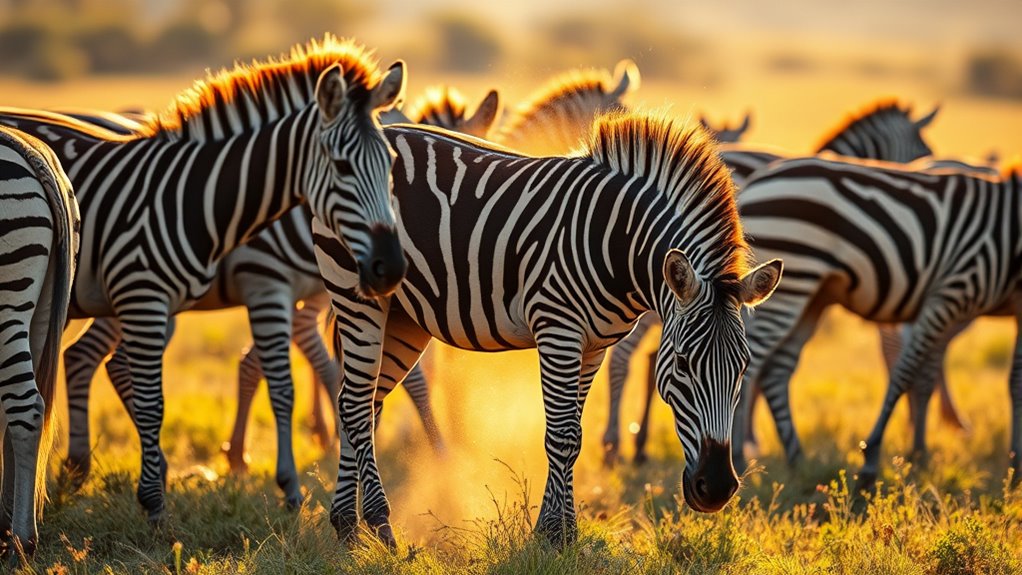

Zebras have stripes mainly to help hide themselves from predators and to stay connected with others in their group. The bold patterns break up their outline, making it harder for predators like lions to single out a target, especially when they move. Plus, each zebra’s unique stripes act like fingerprints, helping herd members recognize one another and communicate. If you want to learn more about how their stripes protect and socialize them, keep exploring this fascinating topic.

Get movie nights delivered free with Prime
- Fast, free delivery on millions of items
- Prime Video, Amazon Music and more included
- Member-only deals all year
Key Takeaways
- Zebra stripes serve as camouflage, blending into a confusing mosaic to hide individual animals from predators.
- Stripes disrupt predators’ line of sight and movement, making it harder for them to target a single zebra.
- Unique stripe patterns enable zebras to recognize each other and maintain social bonds within herds.
- Variations in stripe patterns can indicate age, social status, and help protect juveniles from predators.
- Stripes may also play a role in regional genetic diversity and individual identification.
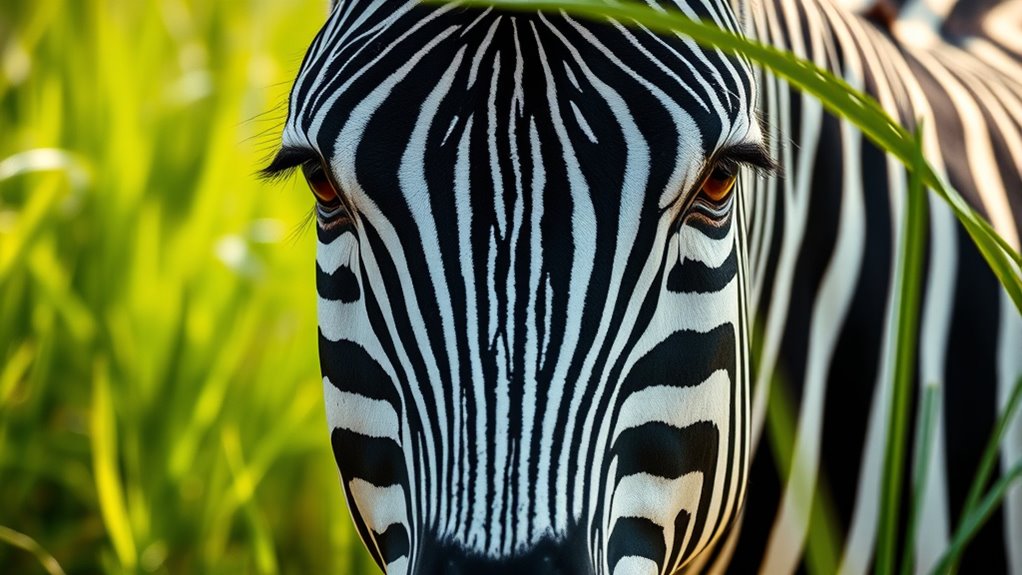
Zebras are easily recognizable by their distinctive black-and-white stripes, which serve multiple purposes beyond just making them look striking. One of the primary reasons for these striking patterns is their role as camouflage patterns. When zebras stand together in a herd, their stripes blend into a confusing mosaic, making it difficult for predators to single out an individual. This visual chaos helps protect them from lions, hyenas, and other predators by disrupting their line of sight. The stripes break up the outline of a zebra’s body, especially when they’re moving, creating a shimmering effect that confuses predators during quick pursuits. This camouflage isn’t perfect, but it considerably increases their chances of survival by making it harder for predators to lock onto a single target. Additionally, the pattern of stripes can vary between populations, which may assist in regional genetic diversity.
Beyond camouflage, the stripes also play a crucial role in social signaling. Zebras are highly social animals that rely on visual cues to recognize one another, especially within large herds. Each zebra’s stripe pattern is unique, much like human fingerprints, allowing members of the herd to identify individuals quickly. When you observe a herd of zebras, you’ll notice that they often engage in social interactions based on visual recognition, which helps maintain social bonds and coordinate movements. The stripes also communicate information about age, sex, and social status, helping to strengthen group cohesion. Young zebras, for example, typically have narrower stripes, which can signal their age to other herd members and help protect them from being mistaken for adults by predators.
As an affiliate, we earn on qualifying purchases.
Frequently Asked Questions
Do All Zebra Species Have the Same Stripe Pattern?
No, not all zebra species have the same stripe pattern. You see, genetic variation influences each species’ unique design, with some having narrow stripes while others sport broader ones. These differences serve an evolutionary purpose, helping zebras with camouflage, social bonding, and insect deterrence. So, as you observe various zebra species, you’ll notice that their stripe patterns reflect their distinct adaptations and evolutionary histories, making each one uniquely fascinating.
How Do Zebra Stripes Develop in the Fetus?
Imagine watching a zebra’s tiny fetus in the womb as its striped pattern begins to emerge. During embryonic development, fetal pigmentation cells activate, creating the initial black and white markings. These stripes form through a complex process where pigment-producing cells migrate and differentiate, shaping each pattern uniquely. This intricate development guarantees that, even before birth, the zebra’s distinctive stripes are etched into its skin, a beautiful result of precise embryonic processes.
Are Zebra Stripes Unique Like Human Fingerprints?
Yes, zebra stripes are unique like human fingerprints. You can identify individual zebras based on their distinctive stripe patterns, which result from genetic markers. These patterns provide evolutionary advantages, such as camouflage and social recognition. By analyzing their stripe variations, scientists can track zebra populations and study their behavior, helping you understand how genetics and evolution shape their unique appearances.
Do Zebra Stripes Change as They Age?
Imagine zebra stripes as a living canvas that evolves with time. As you observe, their patterns don’t change considerably, but subtle shifts can occur due to genetic variation and environmental influence. Young zebras are born with faint stripes that darken and refine as they mature. While the core pattern remains, minor adjustments happen, reflecting their growth and surroundings, making each zebra uniquely adaptable throughout its life.
Can Zebra Stripes Be Used to Identify Individual Animals?
Yes, you can use zebra stripe variation to identify individual animals. Each zebra’s pattern is unique, much like a fingerprint, making it easier to tell them apart. These stripe variations also help with predator confusion, as the distinctive patterns blend into a moving herd. By observing the specific arrangement of stripes, you can distinguish one zebra from another, proving the usefulness of their unique markings.
As an affiliate, we earn on qualifying purchases.
Conclusion
Now you see, zebra stripes aren’t just for show—they help you stay safe, cool, and connected. Just like a barcode helps identify a product, each zebra’s pattern is unique, making them special. These stripes are your nature’s way of using a clever disguise, blending into the herd like a chameleon in a colorful forest. So, next time you see a zebra, remember, those stripes are more than just pretty—they’re a smart survival tool, as essential as your own fingerprints.
As an affiliate, we earn on qualifying purchases.
zebra stripe identification guide
As an affiliate, we earn on qualifying purchases.
As an affiliate, we earn on qualifying purchases.
Fall Picks
fall essentials
As an affiliate, we earn on qualifying purchases.