
Bees navigate using their sense of the sun as a compass, even on partly cloudy days, helping them find flowers and return efficiently to the hive. They also use scent cues to identify floral sources and hive odors for organization. Additionally, they communicate through the waggle dance, sharing precise information about food locations. If you’re curious about how these clever tricks work together, you’ll uncover even more fascinating details as you continue.
Key Takeaways
- Bees use the sun’s position as a compass, adjusting for its movement to navigate accurately to flowers and the hive.
- They rely on their sense of smell to detect floral scents, remembering them for efficient foraging and returning to the same patches.
- Bees memorize the sun’s angle at specific times to compensate for its movement across the sky, enhancing navigation precision.
- The waggle dance conveys information about distance and direction of food sources, guiding other bees efficiently.
- Hive scent cues coordinate activities and help bees communicate, ensuring organized resource storage and hive maintenance.
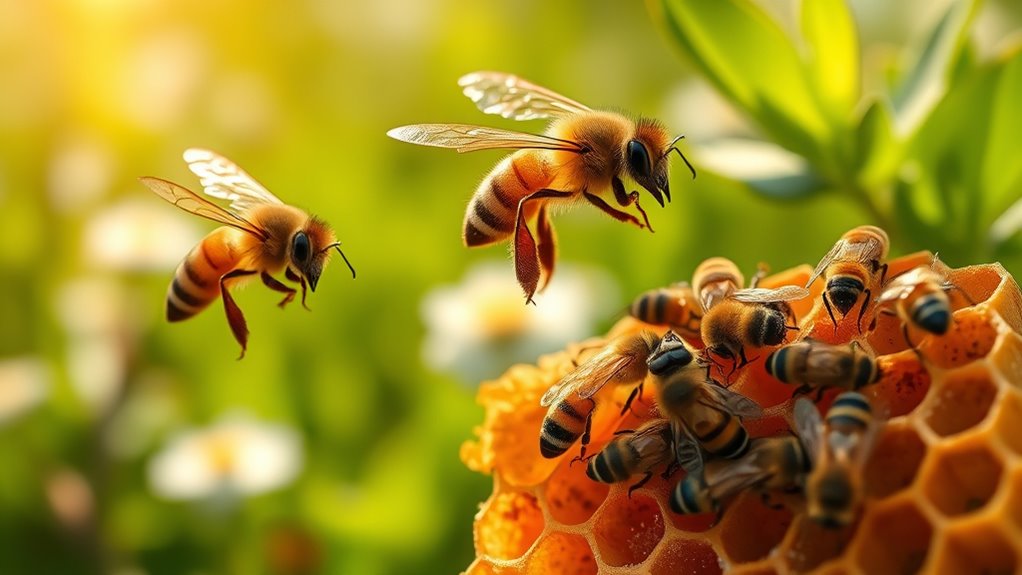
Have you ever wondered how bees find their way back to the hive from miles away? It’s a remarkable feat that combines natural navigation skills and complex communication. Bees rely on a combination of the sun’s position, their sense of smell, and a fascinating dance to guarantee they return with nectar or pollen. This navigation isn’t just about traveling; it’s also vital for honey production and maintaining hive organization. When a forager bee leaves the hive, she sets out with a purpose, and her return journey is guided by these incredible tools.
First, bees use the sun as a compass. They can detect the sun’s position even on partly cloudy days and adjust their flight path accordingly. To do this accurately, they need to compensate for the sun’s movement across the sky throughout the day, which they do instinctively. By memorizing the sun’s angle at specific times, they can navigate directly to rich flower patches and back to the hive. This precision guarantees they spend less time searching and more time gathering resources, directly impacting honey production. The hive’s organization benefits from this efficiency because foragers can be dispatched swiftly and reliably, knowing exactly where to find the best nectar sources.
But what happens on cloudy days or in low-light conditions? That’s where their sense of smell comes into play. Bees have an extraordinary ability to detect floral scents and the chemical signatures of their hive. When they leave, they remember the scent of flowers they visited, helping them locate the same patches again. Inside the hive, scent cues also guide them, especially when coordinating hive activities like honey storage, brood care, and defense. This hive organization relies heavily on scent markers, facilitating smooth communication among colony members and ensuring that honey production is optimized by storing nectar in designated areas.
Lastly, the waggle dance is a sophisticated form of communication that encodes the distance and direction of food sources relative to the hive and the sun. When a forager returns, she performs this dance on the honeycomb, giving other bees precise information. Younger or less experienced bees learn to interpret these signals, which saves time and energy. This dance guarantees that the colony efficiently exploits floral resources, bolstering honey production and keeping hive organization tight. Without this intricate communication, the colony’s ability to gather resources and sustain itself would falter.
In essence, bees combine celestial navigation, scent cues, and complex dances to navigate effectively. This multi-layered system not only supports their survival but also underpins the hive’s organization and honey-making success. You can think of it as a finely tuned GPS system, one that’s been honed over millions of years of evolution, allowing bees to thrive in diverse environments and keep their colonies productive and organized.
Frequently Asked Questions
How Do Bees Remember the Locations of Flowers Over Long Distances?
You keep the flower locations in your memory using sophisticated navigation strategies. Bees rely on flower memory, which helps you recall specific spots even over long distances. You combine this with cues like the sun’s position and the waggle dance to navigate accurately. These strategies enable you to efficiently find flowers repeatedly, ensuring you return to the best nectar sources and maximize your foraging success.
Do Bees Use the Earth’s Magnetic Field to Navigate?
You might wonder if bees use magnetic cues to navigate. While some studies suggest bees can sense the Earth’s magnetic field, they primarily rely on celestial navigation, like the sun’s position, and their sense of smell. Magnetic cues are not their main tools; instead, they combine visual cues, the sun, and odor trails to find their way accurately over long distances.
How Do Young Bees Learn to Navigate Effectively?
You might think young bees are born knowing how to navigate, but they actually learn through a mix of discovery and mimicry. During bee learning, they observe experienced workers, practice flying, and pick up cues like the sun’s position, scent trails, and the waggle dance. This navigation development is a gradual process, turning instinct into skill, much like a child mastering a new game—bumpy at first, then smooth sailing.
Can Bees Navigate in Complete Darkness?
Bees generally can’t navigate in complete darkness because they rely heavily on vision, smell, and the waggle dance. However, some nocturnal bees have developed sensory adaptations that allow them to forage at night, using enhanced olfactory and tactile senses. This nocturnal behavior helps them find food without sunlight, but their navigation still isn’t as precise as in daylight. So, in total darkness, most bees struggle to navigate effectively.
How Do Environmental Changes Affect Bee Navigation Accuracy?
Environmental disruptions can markedly impact your bee navigation accuracy by disturbing magnetic cues and sensory signals. When magnetic fields are altered or environmental conditions change unexpectedly, you might struggle to find your way, especially if you rely on the sun or smell. These disruptions can cause confusion, making it harder for you to follow familiar routes or perform the waggle dance accurately, ultimately affecting your ability to locate food and communicate effectively.
Conclusion
Just like a skilled sailor relies on the sun, smell, and the waggle dance to find their way, you can think of bees as nature’s navigators guiding their journey. Imagine a tiny bee, confidently dancing in the hive, sharing the location of nectar like a secret map. Their remarkable methods remind us that even in a complex world, simple signals and instincts can lead you straight to your goal—whether you’re exploring a garden or chasing your dreams.