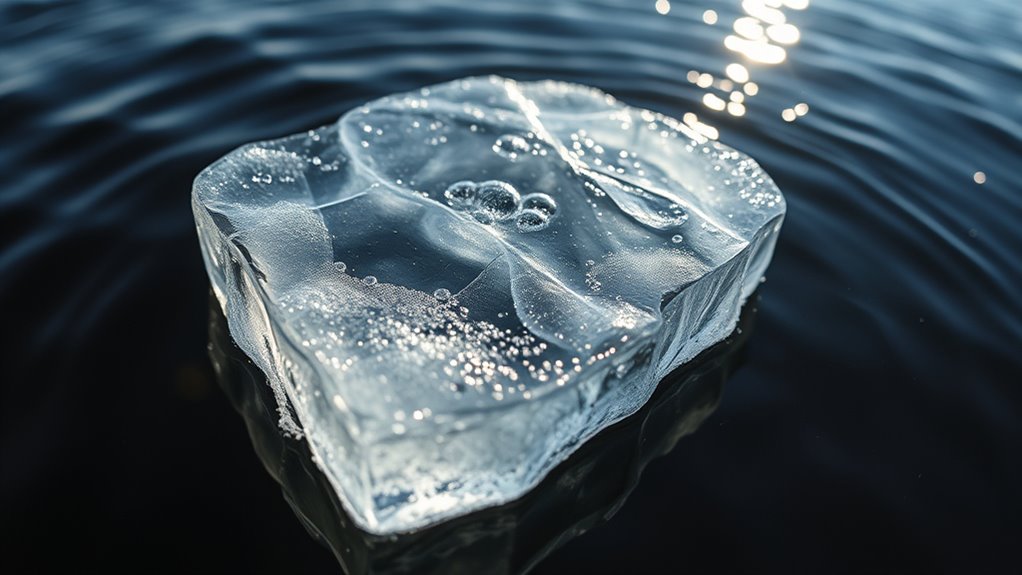

You might be surprised, but water expands when it freezes because of its molecular structure. Instead of packing tightly, water molecules form an open hexagonal lattice, which takes up more space. This less dense arrangement makes ice float on liquid water. Most substances get denser as they cool, but water’s unique pattern is different. Want to understand how this strange property impacts life and the environment? Keep exploring to discover more about this fascinating process.
Key Takeaways
- Water molecules form a hexagonal crystalline lattice when freezing, creating an open, spacious structure.
- This lattice structure causes ice to occupy more volume than the same amount of liquid water.
- The increased volume results in a lower density of ice compared to water.
- Lower density makes ice buoyant, allowing it to float on liquid water.
- The floating ice insulates water bodies, supporting aquatic life during cold temperatures.

Have you ever wondered why ice floats on water instead of sinking? It’s a fascinating quirk of nature that often surprises people. The secret lies in the unique molecular structure of water and how it changes when water freezes. When water is in its liquid state, its molecules move freely and are packed relatively close together, which results in a certain density. As the temperature drops and water begins to freeze, its molecular structure shifts dramatically. Instead of compacting further, water molecules form a crystalline pattern called a hexagonal lattice, which is less dense than the arrangement in liquid water. This change in the molecular structure causes a significant density change, making ice less dense than liquid water.
In most substances, cooling causes the material to contract and become denser. However, with water, the formation of that crystalline lattice in ice actually pushes the molecules farther apart. This means that a given volume of ice contains fewer molecules than the same volume of liquid water. Because density is the mass of a substance divided by its volume, and ice has fewer molecules in the same space, it ends up being less dense. This lower density is what makes ice buoyant and allows it to float on water. It’s a counterintuitive phenomenon, but it’s essential for life on Earth. If ice sank, it would form a solid layer at the bottom of bodies of water, freezing everything beneath and disrupting ecosystems.
This density change during freezing isn’t just a scientific curiosity; it impacts our environment in profound ways. The fact that ice floats insulates the water below, keeping lakes and oceans from freezing solid all the way through. This insulation allows aquatic life to survive harsh winters, as the water beneath remains relatively warm. When you consider the molecular structure, it becomes clear why this happens: the geometric arrangement of water molecules in ice creates an open, spacious lattice. This lattice structure is responsible for the decrease in density compared to liquid water, which has a more tightly packed molecular arrangement. So, next time you see ice floating, remember that it’s all about the molecular structure and the way water molecules arrange themselves during freezing, leading to a surprising and essential density change. Understanding this molecular arrangement helps explain the critical role of ice in supporting life and maintaining ecological balance on Earth.
Frequently Asked Questions
How Does the Molecular Structure of Water Cause Expansion When Freezing?
When water freezes, its molecular arrangement shifts into a crystal lattice that takes up more space. You see, as molecules slow down, they form a rigid structure with each molecule spaced further apart compared to liquid water. This expansion occurs because of hydrogen bonds, which hold the molecules in a specific pattern, causing ice to be less dense and float. So, the molecular structure directly causes ice to expand when it freezes.
Why Is Ice Less Dense Than Liquid Water?
You’ll notice ice is less dense than liquid water because of the phase change during freezing. As water cools and turns into ice, its molecules arrange into a crystalline structure with more open space, reducing density. This molecular arrangement causes the density difference, making ice buoyant and able to float. The expansion during the phase change results in a solid that’s less dense than its liquid form, which is quite unique among substances.
How Does Ice Floating Impact Aquatic Life During Winter?
During winter, ice floating creates an insulating layer that protects aquatic ecosystems from extreme cold. Imagine a pond where ice forms on the surface; this layer prevents the entire water body from freezing solid, allowing fish and plants to survive. You benefit from this natural winter insulation because it maintains oxygen levels and supports aquatic life through harsh conditions. Without ice floating, many species couldn’t endure the cold months.
Can Ice Floating Be Observed in Other Substances Besides Water?
You can observe floating phenomena in some alternative substances besides water. For example, helium gas makes balloons float, and certain oils or waxes can float on water due to their density. These substances exhibit floating because their densities are lower than the medium they’re in. This kind of floating is common in various contexts, showcasing how different materials behave based on their physical properties, just like water’s unique expansion causes ice to float.
What Role Does Hydrogen Bonding Play in Water’s Expansion Upon Freezing?
Hydrogen bonds are key to water’s expansion when it freezes. They form a crystalline structure that keeps water molecules apart more than in liquid form. This arrangement creates open spaces, making ice less dense and able to float. You can think of hydrogen bonds as the glue that holds these molecules in a specific pattern, causing the unusual expansion and making ice uniquely buoyant compared to liquid water.
Conclusion
Now that you know why ice floats, you can appreciate just how strange and fascinating water really is. It’s not just about ice being less dense; it’s about water’s unique molecular structure and how it expands when it freezes. This strange behavior plays a vital role in our environment, from climate to aquatic life. So next time you see ice floating, remember, you’re witnessing nature’s quirky, wonderful science in action. Isn’t that pretty amazing?