Motorsports beyond F1, like IndyCar, WEC, and MotoGP, offer you a thrilling mix of speed, technology, and safety innovations. These series push drivers to their physical and mental limits, blending skill, precision, and resilience. Safety features such as Aeroscreens and advanced helmets improve driver confidence while technological advancements like hybrid engines and electronic aids enhance performance. If you keep exploring, you’ll discover how these sports continually evolve to deliver excitement and greater protection.
Key Takeaways
- IndyCar, WEC, and MotoGP offer diverse racing disciplines that challenge drivers’ skills and endurance beyond Formula 1.
- Advanced safety features like IndyCar’s Aeroscreen and MotoGP’s airbag suits enhance driver protection.
- Technological innovations such as hybrid systems, telemetry, and electronic aids improve performance and safety across series.
- Continuous safety and tech advancements enable drivers to race confidently at high speeds and demanding conditions.
- These motorsport series promote exciting competition while pushing the boundaries of safety and technological progress.
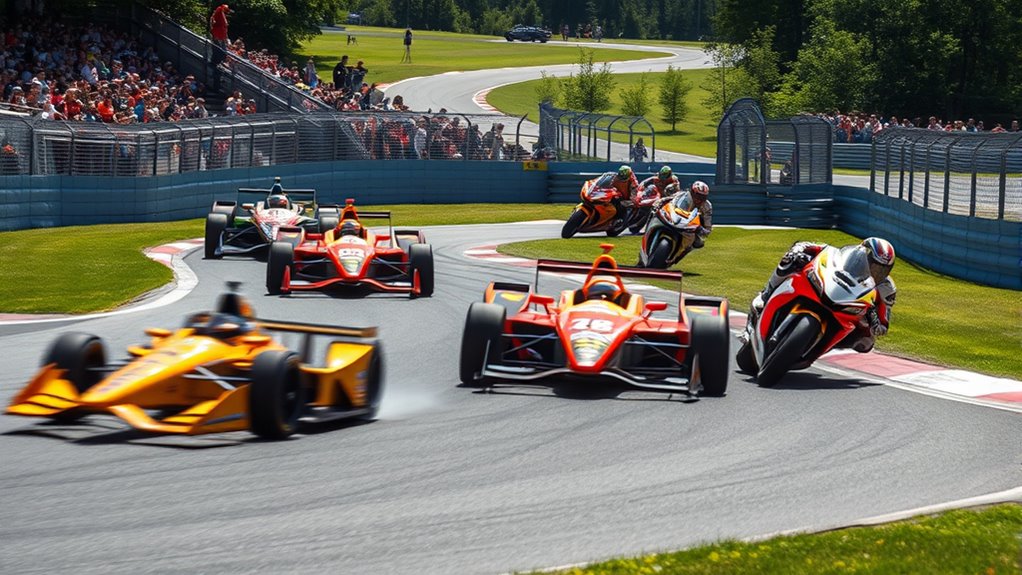
While Formula 1 often dominates motorsports headlines, there’s a whole world of racing beyond its high-speed circuits. You might be surprised to discover the diversity and excitement found in series like IndyCar, WEC, and MotoGP. These disciplines push drivers to their limits, demanding skill, precision, and resilience. A key focus across all these motorsports is driver safety, which has seen remarkable progress thanks to technological advancements. Modern safety features, such as advanced crash barriers, fire-resistant suits, and improved helmet designs, substantially reduce the risks drivers face. In IndyCar, the introduction of the Aeroscreen—a cockpit protection device—has dramatically improved driver safety by deflecting debris and providing better impact protection. Similarly, the World Endurance Championship (WEC) leverages cutting-edge safety innovations, including stronger chassis and crash zones, to protect drivers during high-impact accidents. MotoGP, with its high-speed motorcycle racing, has also prioritized rider safety by developing more secure helmets, airbag suits, and better track safety measures. These technological advancements not only protect drivers but also enhance their confidence, allowing them to perform at their best in demanding conditions. Additionally, the integration of advanced simulation and virtual testing**** plays a crucial role in refining safety systems before deployment on the track.
Beyond safety, technological progress has transformed how these series operate. In IndyCar, sophisticated telemetry systems and data analytics help teams optimize performance and make real-time decisions, reducing driver error. The WEC benefits from hybrid powertrains and advanced aerodynamics that improve efficiency and speed while maintaining safety standards. MotoGP bikes are equipped with electronic aids like traction control and ride-by-wire systems that assist riders in managing power and stability, especially during aggressive cornering. These innovations have made racing more competitive and safer, allowing drivers to push their limits with greater confidence.
You’ll notice that each series emphasizes continuous improvement. The safety innovations are often driven by past incidents, leading to smarter, more resilient designs. The use of simulation and virtual testing also plays a crucial role in refining vehicle safety systems before they hit the track. As a spectator, you benefit from these advancements because they keep racing exciting while minimizing risks. The combination of driver safety initiatives and technological advancements ensures that motorsports beyond F1 can deliver thrilling, high-stakes competition with a focus on protecting the athletes who make it all possible. It’s a reflection of how innovation and safety go hand in hand, elevating the sport and inspiring confidence in racers and fans alike.

Typhoon Helmets Snell SA2020 – DOT Certified – Full Face Racing Helmet (Matte Black, X Large)
Snell SA2020 and DOT Certified : This helmet is manufactured to be used for automobile racing. It is…
As an affiliate, we earn on qualifying purchases.
As an affiliate, we earn on qualifying purchases.
Frequently Asked Questions
How Do Indycar Races Differ From Formula 1 Events?
You’ll notice IndyCar races differ from F1 events in race format and team strategies. IndyCar races are typically longer, often lasting around 2-3 hours, with fewer pit stops, and feature oval and street circuits. F1 has shorter, more technical races with more frequent pit stops. Teams in IndyCar focus on endurance and adapting to diverse tracks, while F1 emphasizes precision and aerodynamics. These differences shape how you experience each race.
What Are the Main Safety Features in Motogp?
Imagine soaring at high speeds, feeling the rush of adrenaline and the danger that comes with MotoGP. You’re protected by advanced safety gear like full-body suits, helmets, and back protectors that absorb impacts. Crash barriers line the track, shielding riders from deadly crashes. These safety features work together to keep you safe, minimizing injury in the event of a fall, so you can focus on conquering every turn with confidence.
How Does the WEC Manage Endurance Race Logistics?
You manage WEC endurance race logistics by carefully planning fuel management and pit stop strategies. You monitor fuel levels constantly to guarantee your car can complete stints without unnecessary stops, saving time. You coordinate pit stops efficiently, balancing driver changes, tire swaps, and refueling. This meticulous planning helps optimize performance, reduce downtime, and maintain a competitive edge throughout the race’s demanding, multi-hour duration.
What Are the Key Technical Differences Between Indycar and F1 Cars?
Think of IndyCar and F1 cars as two different symphonies; one emphasizes raw power, the other precision. IndyCar’s aerodynamic design favors simplicity and robustness, while F1’s complex aerodynamics maximize downforce. You’ll notice tire specifications differ too—IndyCar uses more robust, all-weather tires, whereas F1 features specialized slicks. These differences shape how each car handles, turning, and speeds, making each race a unique ballet of engineering and skill.
Which Motorsport Series Has the Most Global Audience?
You’ll find MotoGP has the largest global viewership among motorsport series, thanks to its extensive international reach and passionate fan base. Its races attract millions across continents, making it a truly global sport. IndyCar and WEC have strong followings but primarily in North America and specific regions. If you’re looking for the broadest international appeal, MotoGP dominates, drawing diverse fans from around the world to watch its thrilling motorcycle races.

TRGGBH Motorcycle Airbag Vest for Men And Women, Motocross Air Bag Riding Jacket with Reflective Strip, Adult Moto 3X-Large
LIGHT WEIGHT: The Moto Airbag Vest is also super light weight making it comfortable while wearing it over…
As an affiliate, we earn on qualifying purchases.
As an affiliate, we earn on qualifying purchases.
Conclusion
So, as you explore the thrilling worlds beyond F1—IndyCar, WEC, and MotoGP—you realize motorsports aren’t just races; they’re symphonies of speed, skill, and passion. Each series offers its own heartbeat, echoing a universal truth: racing is more than a sport, it’s a relentless pursuit of excellence. Like a fire that never dims, these disciplines remind you that the spirit of competition ignites our very souls, pushing us to chase greatness beyond the checkered flag.

Carrera Hybrid Racing Car Porsche 911 GT3 R Blue Thunder 1:50 Scale Front and Rear Lights USB-C Rechargeable RC Additional Vehicle
HIGHLY-DETAILED REPLICA OF LEGENDARY PORSCHE 911 GT3 R: The 1:50 scale Carrera Hybrid "Blue Thunder" car impresses with…
As an affiliate, we earn on qualifying purchases.
As an affiliate, we earn on qualifying purchases.

SAFEBUILDER ABS Work-at-Height and Rescue Hard Hat Construction Safety Helmet Slotted Ventilated w/Adjustable Ratchet 6-Point Suspension ANSI Z89.1-14 (01-White Safety Helmet)
【Comfortable Fit】: SAFEBUILDER Work Hard Hat with 6-points suspension, Good at Shock Impact when workers work in danger,…
As an affiliate, we earn on qualifying purchases.
As an affiliate, we earn on qualifying purchases.