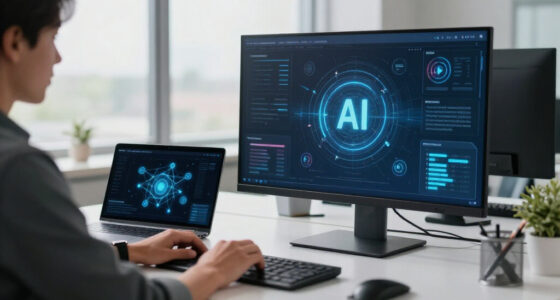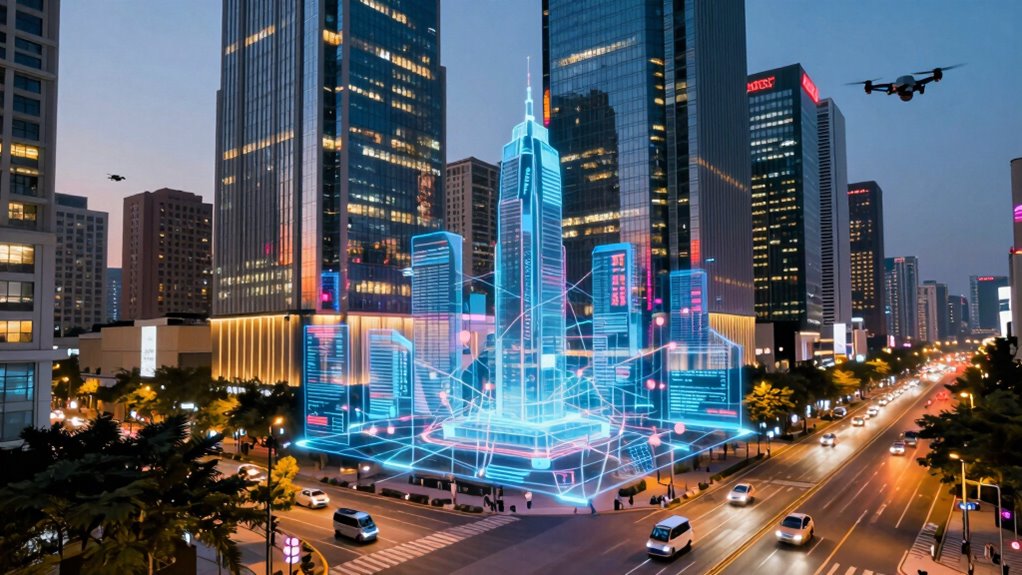

Digital twins could considerably improve your city and industry by providing real-time virtual models that help you test scenarios, predict outcomes, and make smarter decisions without risks. They enable you to monitor infrastructure, optimize operations, and respond quickly to issues. As these digital copies grow more sophisticated with AI and sensor data, they’ll create smarter, resilient environments. To see how this technology shapes the future, keep exploring its potential.
Key Takeaways
- Enable real-time monitoring and management of urban infrastructure and industrial processes, improving efficiency and response times.
- Facilitate predictive maintenance and scenario testing to reduce operational costs and prevent failures.
- Support data-driven decision-making through integrated simulations and advanced analytics.
- Promote collaboration among stakeholders by sharing accurate, up-to-date virtual models.
- Drive city resilience and industrial innovation via AI-enhanced insights and continuous system improvements.
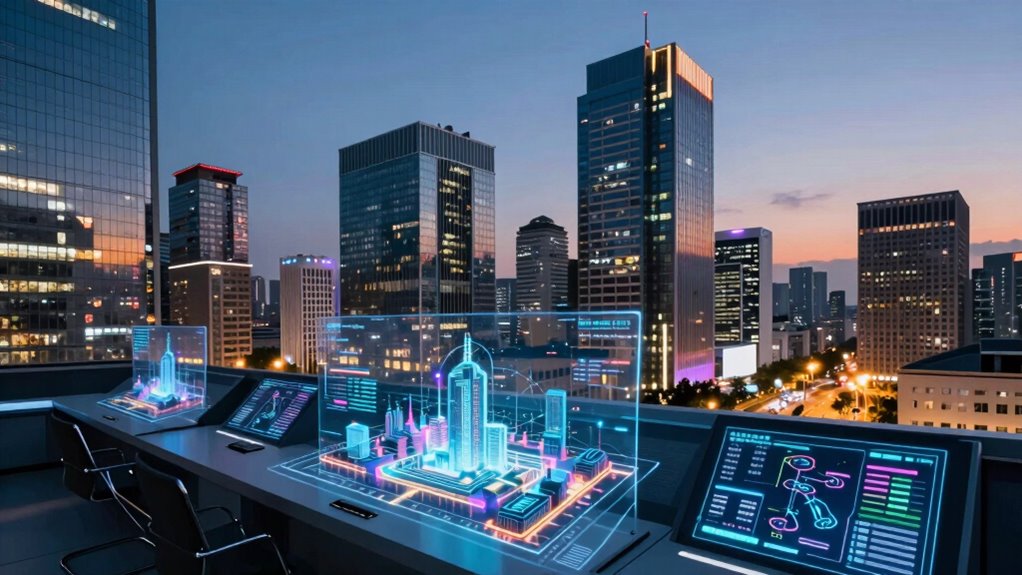
Have you ever wondered how industries are transforming through advanced technology? Digital twins are at the forefront of this revolution, offering a new way to understand and optimize complex systems. Imagine creating a virtual replica of a city or an industrial process—this is what digital twins enable. By harnessing virtual simulation, you can test scenarios, predict outcomes, and make smarter decisions without risking real-world consequences. These virtual models are more than just static images; they are dynamic, constantly updated with data from sensors embedded in physical assets. This continuous flow of information allows for real time monitoring, giving you immediate insights into the health, performance, and potential issues of infrastructure or machinery.
In cities, digital twins can revolutionize urban planning and management. With real time monitoring, you can track traffic flows, air quality, energy consumption, and even water usage across different neighborhoods. This data lets you identify bottlenecks or inefficiencies and respond swiftly. Virtual simulation helps city planners envision the impact of new policies, infrastructure projects, or environmental changes before implementation, saving time and resources. Emergency response strategies can be refined through simulated scenarios, improving safety and resilience. As a result, cities become smarter, more sustainable, and better equipped to handle growth or crises. Additionally, digital twins facilitate integrated data management, enabling a comprehensive view of urban systems that enhances decision-making. Incorporating sensor technology into digital twins further enhances real-time data collection and system responsiveness. The integration of advanced analytics can also help predict future trends and identify potential risks before they materialize. Moreover, the ability to simulate various scenarios allows for better resource allocation, leading to more efficient urban development. Incorporating software quality assurance practices into digital twin implementations ensures the reliability and security of these complex systems.
Within industries, digital twins streamline operations and maintenance, reducing downtime and costs. For example, in manufacturing, you can create a digital twin of a production line. By continuously monitoring equipment through sensors, you identify early signs of wear or failure—often before anyone notices a problem. This proactive approach allows for predictive maintenance, minimizing disruptions. Virtual simulation also enables you to optimize processes, testing different configurations to find the most efficient setup. The ability to see how changes will play out in a risk-free environment accelerates innovation and enhances productivity.
Furthermore, digital twins foster collaboration. Engineers, city officials, and stakeholders can collaborate on a shared virtual model, making decisions based on accurate, real-time data. This transparency improves communication and aligns efforts toward common goals. As technology advances, digital twins will become even more sophisticated, integrating AI and machine learning to further refine predictions and automate responses. Ultimately, these tools will empower you to create more resilient cities and industries, driven by accurate data and real-time insights, transforming how you plan, operate, and innovate in an increasingly complex world.

Building Digital Twin Metaverse Cities: Revolutionizing Cities with Emerging Technologies (Maker Innovations Series)
As an affiliate, we earn on qualifying purchases.
As an affiliate, we earn on qualifying purchases.
Frequently Asked Questions
How Secure Are Digital Twins From Cyber Attacks?
Digital twins face cybersecurity vulnerabilities, but you can protect them effectively. By implementing strong data encryption, you make it harder for cyber attackers to access sensitive information. Regular security updates and monitoring are essential to identify and fix potential threats promptly. While no system is completely invulnerable, these measures help you enhance cybersecurity, safeguarding your digital twin from cyber attacks and ensuring the integrity of your data and operations.
What Is the Cost of Implementing Digital Twins?
The cost of implementing digital twins varies based on factors like project scope and complexity. You should conduct a thorough cost analysis to understand expenses, including software, sensors, and infrastructure. Keep in mind, implementation challenges like data integration and system compatibility can increase costs. While initial investments might seem high, digital twins can save money long-term by improving efficiency and predictive maintenance, making them a worthwhile investment for cities and industry.
How Do Digital Twins Integrate With Existing Infrastructure?
You integrate digital twins with your existing infrastructure by connecting them through virtual infrastructure, which acts as a bridge between physical assets and digital models. This process relies on real-time synchronization, ensuring data from sensors and systems updates continuously. You’ll need to upgrade or adapt your current systems to support data flow and communication, making sure digital twins reflect real-world conditions accurately for effective monitoring, analysis, and decision-making.
Can Digital Twins Predict Unforeseen Urban Issues?
Like the fabled oracle, digital twins can forecast unforeseen urban issues by simulating scenarios, aiding your urban planning and resource management. They analyze real-time data, revealing vulnerabilities before problems surface, much like a crystal ball. This proactive approach empowers you to address challenges early, optimize infrastructure, and enhance city resilience. With digital twins, you’re better equipped to anticipate and mitigate issues, creating smarter, safer cities for everyone.
How Do Digital Twins Affect Privacy Concerns?
Digital twins raise significant privacy concerns because they gather extensive data about individuals and environments. You might worry about data privacy, as sensitive information could be exposed or misused. Ethical considerations come into play, urging you to guarantee proper data handling, consent, and transparency. By addressing these issues proactively, you can help protect privacy while benefiting from the insights digital twins provide, fostering responsible innovation.

Digital Twin Engineering: From Sensors to the Industrial Metaverse (Volume -II): A Comprehensive Guide to Designing, Implementing, and Scaling … … Digital Twin Engineering Series Book 2)
As an affiliate, we earn on qualifying purchases.
As an affiliate, we earn on qualifying purchases.
Conclusion
As you explore the world of digital twins, remember they’re more than just mirrors of reality—they’re silent guides shaping our future. Embracing this technology gently steers your city and industry toward unseen opportunities, quietly transforming challenges into chances for growth. While the full impact remains a subtle unfolding, trusting in this innovative dance promises a more resilient, harmonious tomorrow. Sometimes, progress whispers softly, inviting you to listen closely and step confidently into the evolving landscape.
SMART URBAN INFRASTRUCTURE: Intelligent monitoring and responsive urban planning for future cities
As an affiliate, we earn on qualifying purchases.
As an affiliate, we earn on qualifying purchases.

DIGITAL TWIN ENGINEERING FOR COMPLEX SYSTEMS: Simulation modeling lifecycle monitoring and predictive maintenance
As an affiliate, we earn on qualifying purchases.
As an affiliate, we earn on qualifying purchases.