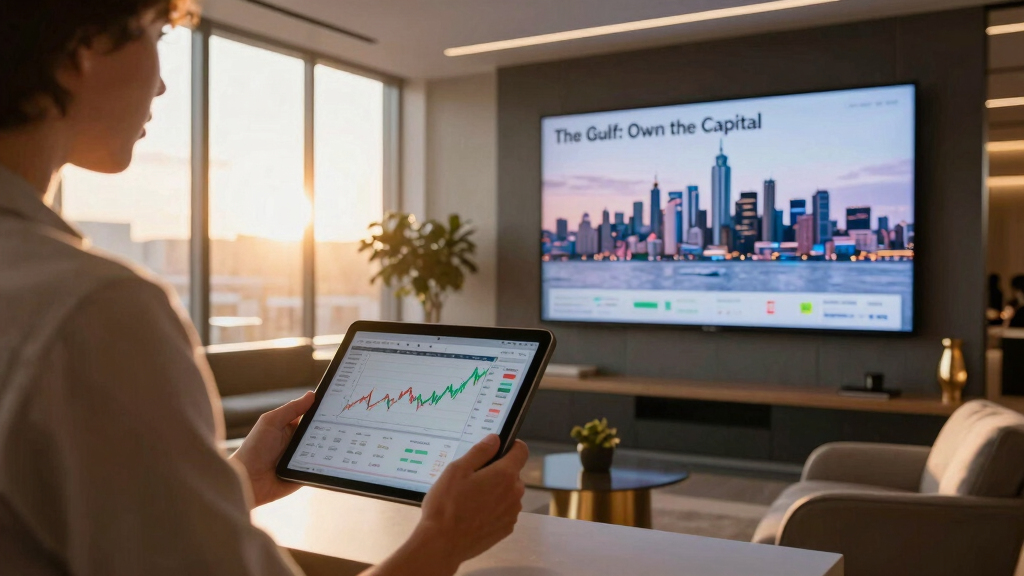

📊 Full opportunity report: The Gulf: Own the Capital on ThorstenMeyerAI.com — validation score, market gap, and execution plan.

Get movie nights delivered free with Prime
- Fast, free delivery on millions of items
- Prime Video, Amazon Music and more included
- Member-only deals all year
TL;DR
Gulf nations are actively investing over two trillion dollars into AI and digital infrastructure, using their sovereign wealth funds to acquire ownership of key technologies. This marks a shift towards state-controlled capital in the AI economy, contrasting with Western models.
Gulf countries are rapidly investing over two trillion dollars into AI infrastructure and technology, using their sovereign wealth funds to acquire ownership stakes, aiming to shape the future economy through state-led capital ownership.
Since 2017, Gulf states including the UAE, Saudi Arabia, and Qatar have launched major AI initiatives, establishing national champions like G42, HUMAIN, and Qai. These investments are driven by sovereign wealth funds such as Mubadala, PIF, and QIA, which are deploying capital at a scale private investors cannot match. The region’s strategy focuses on owning the means of AI production—data centers, compute resources, and frontier labs—effectively making governments owners of the AI economy. This approach contrasts sharply with Western models, which tend to favor private markets and minimal state intervention. The Gulf’s model is rooted in resource wealth, converting oil assets into ownership of emerging technologies, with the goal of maintaining economic sovereignty as oil depletes.Own the Capital
For five rows, one lever stayed dark. The Gulf pulls it hard: own the capital, distribute its returns to citizens — and now spend that capital to buy into AI, so the dividend outlives the oil.
Independent commentary, produced with AI assistance under human editorial oversight. The views are the author’s own and may change. This is analysis, not policy, economic, investment, or legal advice. Descriptions of Gulf sovereign wealth funds, the rentier social contract, national AI champions (G42, MGX, HUMAIN, Qai), and AI-infrastructure investment reflect publicly reported information as of mid-2026 and may change; population, asset, and investment figures are indicative. This phase maps differing approaches and endorses none; characterizations of contested political and labor arrangements present competing views, not a verdict. Country, program, and company names are referenced for analysis and imply no affiliation.
Implications of Gulf States’ AI Capital Strategy
This shift signifies a fundamental change in how nations can leverage resource wealth to control future economic assets, similar to the ideas discussed in The labor share. By owning AI infrastructure, Gulf countries aim to secure economic influence and preserve citizen benefits amid global technological shifts. It also challenges traditional Western approaches, highlighting a model where the state plays a central role in technological ownership and wealth distribution, which could reshape geopolitical power dynamics.
As an affiliate, we earn on qualifying purchases.
Gulf’s Longstanding Resource-to-Capital Model
The Gulf’s economic model has historically relied on resource extraction, primarily oil, which funds sovereign wealth funds that distribute wealth through social programs, jobs, and subsidies. This model has been extended into the digital age, with recent investments in AI infrastructure seen as a way to diversify and sustain economic benefits beyond oil. The region’s strategic focus on AI began around 2017, with the UAE leading the way through initiatives like G42 and MGX, followed by Saudi Arabia’s HUMAIN and Qatar’s Qai. For more on how these initiatives are structured, see The clause. These efforts are part of a broader regional push to become global leaders in AI and digital infrastructure, driven by the desire to maintain economic sovereignty and influence.
As an affiliate, we earn on qualifying purchases.
Unclear Long-Term Outcomes of Gulf AI Ownership
It remains uncertain how sustainable and effective this state-led ownership model will be in the long term, especially as global AI regulation, geopolitical tensions, and technological competition evolve. The regional investments are recent, and their impact on economic stability and global influence is still unfolding.
AI infrastructure development kits
As an affiliate, we earn on qualifying purchases.
As an affiliate, we earn on qualifying purchases.
Next Steps in Gulf AI Investment and Global Impact
Gulf countries are expected to continue expanding their AI infrastructure investments, aiming to deepen ownership and develop regional technological ecosystems. Monitoring how these initiatives influence global AI markets and regional geopolitics over the coming years will be key, alongside potential shifts in domestic policies and international cooperation. Insights into the importance of owning AI infrastructure can be found in The cleaner cap table.
sovereign wealth fund investment books
As an affiliate, we earn on qualifying purchases.
As an affiliate, we earn on qualifying purchases.
Key Questions
Why are Gulf countries investing so heavily in AI?
They aim to own the next economic frontier, diversify their economies beyond oil, and maintain geopolitical influence through strategic technological ownership.
How does this approach differ from Western models?
Gulf states use their sovereign wealth funds to directly acquire ownership stakes in AI infrastructure and technologies, contrasting with Western reliance on private markets and minimal state intervention.
What are the risks of this state-led ownership model?
Potential risks include over-reliance on volatile resource wealth, geopolitical tensions, and challenges in managing technological innovation and regulation.
Will this model influence global AI development?
Yes, if Gulf countries succeed in establishing dominant ownership positions, they could shape global AI standards, supply chains, and geopolitical alliances.
Source: ThorstenMeyerAI.com
Halloween Picks
halloween
As an affiliate, we earn on qualifying purchases.