
📊 Full opportunity report: How We Built Corvus ISR In Public: Day 1 With WAMI Exploitation And Synthetic Data on ThorstenMeyerAI.com — validation score, market gap, and execution plan.
TL;DR
Corvus ISR has launched its build-in-public project with a Day 1 demo of synthetic wide-area motion imagery (WAMI). The demonstration features live detection and tracking in a browser-based scene, establishing a foundation for future development. The project aims to address exploitation gaps in WAMI sensor data, starting with synthetic environments.
Thorsten Meyer has publicly launched Corvus ISR, a new wide-area motion imagery (WAMI) exploitation platform, with a live demonstration of synthetic scene analysis. This marks the first step in a build-in-public series aimed at developing an open, customizable WAMI exploitation stack, starting with synthetic data to bypass legal and privacy restrictions.
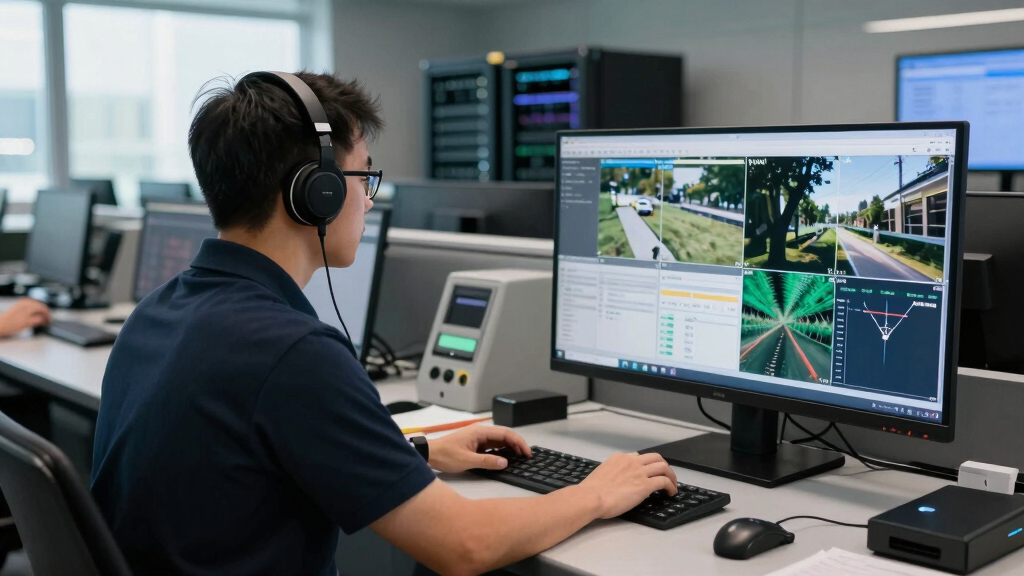
The initial artifact features a browser-based synthetic WAMI scene generated with a few hundred moving vehicles on a procedurally created road network. The scene includes a simulated sensor with adjustable coverage and a live detection and tracking system that produces bounding boxes, persistent IDs, and trail histories. Detection is geometric, not based on deep learning, emphasizing the pipeline’s architecture and measurable output.
Corvus ISR is designed to provide an open, infrastructure-controlled alternative to existing proprietary, US-controlled WAMI exploitation software. It offers two editions: a sovereign version for air-gapped environments, and a governed version for EU cloud deployment, reflecting a strategic focus on data custody and jurisdictional control. The project emphasizes building the pipeline from synthetic data first, then transitioning to real data, to ensure legal compliance and technical robustness.
CORVUS ISR · synthetic WAMI scene — live detect & track
BUILD IN PUBLIC · DAY 1 ARTIFACTPotential Impact on WAMI Data Exploitation Practices
This project addresses the longstanding gap between WAMI data collection and exploitation, especially in European markets wary of US-controlled analysis software. By developing an open, customizable platform that runs on infrastructure the customer controls, Corvus ISR could reshape the economics and sovereignty of WAMI analysis. Starting with synthetic data allows for rapid development, benchmarking, and iteration without legal or privacy constraints, laying the groundwork for future real-data integration.
For defense and intelligence operators, this could mean more accessible, transparent, and adaptable analysis tools, reducing reliance on proprietary solutions and enhancing operational sovereignty. The project also signals a broader shift toward open, build-in-public development in ISR software, emphasizing transparency, community involvement, and rapid iteration.
synthetic WAMI scene simulation software
As an affiliate, we earn on qualifying purchases.
As an affiliate, we earn on qualifying purchases.
The Challenges and Opportunities in WAMI Data Exploitation
WAMI sensors produce gigapixel images covering entire cities, generating data volumes that far exceed satellite imagery. Traditionally, the exploitation software layer has been proprietary, US-controlled, and closed, leading to dependency concerns among European and allied buyers. The collection-to-exploitation gap has widened as sensors proliferate across various platforms, but analysis tools have lagged behind.
Previous efforts to develop open or customizable WAMI exploitation software have faced legal, technical, and resource barriers. Synthetic data has become a strategic tool to overcome these obstacles by providing a safe, labeled environment for developing detection, tracking, and indexing algorithms. This approach allows for benchmarking and system validation before deploying on real, sensitive data.
“Building Corvus ISR on synthetic data allows us to develop, test, and benchmark without legal or privacy constraints, creating a solid foundation before real data integration.”
— Thorsten Meyer
wide-area motion imagery detection system
As an affiliate, we earn on qualifying purchases.
As an affiliate, we earn on qualifying purchases.
Limitations of Synthetic Data and Transition to Real World
While the initial demo shows promising results, it remains unclear how well the synthetic-based pipeline will transfer to real WAMI data, which presents more complex and unpredictable scenarios. The effectiveness of detection, tracking, and indexing in real environments has yet to be validated, and the roadmap includes plans for real data testing.
browser-based surveillance analysis tools
As an affiliate, we earn on qualifying purchases.
As an affiliate, we earn on qualifying purchases.
Roadmap: From Synthetic Benchmarks to Real Data Deployment
Next steps include refining the detection and tracking algorithms, integrating additional sensor models, and transitioning to real WAMI datasets for validation. The project aims to develop a fully operational exploitation stack that can be deployed in both sovereign and cloud environments, with ongoing transparency and community engagement.
As an affiliate, we earn on qualifying purchases.
Key Questions
Why start with synthetic data for Corvus ISR?
Using synthetic data allows development without legal, privacy, or export restrictions, provides perfect ground truth for benchmarking, and enables manufacturing failure cases before touching operational data.
Will Corvus ISR work with real WAMI data eventually?
Yes, synthetic data is a first step. The plan is to validate and adapt the pipeline for real data, which will involve additional challenges and testing phases.
What are the benefits of an open, build-in-public approach?
This approach fosters transparency, rapid iteration, community feedback, and customization, reducing reliance on proprietary solutions and enhancing sovereignty.
What is the significance of the two editions (Sovereign and Governed)?
The two editions address different operational and legal requirements: Sovereign for air-gapped, secure environments; Governed for EU cloud deployment with compliance features.
What are the main technical features demonstrated in Day 1?
The demo shows live detection, tracking, and indexing in a synthetic scene, with adjustable sensor coverage and real-time visualization in a browser.
Source: ThorstenMeyerAI.com