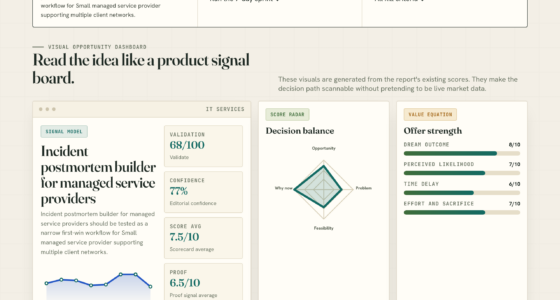
📊 Full opportunity report: How To Use A Competitor-Price Tracker For TikTok Shop Success on IdeaNavigator AI — validation score, market gap, and execution plan.
TL;DR
A new browser extension for TikTok Shop sellers allows real-time competitor price monitoring, helping small operators reprice efficiently. This tool aims to improve margins and conversions. Its effectiveness is currently being tested with early users.
Independent TikTok Shop operators managing small catalogs are now testing a new browser extension designed to display real-time competitor pricing on product pages. This development aims to address a common challenge: manual repricing and limited visibility into competing listings, which can hinder sales and margins. The tool is expected to streamline repricing workflows and improve competitiveness in the rapidly expanding TikTok Shop marketplace.
The competitor-price tracker is a minimal viable product (MVP) that integrates as a browser extension, showing current prices, discounts, and shipping costs of competing listings for any product on TikTok Shop. It is targeted at small, independent sellers who lack advanced repricing tools, a gap that has grown as TikTok Shop has expanded rapidly across the US, onboarding many new small-scale operators.
According to early testing plans, the extension will allow sellers to view competing prices on their product pages and adjust their own prices in a single pass. This aims to enable more dynamic and competitive pricing strategies, potentially increasing sales volume and profit margins. The extension will be offered via a per-seat monthly subscription model, with initial validation involving ten TikTok Shop operators managing their top twenty SKUs weekly.
Validation will focus on measuring whether this repricing approach improves conversion rates or margins, with feedback expected to guide further development and potential scaling of the tool.
Impact of Real-Time Pricing Data on TikTok Shop Sales
This tool could significantly influence how small TikTok Shop sellers compete in a crowded marketplace. By providing instant visibility into competitor pricing, it enables more strategic repricing, which can lead to increased sales and better margins. As TikTok Shop continues its rapid growth, such tools could become essential for small sellers aiming to stay competitive without the complex infrastructure used by larger e-commerce platforms.
Early validation results will determine whether this approach can deliver measurable improvements in seller performance, potentially shaping the future of small-scale TikTok Shop operations and software solutions.
TikTok Shop competitor price tracker extension
As an affiliate, we earn on qualifying purchases.
As an affiliate, we earn on qualifying purchases.
Rapid Growth of TikTok Shop and Repricing Challenges
Since its expansion into the US, TikTok Shop has onboarded a large number of small sellers, many of whom lack sophisticated repricing tools. Unlike Amazon or eBay, where automated repricing is common, TikTok Shop sellers often rely on manual adjustments, which can be time-consuming and less effective. This creates a market opportunity for lightweight, easy-to-use tools that provide real-time competitive insights.
The concept of competitor-price tracking is well-established on platforms like Amazon, but it is still emerging within TikTok Shop’s ecosystem. Early efforts focus on small operators managing limited product catalogs, aiming to validate whether such tools can meaningfully improve their competitiveness.
Initial testing involves collaboration with ten sellers, who will manually track prices for their top twenty SKUs weekly, providing data to assess the impact of automated repricing support.
“This extension could reduce the manual workload for small TikTok Shop sellers and help them react faster to market changes.”
— an anonymous researcher
real-time repricing tool for TikTok Shop
As an affiliate, we earn on qualifying purchases.
As an affiliate, we earn on qualifying purchases.
Uncertain Impact and Adoption of the Repricing Tool
It is not yet clear how effectively the extension will improve seller margins or sales conversions, as validation is still ongoing. Additionally, user adoption rates and potential resistance to new workflows remain unknown, and the long-term viability of the subscription model has yet to be tested in broader markets.
browser extension for TikTok marketplace pricing
As an affiliate, we earn on qualifying purchases.
As an affiliate, we earn on qualifying purchases.
Next Steps for Validation and Scaling of the Extension
Validation results from the initial ten sellers will inform whether the tool can be refined and scaled. Developers plan to analyze whether repricing in response to real-time data leads to measurable improvements in sales or margins. If successful, the extension could be rolled out to a larger user base and integrated with additional features, such as automated repricing suggestions.
Further testing and user feedback will determine the future development roadmap, with potential expansion into other marketplaces or larger seller accounts.
small business TikTok Shop repricing software
As an affiliate, we earn on qualifying purchases.
As an affiliate, we earn on qualifying purchases.
Key Questions
How does the competitor-price tracker work?
The extension displays current prices, discounts, and shipping costs of competing listings directly on a TikTok Shop product page, allowing sellers to quickly compare and adjust their prices.
Who is this tool designed for?
It is primarily aimed at small, independent TikTok Shop sellers managing limited product catalogs who lack advanced repricing tools.
Will this tool automatically reprice products?
Initially, the extension provides data for manual repricing. Automated repricing features may be considered in future versions based on user feedback and validation results.
How will the extension be priced?
The tool will be offered via a per-seat monthly subscription fee, with pricing details to be announced after initial validation.
What are the risks or limitations of this approach?
The effectiveness depends on user engagement and the accuracy of competitor data. Additionally, the impact on margins and sales remains to be proven through ongoing validation.
Source: IdeaNavigator AI