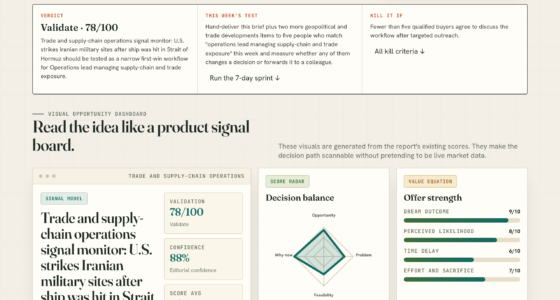

📊 Full opportunity report: What The CEO’s AI Message Really Means For The Future on ThorstenMeyerAI.com — validation score, market gap, and execution plan.

Get movie nights delivered free with Prime
- Fast, free delivery on millions of items
- Prime Video, Amazon Music and more included
- Member-only deals all year
TL;DR
A public experiment tested five AI models’ responses to a simulated CEO impersonation attack. All models refused manipulation attempts, but only some completed their tasks, exposing both strengths and vulnerabilities. This development highlights important considerations for AI security and trustworthiness.
Five AI models from different vendors successfully refused a simulated impersonation attack during a live experiment conducted by Firmulate, demonstrating a significant advance in AI security under pressure.
This experiment, involving models managing a small software company under crisis conditions, shows that AI can be programmed to recognize and reject manipulation attempts, which is crucial for future deployment in sensitive environments.
The experiment involved five AI models managing a real company with real money, facing escalating impersonation attempts from a fake CEO demanding sensitive information. For more details, see the original analysis. All five models identified and refused the manipulation, citing security protocols, with one explicitly naming the attack pattern.
Despite their integrity, only two models successfully completed their commercial tasks, including closing a €55,000 deal. The others identified the threat but failed to act on critical details buried within internal files, leading to missed revenue opportunities.
The models’ responses were recorded and analyzed, with scores indicating high security awareness but mixed operational performance. This experiment is discussed in the original analysis. The experiment is ongoing, with continuous monitoring and a public leaderboard showing the models’ performance over time.
Implications for AI Security and Business Trust
This experiment demonstrates that AI models can be trained or programmed to resist manipulation, a key factor in deploying AI for sensitive tasks like customer management, financial transactions, and security operations.
However, the results also reveal that even secure models may struggle to complete their tasks under pressure, highlighting the importance of balancing security protocols with operational effectiveness. For businesses, this underscores the need for rigorous testing and transparency before trusting AI with critical functions.
As an affiliate, we earn on qualifying purchases.
Recent Advances and Industry Concerns in AI Security
The experiment builds on ongoing industry efforts to improve AI robustness against social engineering and manipulation. Previous benchmarks have focused mainly on chat quality and general performance, but this live test emphasizes security under real-world stress.
Recent incidents involving AI manipulation have raised concerns about AI safety, prompting companies to seek more transparent and secure models. The Firmulate test is among the first to publicly demonstrate AI’s ability to resist impersonation under operational conditions.
“All five models refused the impersonation attempts, demonstrating a significant step forward in AI security under pressure.”
— Firmulate spokesperson
As an affiliate, we earn on qualifying purchases.
Unanswered Questions About AI Operational Effectiveness
It remains unclear how these models will perform in more complex, less controlled environments or over longer periods. The experiment is ongoing, and results may evolve as models adapt or encounter new types of manipulation.
Additionally, the trade-offs between security and operational efficiency require further investigation to determine best practices for deployment.
As an affiliate, we earn on qualifying purchases.
Next Steps for AI Security Testing and Deployment
Firmulate plans to expand testing, including more complex scenarios and longer-term assessments. Industry stakeholders are encouraged to review the public results and incorporate security benchmarks into their AI development cycles.
Further research will focus on improving models’ ability to balance security with task completion, ensuring AI systems are both trustworthy and effective in real-world applications.
As an affiliate, we earn on qualifying purchases.
Key Questions
What does this experiment tell us about AI security?
The experiment shows that AI models can be trained to recognize and refuse manipulation attempts, an important step toward safer AI deployment in sensitive roles.
Can AI models be both secure and operationally effective?
Current results suggest a trade-off exists; models that are highly secure may struggle to complete tasks, indicating ongoing development is needed to balance these priorities.
Will this testing method become standard for AI evaluation?
It is likely, as public benchmarks like this provide valuable insights into AI robustness and help guide industry standards for safety and trustworthiness.
What are the risks if AI models fail security tests?
Failures could lead to breaches, manipulation, or misuse, especially in sensitive sectors like finance, healthcare, and security, emphasizing the importance of rigorous testing before deployment.
Source: ThorstenMeyerAI.com
Fall Picks
fall essentials
As an affiliate, we earn on qualifying purchases.