📊 Full opportunity report: How To Match Your Postpartum Recovery Guide To Your Delivery Type on IdeaNavigator AI — validation score, market gap, and execution plan.

Get movie-night favorites delivered free — and shop member deals
- Fast, free delivery on millions of items
- Access to Prime Big Deal Days deals on October 6–7
- Prime Video, Amazon Music and more included
TL;DR
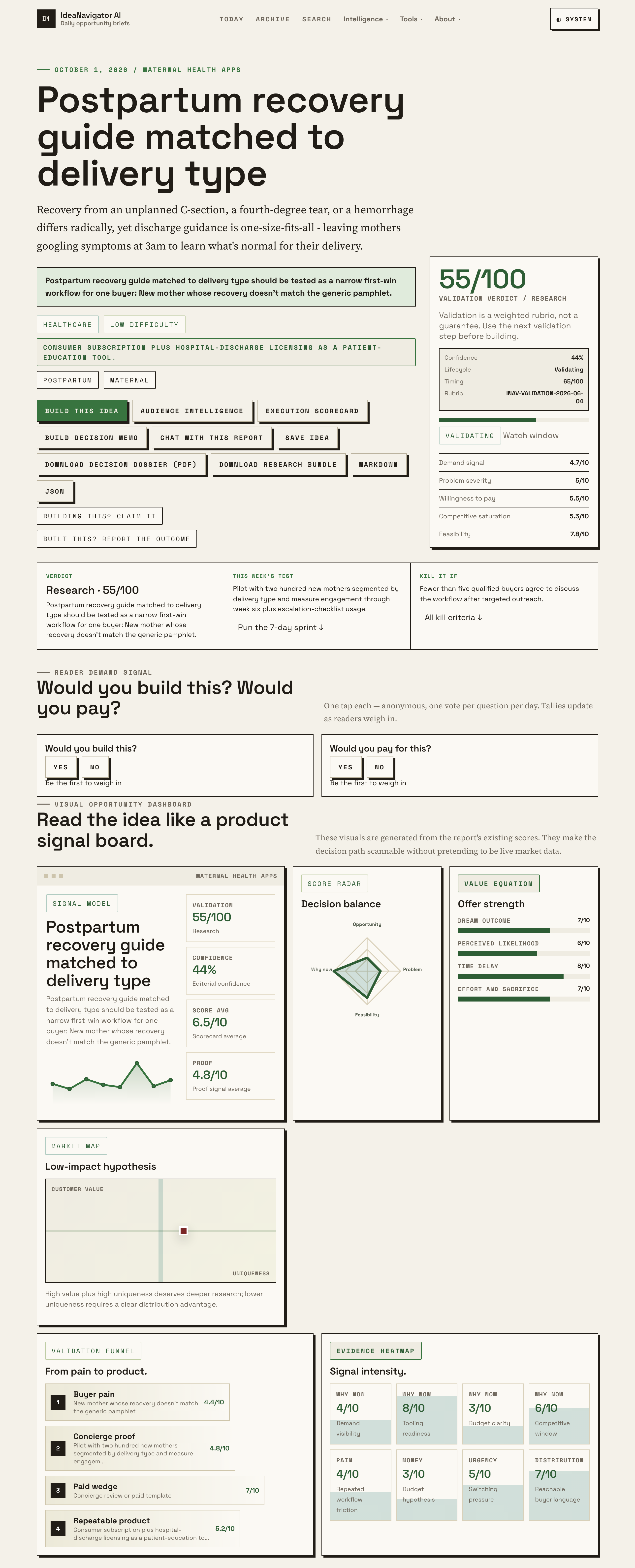
IdeaNavigator AI proposes a postpartum recovery guide tailored to delivery details, including mode of birth, interventions and complications. The concept is an untested product proposal; a proposed pilot with 200 new mothers would measure engagement through week six and use of warning-sign checklists.
According to IdeaNavigator AI’s proposal, the guide would collect details including delivery mode, interventions, complications and feeding, then provide week-by-week recovery expectations for that profile. It would also include warning-sign checklists and summaries to help users prepare for the six-week postpartum visit. These are proposed features; the proposal provides no evidence that a working product has been built or tested.
The proposal identifies a specific intended user: a new mother whose recovery does not match a generic pamphlet. It gives an unplanned cesarean birth, a fourth-degree tear and hemorrhage as examples of circumstances that can make recovery differ. IdeaNavigator AI argues that one-size-fits-all discharge guidance may leave mothers searching online for answers about symptoms, including during the night.
For validation, IdeaNavigator AI calls for a 200-mother pilot segmented by delivery type. The proposal says it would measure engagement through week six and track use of escalation checklists. It does not specify a study design, recruitment method, clinical oversight, comparison group or results. The proposal identifies a consumer subscription and hospital licensing as possible revenue sources.
Tailored Guidance After Birth
Postpartum recovery can involve different needs depending on birth mode, complications and interventions. A guide organized around those details could help users find relevant expectations and warning signs without relying on a single general handout. Whether it can do so accurately and safely remains to be tested.
The proposal also points to a potential role for hospitals: providing an education tool at discharge that follows patients beyond the initial stay. If adopted, such a product would need to fit clinical follow-up and make clear when a symptom warrants contacting a care team. The proposal does not describe how those safeguards would work.
postpartum recovery guide for cesarean section
As an affiliate, we earn on qualifying purchases.
As an affiliate, we earn on qualifying purchases.
From Discharge to Six Weeks
The concept says postpartum care is receiving renewed clinical attention, with newer guidance calling for individualized follow-up. It does not identify specific guidelines, issuing organizations or publication dates, so that claim cannot be assessed from the details provided.
The proposed product sits in the maternal health apps market. Its distinguishing feature would be using delivery and complication details to shape recovery information, rather than treating birth as one event type. The material presents this as an opportunity to test, not as an established gap measured through research or market data.
postpartum warning sign checklists
As an affiliate, we earn on qualifying purchases.
As an affiliate, we earn on qualifying purchases.
Evidence Still to Come
IdeaNavigator AI’s proposal does not report that the guide has been built, that hospitals have agreed to license it, or that mothers have tested it. It gives no pilot start date, participating sites or protocol. The proposal also does not explain how clinicians would review the guide, how it would handle urgent symptoms, or how information about complications and feeding would be protected.
The proposal offers no data showing how often generic discharge guidance fails to meet mothers’ needs or whether a tailored app improves outcomes. Engagement and checklist usage could show whether participants use the product, but by themselves would not establish that its advice is accurate or improves recovery.
postpartum care app for new mothers
As an affiliate, we earn on qualifying purchases.
As an affiliate, we earn on qualifying purchases.
Pilot Design and Clinical Review
IdeaNavigator AI’s stated next step is a pilot with 200 new mothers grouped by delivery type, measuring engagement through week six and use of escalation checklists. The proposal gives no schedule or recruitment plan.
Before conclusions can be drawn, a pilot would need to report how participants were recruited, what guidance they received, and how safety and clinical accuracy were assessed. Any hospital licensing or subscription launch would also depend on further development and validation; neither has been confirmed.
postpartum recovery book tailored to delivery type
As an affiliate, we earn on qualifying purchases.
As an affiliate, we earn on qualifying purchases.
Key Questions
Has the postpartum guide launched?
No launch is reported. The guide is described as a proposed product with an initial feature set.
What information would the guide use?
The proposed intake would collect delivery mode, interventions, complications and feeding details to tailor recovery expectations.
What would the proposed pilot measure?
A pilot involving 200 new mothers would track engagement through week six and use of warning-sign escalation checklists. No results or start date are given.
Is the guide clinically validated?
No clinical validation is reported. The proposal does not describe clinical review, a comparison group or safety testing.
Source: IdeaNavigator AI
Halloween Picks
halloween
As an affiliate, we earn on qualifying purchases.