This checklist is for anyone putting together a comfortable streaming setup, whether you’re adding a screen, improving sound, or making late-night viewing easier. It covers a mix of product picks and advice-only categories so you can focus on the parts your room actually needs.

Get movie nights delivered free with Prime
- Fast, free delivery on millions of items
- Prime Video, Amazon Music and more included
- Member-only deals all year
The sections follow the key pieces of a setup: a streaming display option, remote control, soundbar, TV backlighting, headphones, and a place for a streaming device. Each slot explains what to consider, common fit or compatibility snags, and who may find the pick most useful.
Use it as a buying checklist, not a requirement to purchase every item. Check the connections and controls on your current TV and other equipment first, then choose the upgrades that address a real need in your space.
Streaming media player
A streaming source is central to a setup, but the right choice depends on how you watch and what display you already own. The listed pick, WiMiUS G2 Smart Projector with Google TV, combines a projector name with Google TV, so consider whether you want a projector-style viewing setup rather than simply adding a separate player to an existing television.
A common mistake is to treat every streaming product as interchangeable. Before choosing, check your room layout, where the image will be viewed, and whether the setup you have in mind works with your existing equipment. Think through where the projector will sit and whether its placement suits your viewing area. Avoid buying based only on the word “streaming” in a product name; confirm that the device type matches the role you need it to fill.
For fit, consider viewing distance, available space, and how you plan to control the setup. Make sure the location and connections work for the rest of your equipment, and account for how you will route power and any cables. If you already have a TV and only need an additional streaming source, compare the projector-based pick with the kind of device your current screen can accommodate before deciding.
What to look for:
- Confirm whether you want a projector or a separate player for an existing TV.
- Check that the planned location works with your room layout and viewing area.
- Review how the device will connect to the rest of your setup.
- Plan access to power and a practical route for cables.
- Consider how you will control the device from your usual viewing position.
WiMiUS G2 Smart Projector with Google TV

The WiMiUS G2 combines Google TV streaming, voice control, and built-in live TV channels with a native 1080p image, 4K decoding, HDR10, and 1100 ANSI brightness. It includes MEMC motion smoothing, 30W Dolby Audio, automatic focus and keystone correction, Wi-Fi 6, Chromecast, and multiple ports for home or outdoor entertainment.
Pros:
- Built-in Google TV with voice control and streaming apps
- Automatic focus and image correction simplify setup
- MEMC motion smoothing supports sports and fast-action viewing
- Multiple wired and wireless connectivity options
Cons:
- Displays 4K-labeled video at its native 1080p resolution
- Daytime viewing may depend on having curtains drawn
Best for: Viewers planning a projector-based streaming setup
Not ideal for: Anyone seeking only a separate player for an existing TV
Bottom line: Choose the WiMiUS G2 only if its projector format fits the viewing setup you want.
Universal remote control
A universal remote can make a multi-device setup easier to manage, provided it works with the equipment you want to control. The listed Universal Infrared TV Remote Control for Major TV Brands is framed around infrared control and major TV brands, so start by checking your television’s brand and whether infrared is the control method your setup uses.
A frequent buying mistake is assuming that “universal” means every function on every device will work. Check the product’s compatibility details against the exact TV and any other equipment you hope to operate. A remote described for TVs may not cover a streaming device, soundbar, or other component. Also consider whether the controls you use most often are easy to reach and distinguish; a single replacement remote is useful only if it supports the tasks you need.
For fit, think about how the remote will be used from your usual seat and whether it can communicate with the equipment from that position. Infrared controls generally need a clear path to the receiving equipment, so consider any obstructions or cabinets in your setup. Verify the device and control requirements before replacing an existing remote, especially if your equipment relies on a different control method.
What to look for:
- Match the TV brand and model against the remote’s compatibility information.
- Confirm your TV uses infrared control.
- Check whether other devices in the setup are supported.
- Consider obstructions between the remote and equipment.
- Make sure the buttons cover the functions you use regularly.
Universal Infrared TV Remote Control for Major TV Brands

This 49-button universal infrared remote supports up to three devices, including compatible TVs and DVD/Blu-ray players. Setup uses brand-specific codes or automatic code search; it requires two AAA alkaline batteries, which are not included.
Pros:
- Supports a wide range of major TV brands
- Can control up to three devices
- Includes setup instructions and a code list
- Offers automatic code search if listed codes fail
Cons:
- Requires two AAA batteries, which are not included
- Does not support streaming sticks, Fire TV devices, Apple TV, or Chromecast
- Incompatible with some sound bars
Best for: Viewers with a compatible infrared TV
Not ideal for: Setups that need one remote for unsupported devices
Bottom line: Verify the TV’s brand and infrared compatibility before choosing this remote.
Soundbar speaker
Sound is a major part of the viewing experience, and a soundbar can be a practical way to organize audio around a television. The listed JBL Bar 1300XMK2 Dolby Atmos Soundbar with Detachable Speakers, Black calls out Dolby Atmos and detachable speakers. Consider whether those features suit your room and the way you want to arrange listening, rather than choosing by feature names alone.
A common mistake is buying a soundbar without checking how it will connect to the TV and fit in the room. Review the available connections on both pieces of equipment and make sure the planned placement leaves access to ports and controls. Check the width and depth of the soundbar against the furniture or shelf where it will sit. If you plan to use detachable speakers, decide where they would go and whether that arrangement makes sense for your seating area.
Compatibility and placement matter as much as the soundbar itself. Confirm that your TV supports the connection and audio features you intend to use, and account for cable routing and nearby power access. Make sure the soundbar will not block the screen, remote sensor, or other equipment. If you have limited space, measure the available area before committing to a larger audio setup.
What to look for:
- Check the TV’s available audio connections and feature support.
- Measure the intended surface for width and depth.
- Plan placement for the detachable speakers and viewing seats.
- Keep access to ports, controls, and the TV remote sensor clear.
- Consider cable routing and power access at the chosen location.
JBL Bar 1300XMK2 Dolby Atmos Soundbar with Detachable Speakers, Black

The JBL Bar 1300XMK2 is an 11.1.4-channel home theater soundbar system with Dolby Atmos and DTS:X spatial audio, detachable wireless surround speakers, and a 12-inch wireless subwoofer. It offers up to 1570 watts of output, MultiBeam 3.0 room tuning, PureVoice 2.0 dialogue enhancement, and Bluetooth playback from the detachable speakers.
Pros:
- Detachable wireless surround speakers
- Supports Dolby Atmos and DTS:X
- 12-inch wireless subwoofer with up to 1570 watts of output
- PureVoice 2.0 enhances dialogue clarity
Cons:
- Availability can vary
Best for: Viewers planning a soundbar with detachable speakers
Not ideal for: Rooms without suitable space or compatible connections
Bottom line: Match the soundbar’s connections and speaker layout to your TV and room.
TV backlight kit
Backlighting is an advice-only slot in this checklist, with no product pick. It may be worth considering if you want to change the atmosphere around the screen, but first decide whether the lighting effect suits your viewing habits and room. The right placement depends on the TV’s position, the surface behind it, and how much of that area is visible from your seating.
A common mistake is choosing a kit before checking the back of the television and the space around it. Wall-mounted TVs, narrow gaps, stands, and nearby furniture can affect where a light strip can go. Inspect the screen’s rear surface and plan a route for the power lead that does not interfere with the mount or other cables. Confirm how the kit is controlled and powered before selecting one, especially if you want to operate it alongside other equipment.
For fit, measure the edges you intend to illuminate and check whether the kit can follow that layout. Avoid placing lighting where it shines directly into viewers’ eyes or creates distracting reflections on the screen. Consider whether the TV is close to a wall and whether the surrounding area leaves room for an even installation. A careful layout check helps keep the lighting functional and tidy.
What to look for:
- Measure the TV edges you plan to illuminate.
- Check the rear surface and clearance around the TV.
- Plan a power lead route that avoids the mount and other cables.
- Review how the kit is powered and controlled.
- Position lights to avoid glare and screen reflections.
Headphones
Headphones can make TV listening more personal and help accommodate different listening preferences in one room. The listed Avantree Duet Aura – HDMI ARC Dual Wireless TV Headphones for Seniors highlights dual wireless listening and HDMI ARC in its name. Check whether your television offers the needed connection and whether two listeners are part of your intended setup.
A common mistake is assuming that a connection label guarantees compatibility with every TV. Review the television’s audio outputs and settings, then compare them with the headphone system’s requirements. Confirm how audio will be routed when headphones are in use and whether the TV’s speakers can behave as you expect. If the headphones are for a senior viewer, consider comfort, ease of controls, and whether the system can be operated without frequent setup changes.
For fit, think about where the listeners will sit in relation to the TV and any wireless equipment, as well as how charging or storage will work in your room. Make sure the base or connecting equipment has a practical home near the television and access to power. Verify that the dual-listener arrangement fits your household’s needs, and check that the physical controls are understandable for the person who will use them most.
What to look for:
- Confirm the TV has compatible HDMI ARC support and settings.
- Check how TV speakers behave while headphones are connected.
- Decide whether dual wireless listening fits your household.
- Consider comfort and straightforward controls for the intended listener.
- Plan a powered location and convenient storage for the system.
Avantree Duet Aura – HDMI ARC Dual Wireless TV Headphones for Seniors
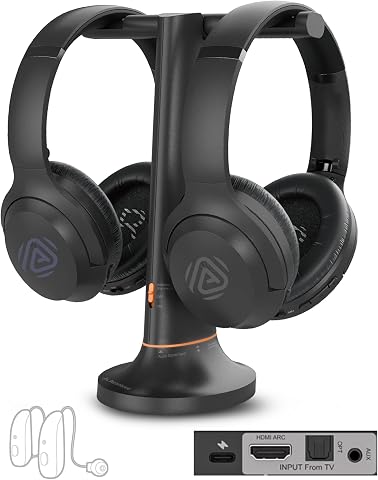
The Avantree Duet Aura offers dual wireless TV headphones with a charging dock, allowing two viewers to listen at different volumes simultaneously. It connects via HDMI ARC, Optical, or AUX, and features clear voice modes and independent volume controls.
Pros:
- Allows two users to listen at different volumes simultaneously
- Multiple connection options for compatibility with various TVs
- Features clear voice modes and independent volume controls
- Supports audio sharing with additional Auracast-compatible devices
Cons:
- HDMI ARC may disable TV speakers depending on TV settings
- Does not support HDMI ARC soundbar pass-through
- Requires setup with compatible TVs and devices
Best for: Households seeking dual wireless TV listening
Not ideal for: TVs without compatible HDMI ARC support
Bottom line: Check HDMI ARC support and everyday usability before choosing these headphones.
Streaming device stand
This is an advice-only category, with no specific stand pick. A stand can help give a streaming device a stable, accessible place near the TV, but the best arrangement depends on the device, its cables, and the furniture or wall mount already in use. First decide whether a stand would solve a real placement problem in your setup.
A common mistake is buying a holder without checking the device’s size, shape, and ventilation needs. Compare the stand’s dimensions and mounting approach with the device and the available surface. Make sure the arrangement does not cover ports, buttons, or vents, and avoid placing equipment where it may be knocked loose. If the device connects directly to a TV port, consider whether a stand could add strain to that connection or make cable routing awkward.
For fit, measure the intended location and account for nearby power and connection cables. Consider whether you need a shelf, a mount, or simply a clear spot beside the television; each option has different space requirements. Keep the device reachable for troubleshooting while leaving the TV’s controls and ventilation unobstructed. A tidy location should support reliable access to the device and its connections.
What to look for:
- Measure the device and the available mounting or shelf space.
- Keep ports, buttons, and vents accessible.
- Check that the setup will not strain a TV port or cable.
- Plan power and connection cable routes.
- Choose a location that remains reachable for adjustments.
Buy in a need-first order: confirm your display and connections, then address the biggest gap in your setup, such as sound, shared listening, or device placement. Check compatibility and room fit before adding optional touches like backlighting or a different remote.
You do not need every item for a complete setup. A few careful measurements and connection checks can help you choose upgrades that work together and make your next viewing session more comfortable.