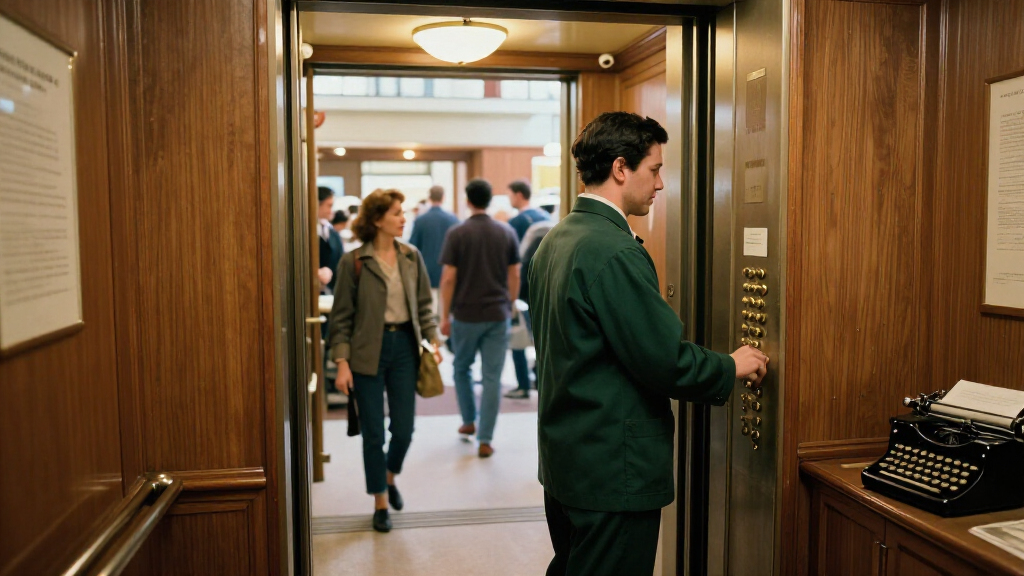

🔍 Read the full analysis: AI And The Jobs We No Longer See: Elevator Operators, Typists, Typesetters on ThorstenMeyerAI.com

Get movie nights delivered free with Prime
- Fast, free delivery on millions of items
- Prime Video, Amazon Music and more included
- Member-only deals all year
TL;DR
A November 21, 2026, article from ThorstenMeyerAI.com examines elevator operators, typists and typesetters as examples of how technology changed work. It reports that economist James Bessen identified only one occupation largely eliminated by automation among 271 occupations tracked from 1950 to 2010, while warning that current forecasts of office-job declines do not establish how many jobs AI will eliminate.
ThorstenMeyerAI.com published a historical report November 21 examining elevator operators, typists and typesetters as cases of technology changing work. The article draws on census data and economist James Bessen’s study of occupations from 1950 to 2010, while noting that claims tying a 1945 elevator-worker strike directly to the adoption of automatic elevators are not established by the documents it reviewed. Its relevance to current AI debates is that technology often replaces tasks without eliminating entire occupations, though jobs centered on a narrow set of tasks can shrink sharply.
The report cites Bessen, an economist at Boston University, who followed 271 detailed occupations recorded in the 1950 U.S. census through 2010. In a 2016 paper, Bessen concluded that among the occupations that disappeared or merged into broader categories, elevator operator was the only one whose decline he largely attributed to automation. Other occupations faded for different reasons, including reduced demand or the obsolescence of the technology they served. The report presents the finding as evidence that automation more commonly takes over parts of jobs than entire occupations.
The article traces elevator operators’ rise and decline using census figures: about 13,000 in 1900, 97,000 at a peak in 1950, about 77,000 in 1960 and 37,000 in 1970. It says Otis offered recorded voices in 1948 to help passengers adjust to automatic elevators that still had attendants. In 1950, an unattended Autotronic system opened in the Atlantic Refining Building in Dallas. The report attributes the description of that installation as the world’s first building with Otis high-speed, no-operator elevators to Otis’s company history.
For typists, the report compares 985,000 U.S. word processors and typists in 1988 with about 40,400 in 2025. It says official forecasters anticipated a 6% decline by 2000, while the eventual decline was 51%; the supplied material does not give the precise series or calculation behind that comparison. It also reports that the Bureau of Labor Statistics projected in August 2026 that office and administrative support would shrink faster than any other occupational group by 2035, partly because of AI tools. That projection describes a forecast, not a confirmed outcome.
Infographic 01 · The number to remember
The one job automation wiped out
Elevator operators rose with the skyscrapers and fell with the automatic elevator. Of 271 occupations in the 1950 census, it is the only one that automation largely wiped out.
US elevator operators · census · thousands
Story vs. evidence
- Documented (TIME, 8 Oct 1945): 16,600 elevator operators and building workers on strike in 2,100 Manhattan buildings for five and a half days.
- Documented (Otis, company account): 1948 a recorded voice to help passengers trust automatic elevators; 1950 the first building with Otis high-speed, no-operator elevators (Dallas).
- Not documented: that the strike made owners switch to automatic elevators. A popular story; no source we found shows it.
Census figures: economically active persons 14 and over, each census in its own classification (1950 in the 1950 classification). Today the BLS publishes no separate count of elevator operators; installers and repairers are a different occupation.
Sources: US Census Bureau, Historical Statistics of the United States (1975), series D 233-682 (row D 587); J. Bessen, How Computer Automation Affects Occupations (2016); TIME, 8 Oct 1945; Otis company history; BLS Employment Projections 2025-35 (27 Aug 2026).
Powered by Thorsten Meyer AI
What Past Job Losses Say About AI
The histories matter because they distinguish automation of tasks from the disappearance of a job title. Elevator operators are an unusual case in Bessen’s analysis; the much broader pattern was that technology changed what workers did. That distinction can help readers assess claims that AI will erase whole occupations: a tool’s ability to perform a task does not by itself show that an entire job will disappear.
The typist example also shows why averages can obscure sharp changes. A large occupation can contract as office technology changes, even while office work persists in new forms. The article says roughly one in nine American jobs remains in office and administrative support, while the BLS projects the group will shrink fastest through 2035. The forecast makes the issue relevant to workers and employers, but it does not specify how many losses will be caused by AI, how quickly they may happen, or whether new tasks and roles will offset them.
Typesetters offer a further reminder that workers and institutions can influence the pace and terms of technological change. According to the report, a German strike in 1978 delayed changes to control over text design, and the apprenticeship was merged into a new media-design trade in 1998. The account frames this as a negotiated shift rather than a simple story of machines instantly replacing everyone in a craft.
Popular right now

Ninja CREAMi Scoop & Swirl 13-in-1 Ice Cream and Soft Serve Maker, NC701

Vitamix Nano Personal Blender with SmoothiePilot, Black

Hisense 65-Inch U8 Series Mini-LED 4K UHD Smart Google TV (65U8QG)
As an affiliate, we earn on qualifying purchases.
From Manual Lifts to Digital Offices
Elevator operators handled doors, floor stops and passenger questions. Automatic elevators existed before the occupation’s peak, but the report says passenger trust was a barrier. Otis’s 1948 recorded voice was one attempt to ease the change while attendants remained. The unattended Dallas installation followed in 1950, before census counts showed a steep occupational decline over the next two decades.
The report also recounts a five-and-a-half-day strike in Manhattan in 1945. TIME reported at the time that 16,600 elevator operators and other building-service workers struck in 2,100 buildings over a War Labor Board wage ruling. The strike ended after New York Gov. Thomas Dewey called for an impartial arbitrator. The report cautions that the popular account—that the strike prompted building owners to install automatic elevators—has not been substantiated by a document linking the two events.
Office typing expanded alongside the typewriter and then contracted as word processors and personal computers spread. In printing, the report says German typesetters’ 1978 action slowed the shift in who controlled text design; in 1998, their apprenticeship was folded into a media-design occupation. These examples provide historical comparisons, not direct predictions of AI’s effects.
“In only one case—elevator operators—can the decline and disappearance of an occupation be largely attributed to automation.”
— James Bessen, economist at Boston University, as quoted in the report
What the Historical Record Cannot Prove
The report says it found no document showing that the 1945 strike caused building owners to replace operators with automatic systems. The strike and later adoption are both part of the timeline, but that timing alone does not demonstrate a causal link. TIME’s contemporary account reported 16,600 workers in 2,100 buildings; the article says later retellings sometimes cite higher figures.
The supplied material does not provide the underlying BLS tables or methodology for the typist decline figures, or details on how the 2026 office-support projection separates AI’s contribution from other changes. Nor does it establish how many office workers may move into other roles. The 2035 forecast is a projection, and the future effects of AI remain uncertain.
Watching the 2035 Office Forecast
The next measurable development will be whether employment in office and administrative support follows the BLS’s August 2026 projection through 2035. Updated employment figures can show changes in the occupational group, but they will not alone identify AI as the cause; changes in business demand, software and job classifications may also matter.
For now, the historical cases support a limited conclusion: technology can remove particular tasks, reshape occupations and, in some cases, contribute to a job’s disappearance. They do not establish the scale or timing of AI-driven job losses. The report’s distinctions—between a forecast and an outcome, and between task change and job elimination—will remain central as new labor-market data arrive.
Key Questions
What is the report’s main finding about automation and entire jobs?
It cites economist James Bessen’s study of 271 occupations from 1950 to 2010. Bessen identified elevator operator as the only occupation in that group whose disappearance he largely attributed to automation; most automation affected tasks within jobs.
Did the 1945 elevator strike cause automatic elevators to replace operators?
The report says the causal link is unproven. It documents the strike and later adoption of unattended elevators but says it found no document showing that the strike caused building owners to make the switch.
How many U.S. typists were there in 1988 and 2025?
The report gives 985,000 word processors and typists in 1988 and about 40,400 in 2025. It also reports an eventual 51% decline against a forecast of 6% by 2000, though the supplied material does not specify the series or calculation used for that comparison.
What does the BLS project for office-support jobs?
The report says the BLS projected in August 2026 that office and administrative support would shrink fastest among occupational groups by 2035, partly because of AI tools. This is a projection, not a count of jobs already lost to AI.
What happened to typesetting work?
According to the report, a three-week strike in Germany in 1978 slowed the shift in control of text design, and the typesetter apprenticeship was merged into a media-design trade in 1998. The account describes a change in the occupation and training path, not a claim that all such work immediately ended.
Source: ThorstenMeyerAI.com