
🔍 Read the full analysis: 10 Best External GPUs For AI In 2027 on ThorstenMeyerAI.com

Get movie nights delivered free with Prime
- Fast, free delivery on millions of items
- Prime Video, Amazon Music and more included
- Member-only deals all year
TL;DR
This is a buyer’s guide, not a report of a new product launch: it compares 10 external GPU options for AI use in 2027 based on supplied product descriptions. The source favors Thunderbolt for broad compatibility and OCuLink for higher bandwidth, but does not provide independent benchmarks, current prices, or verified AI workload results.
A supplied 2027 buyer’s guide identifies 10 external GPU options for AI workloads, from ready-to-use boxes to do-it-yourself docks, and says the right choice depends on a computer’s connection and the buyer’s budget, as outlined in the original analysis. The guide’s central comparison is between Thunderbolt 4’s broad compatibility and OCuLink’s higher claimed bandwidth, a key consideration in this external GPU buyer’s guide. The supplied material does not include independent tests showing how the products perform on specific AI tasks.
The guide names the Razer Core X V2 as its general-purpose pick because, according to the guide, it supports Thunderbolt 4 and uses a separate graphics card that owners can select, much like the options covered in this guide to external GPUs for laptops. That flexibility comes with added cost and setup: the guide describes the enclosure as not including a complete GPU, so buyers must confirm which power supply and card are required. The guide also warns that Thunderbolt’s connection can limit high-end graphics cards; its stated performance-loss estimate applies to CPU-bound scenarios rather than every workload.
For systems with an OCuLink port, the guide recommends the ASUS ROG XG Mobile and MINISFORUM DEG1 for different reasons. It describes the ASUS as an integrated, proprietary product with a custom NVIDIA RTX 5090, and the DEG1 as a lower-cost dock for builders who supply their own components. The source claims OCuLink can provide up to 63 GB/s, compared with Thunderbolt 4’s stated 40 Gbps link rate, but does not cite a test method or explain whether those figures use directly comparable measurements.
The guide’s remaining recommendations span complete boxes and DIY hardware: NIMO RX 7600M XT, OwlTree and RGEEK docks, plus four other entries whose names are not provided in the supplied source. The guide says integrated products simplify setup but limit upgrades, while open docks can reduce enclosure costs and increase assembly demands. Because the supplied material does not name four products, this article cannot verify or describe them as specific models.
The 10 picks
- 1
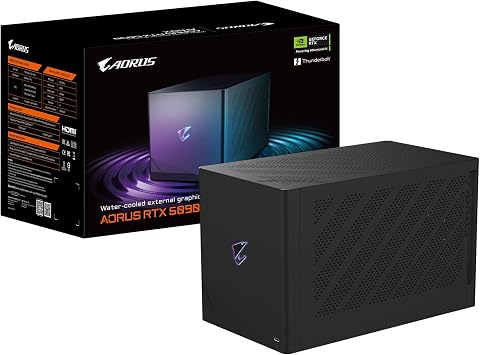 GIGABYTE AORUS RTX 5090 AI Box External GPUView on Amazon →
- 2
 ASUS ROG XG Mobile (2025) External Graphics Card with NVIDIA GeForce RTX 5090View on Amazon →
- 3
 NIMO External Graphics Card Enclosure with AMD Radeon RX 7600M XTView on Amazon →
- 4
 NIMO External GPU Docking Station with AMD Radeon RX 7600M XT 8GB GDDR6View on Amazon →
- 5
 Razer Core X V2 External Graphics Enclosure (eGPU)View on Amazon →
- 6
 MINISFORUM DEG1 OCuLink eGPU DockView on Amazon →
- 7
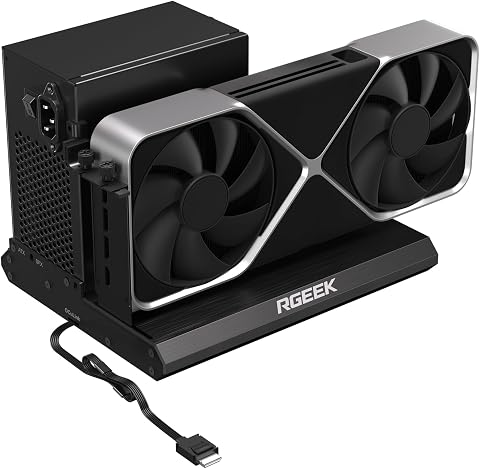 RGEEK PCIe 5.0 OCuLink eGPU Dock for External Graphics CardsView on Amazon →
- 8
 OCuLink PCIe 4.0 x4 eGPU Dock with 19.7-Inch CableView on Amazon →
- 9
 OwlTree PCIe 4.0 x4 eGPU Dock with OCuLink CableView on Amazon →
- 10
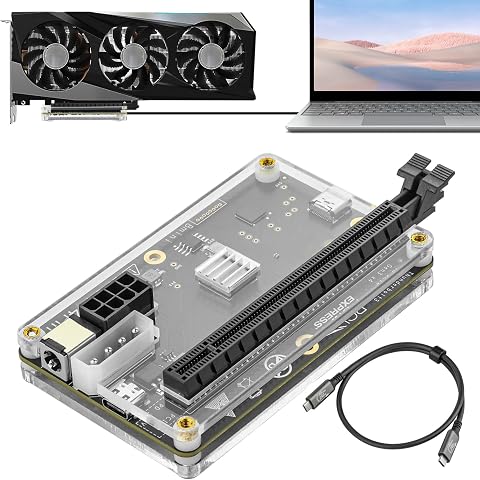 OwlTree PCIe 3.0 x16 eGPU Dock with Thunderbolt 4 CableView on Amazon →
Connection Choice Sets the Ceiling
For AI users, the connection between a host computer and an external GPU can affect how efficiently workloads use the accelerator. The supplied guide’s practical point is that a powerful card alone does not settle the decision: host-port support, bandwidth, power, and software compatibility also matter. A high-bandwidth dock is of little use if a laptop lacks OCuLink, while a Thunderbolt enclosure may be easier to connect across a wider range of compatible systems.
The cost comparison also extends beyond the listed dock or enclosure. Buyers may need to add a graphics card, power supply, cables, and a compatible host computer. For AI tasks, they should also check the GPU’s memory capacity and software support for their chosen models; the supplied guide does not compare those factors or report workload-specific results. That leaves readers with a useful shortlist framework, but not enough evidence to treat the guide’s rankings as an independently tested performance verdict.
Popular right now

De'Longhi Classic Signature Espresso Machine with Adjustable Milk Frother

KitchenAid Classic Series 4.5-Quart Tilt-Head Stand Mixer, Onyx Black

Dyson V8 Cordless Vacuum
As an affiliate, we earn on qualifying purchases.
How the Ten Picks Differ
The supplied guide groups external GPUs into two broad formats. Enclosures and open docks accept a separately purchased GPU, offering component choice and possible upgrades but requiring more planning. Integrated boxes include a graphics processor, which can reduce assembly work but generally limits replacement options. These formats should not be compared on the box price alone because their included components differ.
Connection standards further divide the list. The guide describes Thunderbolt 4 as broadly compatible, with a 40 Gbps link rate, and OCuLink as a direct PCIe 4.0 x4 connection that can reach up to 63 GB/s. Those are claims in the guide, not independently verified figures in this article. OCuLink is also less common, so buyers need to check their laptop or mini PC before selecting a dock. The guide says Thunderbolt power delivery varies by device and setup, while OCuLink arrangements typically require separate power and charging cables.
Benchmarks and Four Models Missing
The supplied guide does not provide independent benchmark data, dated prices, or product links, and it does not name four of the ten promised entries. It also does not report tests involving AI model training, inference speed, GPU memory use, or software compatibility. The bandwidth and performance differences described in the guide should be treated as its claims, not verified outcomes for every computer or workload.
Specific compatibility details remain unclear in the supplied material, including supported host devices, power-delivery wattage, included power supplies, and the exact configuration of each product. The guide calls the ASUS option an integrated RTX 5090 solution and gives a performance-loss estimate for some Thunderbolt scenarios, but supplies no methodology or device-by-device results. Readers should confirm current specifications with manufacturers and check whether their computer supports the required connection.
Verify Before Buying
Before purchasing, readers should identify their computer’s available ports, check manufacturer compatibility guidance, and calculate the full cost of the GPU, dock, power supply, and cables. They should match graphics-card memory and software support to their intended AI workload, then seek benchmarks for that workload and host configuration rather than relying on connection figures alone.
The supplied guide’s ten-item promise cannot be fully checked because four product names and supporting specifications are absent from the material provided. A complete comparison would need those entries, current prices, and reproducible tests across Thunderbolt and OCuLink systems. Until then, the guide’s recommendations are best read as a starting point for evaluating options, not as a verified ranking of AI performance.
Key Questions
What is the main difference between Thunderbolt 4 and OCuLink for an external GPU?
The supplied guide describes Thunderbolt 4 as a broadly supported connection with a 40 Gbps link rate, and OCuLink as a direct PCIe connection with higher claimed bandwidth. OCuLink requires a host device with the appropriate port, which the guide says is less common.
Does the Razer Core X V2 include a graphics card?
No. The supplied guide describes it as an enclosure, so buyers must provide a compatible graphics card and check what power components their setup requires.
Which option is easiest to set up?
The guide presents integrated GPU boxes, including the NIMO RX 7600M XT and ASUS ROG XG Mobile, as simpler than DIY docks. Their convenience may come with less flexibility to replace or upgrade the GPU.
Are the guide’s AI performance rankings independently verified?
The supplied material provides no independent AI benchmarks or test methodology. Its bandwidth and performance statements should be treated as claims from the guide until confirmed by workload-specific testing.
Source: ThorstenMeyerAI.com