IdeaNavigator is developed privately and is not publicly available.

Get movie nights delivered free with Prime
- Fast, free delivery on millions of items
- Prime Video, Amazon Music and more included
- Member-only deals all year
TL;DR
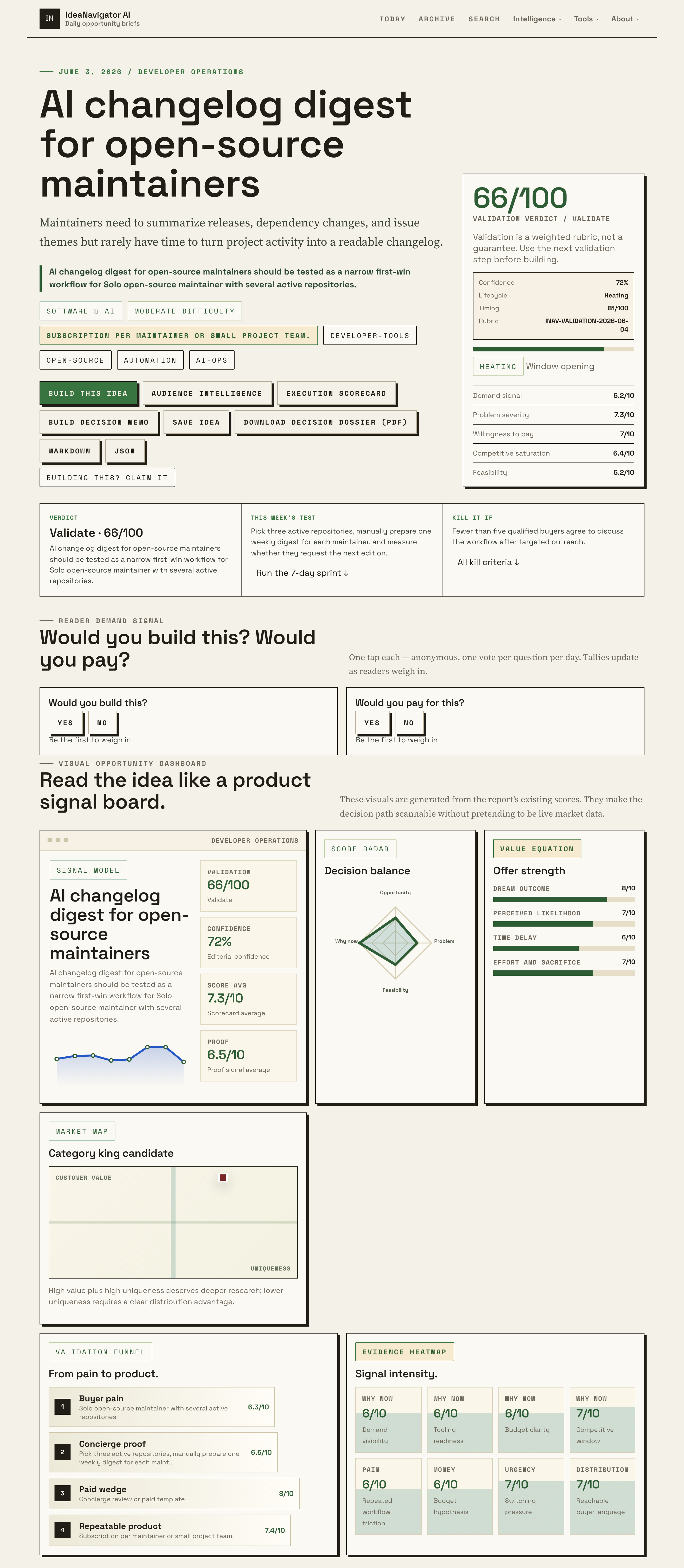
A prototype for an AI-driven changelog digest is being tested for solo open-source maintainers managing multiple repositories. It automates release summaries, dependency updates, and issue themes. The initiative aims to streamline project communication and reduce manual effort.
A new AI-powered changelog digest tool is in the testing stage, targeting solo open-source maintainers managing multiple repositories. The tool aims to automate the process of summarizing releases, dependency updates, and issue themes, helping maintainers save time and improve communication with users. This development reflects advances in AI summarization and project metadata analysis, making such automation feasible without a full developer-relations team.
The initiative is focused on creating a weekly digest generator that reads data from a maintainer’s repositories, including recent releases, merged pull requests, and top issues. The prototype is designed to produce a draft changelog email, which the maintainer can review and approve. The project is still in the testing phase, with initial validation involving three active repositories. The goal is to measure whether maintainers find the generated digests useful enough to request regular editions.
According to sources involved in the project, this approach leverages current AI summarization capabilities and repository metadata feeds to automate what has traditionally been a manual, time-consuming task. The model is intended to produce concise, relevant summaries tailored to each project, reducing the workload for maintainers who often juggle multiple repositories without dedicated communication teams.
Potential Impact on Open-Source Maintenance Workflow
This development could significantly reduce the manual effort required for maintaining clear, up-to-date documentation of project activity. For solo maintainers, especially those managing several repositories, automated digests could improve transparency and user engagement. If successful, this approach might become a standard tool in developer operations, enabling more frequent and consistent communication without additional staffing.
As an affiliate, we earn on qualifying purchases.
Emergence of AI Tools in Developer Operations
Recent advances in AI, particularly in natural language processing, have enabled more sophisticated automation in project management and documentation. Several tools now utilize AI to generate release notes, summarize issues, or assist with code review. This project builds on those trends by focusing specifically on the needs of solo open-source maintainers, who often lack dedicated teams for project communication. The idea is to offer a lightweight, automated solution that integrates with existing repository feeds and reduces manual overhead.
The concept was proposed as a minimal viable product (MVP) by IdeaNavigator AI, emphasizing a narrow scope—generating weekly digests—before expanding features. The approach aims to validate whether such automation can deliver tangible benefits for maintainers managing multiple repositories.
“This tool aims to bridge the gap between active development and effective communication, especially for maintainers without dedicated teams.”
— an anonymous researcher involved in the project
automated release notes tool for developers
As an affiliate, we earn on qualifying purchases.
As an affiliate, we earn on qualifying purchases.
Uncertainties About Adoption and Effectiveness
It is not yet clear how well the AI-generated digests will be received by maintainers or whether they will significantly reduce manual effort. The validation phase involves only three repositories, and broader adoption will depend on user feedback, accuracy, and customization options. Additionally, the long-term impact on maintainer workload and communication quality remains to be seen.
repository activity summary software
As an affiliate, we earn on qualifying purchases.
As an affiliate, we earn on qualifying purchases.
Next Steps for Validation and Expansion
The project team plans to complete initial testing with selected repositories and gather feedback from participating maintainers. If the results are positive, they will refine the tool’s features and potentially expand its scope to include more customization options and integrations. The goal is to establish a reliable, scalable solution that could be offered as a subscription service for open-source projects.
project management automation tools for open-source
As an affiliate, we earn on qualifying purchases.
As an affiliate, we earn on qualifying purchases.
Key Questions
How does the AI changelog digest work?
The tool scans repository data, including releases, pull requests, and issues, then uses AI summarization to generate a concise weekly digest that can be reviewed and approved by the maintainer.
Who is this tool designed for?
It is intended primarily for solo open-source maintainers managing multiple repositories who need an efficient way to communicate project updates without additional staffing.
Is this tool available to the public now?
Currently, it is in a testing phase with a limited number of repositories. Broader availability will depend on validation results and further development.
What are the potential benefits of this AI digest?
Potential benefits include saving time, improving project transparency, and maintaining consistent communication with users and contributors.
What challenges might this tool face?
Challenges include ensuring the accuracy of summaries, customizing content for different projects, and achieving widespread adoption among busy maintainers.
Source: IdeaNavigator AI
Halloween Picks
halloween
As an affiliate, we earn on qualifying purchases.