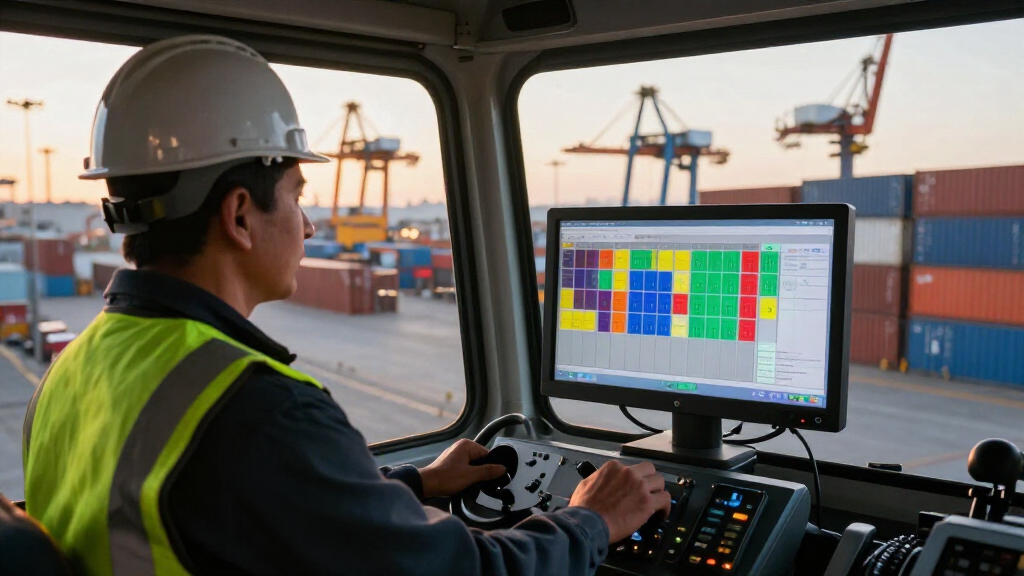

🔍 Read the full analysis: AI Is Changing How Dockworkers Load Containers on ThorstenMeyerAI.com

Get movie nights delivered free with Prime
- Fast, free delivery on millions of items
- Prime Video, Amazon Music and more included
- Member-only deals all year
TL;DR
A November 23, 2026, article from ThorstenMeyerAI.com traces how container shipping transformed port labor, from manual break-bulk handling to crane-loaded boxes and automated terminals. The source documents major job declines and labor agreements, but provides no specific evidence that AI itself is now changing container loading; it also cites a 2024 government report that found automation did not make every terminal faster.
A November 23, 2026, report from ThorstenMeyerAI.com traces how container shipping transformed dock work, replacing the handling of individual sacks, barrels and crates with cargo moved in standardized boxes. The account documents a sharp contraction in some dockworker workforces and decades of labor bargaining over mechanization, but it does not establish that AI specifically is now changing how containers are loaded.
Before container shipping, ports handled cargo piece by piece. A ship’s load could pass from a truck or train to a warehouse and then into a ship’s hold, with dockworkers lifting and securing each item. The report, drawing on historian Marc Levinson’s book The Box, describes a 1954 voyage of the freighter Warrior carrying 194,582 separate bags, barrels, crates and cartons from Brooklyn to Bremerhaven. The crossing took 10 and a half days; some cargo spent more than three months in transit overall.
The account says the cost of loading fell dramatically with containerization. In figures attributed to Levinson, loading loose cargo in 1956 cost about $5.83 per ton, while the container ship Ideal X cost 15.8 cents per ton to load. The report calculates that as roughly 36 times cheaper. On April 26, 1956, a crane in Newark lifted 58 truck bodies onto the Ideal X; five days later the ship reached Houston, where trucks were ready to carry the boxes onward.
That change reduced demand for traditional dock labor, although the source does not isolate the effects of AI. It cites Waterfront Commission figures showing more than 35,000 longshoremen in the Port of New York and New Jersey in the early 1960s, compared with about 3,500 in 2013. In Britain, registered dockworkers fell from a peak of 82,000 to 9,400 in 1989. These figures describe long-term workforce changes and should not be read as measurements of AI-related job losses.
Infographic 01 · Before the box
Why the port cost more than the ocean
Before the container, every sack and crate was handled one by one. The port, not the sea, was the expensive part of a trip.
One truckload of medicine, Chicago → Nancy (France) · estimate ca. 1960 · total $2,386
Cost of loading one ton · 1956
Roughly 36 times cheaper to load (5.83 ÷ 0.158, our calculation). The loading figures are from Levinson’s own article; other authors cite them to The Box, 1st ed. (2006), p. 52.
Sources: M. Levinson, The Box, 2nd ed. (Princeton UP, 2016), ch. 1, Table 1, p. 12 (American Association of Port Authorities data); M. Levinson, The Box That Shrank the World, Works That Work No. 2.
Powered by Thorsten Meyer AI
How Containerization Reshaped Dock Jobs
The history matters because the current debate about AI and port automation follows a much older shift: technology can change not just how cargo is moved, but how many workers are needed and what protections they can negotiate. Standardized containers reduced the need to handle goods individually, lowered handling costs, and helped reorganize the work of shipping and port operations.
The consequences were not limited to efficiency. The source recounts how employers and the International Longshoremen’s and Warehousemen’s Union reached a 1960 West Coast agreement that permitted mechanization while providing registered workers with income guarantees, retirement payments and other benefits. Labor disputes have continued: East and Gulf Coast dockworkers struck in 2024 over wages and automation, according to the account. For workers, shippers and consumers, the central issue is how productivity gains are distributed and whether new systems change staffing, safety and working conditions.
Automation does not guarantee faster operations. The report says a 2024 U.S. government report found denser stacking at some automated terminals, alongside slower moves and more breakdowns at some sites. That finding cautions against treating automation—or AI—as a single, uniform improvement across ports.
Popular right now

Hisense 65-Inch U8 Series Mini-LED 4K UHD Smart Google TV (65U8QG)

KitchenAid Artisan 5-Quart Tilt-Head Stand Mixer, Almond Cream

Dyson Cyclone V10 Origin Cordless Vacuum
As an affiliate, we earn on qualifying purchases.
From Break-Bulk Cargo to Boxes
Malcom McLean, a North Carolina trucking entrepreneur, is associated with the early container system. The source says he did not invent the cargo box: metal containers had been used before. The major change was building a system in which a sealed box could move between truck and ship without its contents being unpacked. The Ideal X voyage in 1956 demonstrated that approach at commercial scale.
Labor negotiations were part of the shift from the beginning. In October 1960, the ILWU and the Pacific Maritime Association signed the Mechanization and Modernization Agreement. Employers gained flexibility to mechanize, while registered workers received protections. The agreement was not a promise that no jobs would ever disappear; the source describes a no-layoff promise for the workers covered alongside income and retirement provisions.
Containerization also altered the economics of shipping. The source gives an estimate for transporting a truckload of medicine from Chicago to Nancy, France, around 1960: port charges accounted for 48.7% of a $2,386 total, excluding an additional $95 for local freight near the port. That example illustrates the expense of manual port handling at the time; it is not a current estimate of shipping costs.
““epochal in the annals of industrial relations””
— ThorstenMeyerAI.com, citing the U.S. Bureau of Labor Statistics on the 1960 labor agreement
What the Evidence Says About AI
The source’s headline frames the subject as AI changing container loading, but its evidence chiefly concerns containerization and mechanization over several decades. It gives no port-by-port account of AI systems currently directing loading, no adoption figures, and no measured estimate of AI’s effect on dockworker numbers, productivity or safety. It is therefore not possible from this material to distinguish AI’s effects from those of cranes, automated vehicles, software, terminal redesign or other technologies.
The workforce figures also use different places and years, and do not establish a single cause for the declines. The source does not provide enough detail about the 2024 government report to identify the terminals studied, its methods or how representative its findings are. The reported 2024 strike is described as involving wages and automation, but the account does not detail the negotiated outcome or specify which automation proposals were at issue.
Evidence Needed on AI at Ports
The next step for judging AI’s role is more specific, current evidence from ports: which systems are in use, what tasks they perform, and how measured outcomes compare with conventional operations. Useful reporting would include terminal-level data on moves per hour, breakdowns, staffing, injuries and cargo delays, alongside worker and employer accounts.
The supplied source does not identify a forthcoming study, agreement or policy decision. Its immediate contribution is historical: it shows that major changes to cargo handling have long brought cost reductions and labor conflict together. Whether AI will produce comparable changes—and how workers and employers will negotiate them—remains an open question.
Key Questions
Does the report show that AI is loading containers at ports?
No. It describes the history of containerization and mechanization, but supplies no specific evidence about AI systems currently loading containers or directing dock operations.
How did containerization change cargo handling?
It allowed cargo to move in standardized boxes between trucks and ships without unpacking each item. That reduced the need to handle individual sacks, barrels and crates by hand.
How much cheaper was loading on the Ideal X?
The figures attributed to Marc Levinson put 1956 break-bulk loading at about $5.83 per ton and loading the Ideal X at 15.8 cents per ton. The source calculates the difference as roughly 36 times; these are historical loading-cost figures, not current prices.
Did automation make terminals faster?
Not in every case cited. The source says a 2024 U.S. government report found denser stacking, but also slower moves and more breakdowns at some automated terminals. It does not provide enough detail to generalize that finding to all ports.
What protections did dockworkers negotiate?
The 1960 West Coast agreement allowed employers to mechanize while setting out protections for registered longshoremen, including income guarantees and retirement benefits. The source does not say those provisions applied to every dockworker or eliminated all job losses.
Source: ThorstenMeyerAI.com