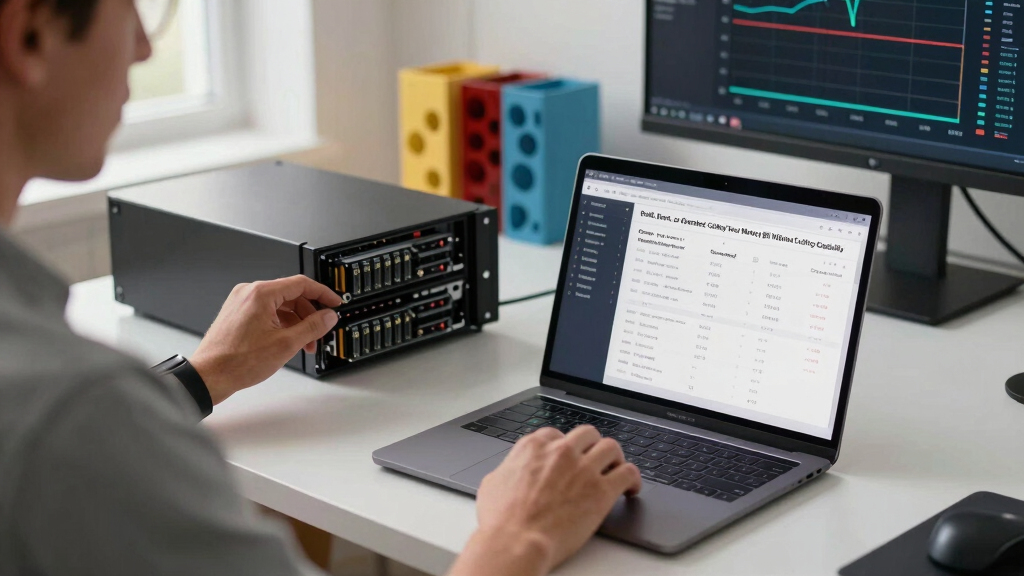

📊 Full opportunity report: Build, Rent, or Quantize: Cutting Your Memory Bill Without Cutting Capability on ThorstenMeyerAI.com — validation score, market gap, and execution plan.

Get movie nights delivered free with Prime
- Fast, free delivery on millions of items
- Prime Video, Amazon Music and more included
- Member-only deals all year
TL;DR
AI developers face rising memory costs; the key options are building their own hardware, renting cloud resources, or using quantization to shrink memory needs. Recent advances like TurboQuant offer significant savings with minimal quality loss.
Recent developments in AI model compression, particularly Google’s TurboQuant, have introduced a new method to significantly reduce memory requirements without sacrificing model quality. This breakthrough offers a third, cost-effective lever alongside building or renting hardware, enabling more efficient AI deployment amid rising memory costs.
The core of the recent innovation is quantization, which shrinks model weights from 16-bit to as low as 4-bit precision, reducing memory use by nearly 4× while maintaining approximately 95% of the original quality. Additionally, FP8 KV-cache quantization, now supported in runtimes like vLLM, halves the memory needed for key-value caches, crucial for long-context models.
Google’s TurboQuant, unveiled in March 2026, compresses caches to about 3 bits per value, achieving roughly a 6× reduction with negligible accuracy loss at 100K-token contexts. While not yet integrated into major inference frameworks, community versions are available, and the technology promises to make models that previously required 18GB fit into 12GB or less, expanding hardware options and reducing costs.
Build, rent, or quantize
Memory got expensive everywhere — to buy and to rent. Most people argue build-vs-rent and miss the cheapest lever: shrink how much memory the work needs in the first place. Cut the bill without cutting capability.
For steady, high-utilization, private work. ~½ the lifetime cost of cloud. Right-size, used 3090s, or Apple unified memory. Capital up front.
For elastic, spiky, uncertain work. Can’t buy half a cluster for two weeks. But the bill creeps up — rent defensively: reserve, right-size, monitor.
Make the model need less memory — modern compression does it at little quality cost. The one move that lowers the bill in both venues.
★ the underused multiplierThe mistake the squeeze punishes hardest is solving a memory problem by buying more memory, when you could have needed less. Build when ownership pays, rent when flexibility pays — and quantize always, because shrinking the requirement is the only lever that makes both cheaper at once, and the only one that’s nearly free. The first question is never “build or rent” — it’s “how little memory can this take?” Next: when does cheap memory come back?
Impact of Quantization on AI Cost Efficiency
This development matters because it offers a cost-effective way to handle the growing memory demands of large AI models. By applying quantization, organizations can reduce hardware expenses, extend the lifespan of existing equipment, and improve scalability without compromising performance. It also shifts the decision-making process from purely build or rent to include a critical focus on model compression techniques, which can be applied regardless of deployment venue.
Popular right now

Ninja Flip Toaster Oven and Air Fryer, 8-in-1, Stainless Steel, SP151

KitchenAid Classic Series 4.5 Quart Tilt-Head Stand Mixer K45SS, Onyx Black

Roborock Robot Vacuum and Mop with LiDAR Navigation and 10,000 Pa Suction
As an affiliate, we earn on qualifying purchases.
Rising Memory Costs in AI Deployment
Over recent years, the cost of AI memory has increased significantly, driven by larger models and longer contexts. Previously, building dedicated hardware was the most economical for steady workloads, while renting was preferred for variable or uncertain needs. Now, with memory prices rising and hardware shortages ongoing, the industry faces a critical need for smarter optimization strategies. Recent innovations like quantization are emerging as vital tools to address this challenge, complementing existing build and rent options.
“TurboQuant achieves approximately a 6× reduction in cache size at 100K tokens, enabling longer contexts on existing hardware.”
— Google AI team (March 2026)
Limitations and Practical Constraints of Quantization
While promising, quantization methods like TurboQuant are not yet standard in all inference frameworks, and their integration may lag behind the technology’s release. Pushing weights below Q4 can degrade reasoning and coding performance, and MoE models do not reduce memory but speed up inference. The long-term reliability and widespread adoption of these techniques remain to be seen, and the precise cost savings depend on implementation and workload specifics.
Upcoming Integration and Adoption of Compression Tech
The immediate next step is the anticipated integration of TurboQuant into major inference frameworks later in 2026. Practitioners should monitor these developments and consider adopting quantization techniques now, such as Q4 weights combined with FP8 KV-cache, to optimize current hardware. Further research and community contributions are expected to refine these methods and expand their practical use, making cost-efficient AI more accessible.
Key Questions
How much can quantization reduce memory costs?
Quantization can shrink model weights by up to 4× (from 16-bit to 4-bit) and cache sizes by approximately 6× with TurboQuant, significantly lowering hardware requirements and costs.
Does quantization affect model accuracy?
When properly applied, especially with Q4 quantization and FP8 KV-cache, the quality loss is minimal (~5%), but pushing below Q4 may impair reasoning and coding performance.
Is TurboQuant available for all inference frameworks now?
Not yet. As of mid-2026, TurboQuant is not integrated into major frameworks, but community versions exist, and official support is expected later in the year.
Can quantization replace building or renting hardware entirely?
Quantization complements existing strategies by reducing memory needs, but it does not eliminate the need for hardware or cloud resources entirely. It is a cost-saving enhancement.
What are the risks of relying on quantization?
Over-quantizing can degrade model performance, especially on complex reasoning tasks. Also, the technology’s maturity and integration status may limit immediate practical deployment.
Source: ThorstenMeyerAI.com