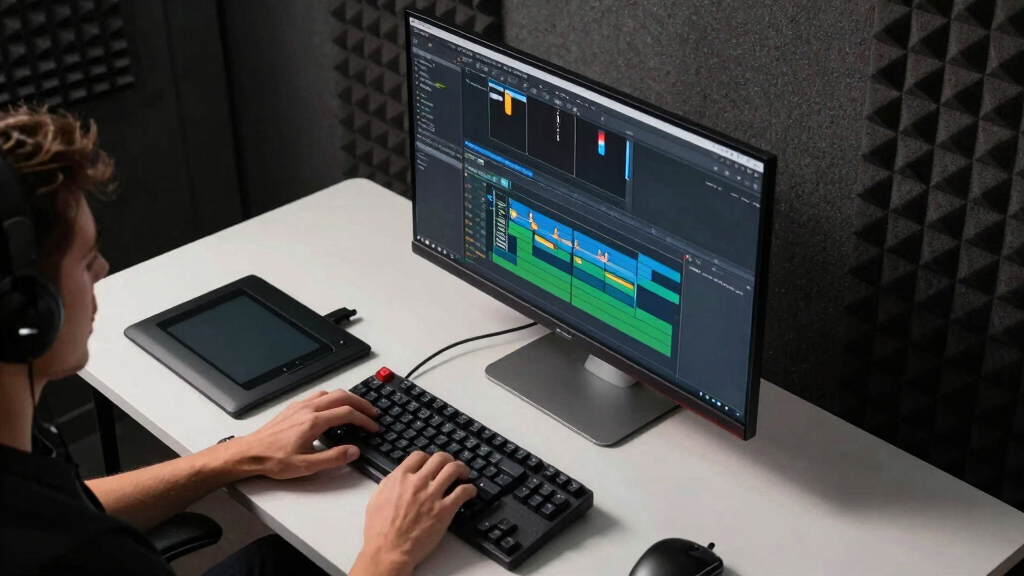

📊 Full opportunity report: Cutrova: Edit the Words, Not the Timeline on ThorstenMeyerAI.com — validation score, market gap, and execution plan.

Get movie nights delivered free with Prime
- Fast, free delivery on millions of items
- Prime Video, Amazon Music and more included
- Member-only deals all year
TL;DR
Cutrova has launched a local-first video editing tool that focuses on editing transcripts instead of timelines, making video production faster, more accessible, and more private. The software emphasizes ownership of data and offline workflow, with optional cloud AI features.
Cutrova has introduced a new approach to video editing that allows users to edit by modifying transcripts rather than manipulating timelines. The software is designed to be local-first, offline-capable, and privacy-oriented, addressing common frustrations in post-production and lowering the skill barrier for creating polished videos. This development matters because it could significantly democratize video editing and improve workflows for individual creators and teams alike.
Cutrova’s core innovation is enabling editing through text — users delete, reorder, or correct spoken words in a transcript, which automatically updates the video footage without manual timeline adjustments. The tool runs entirely on a user’s machine, ensuring that media remains private and under user control. It also supports exporting captions, fixing errors via overdubbing, and generating various formats like social clips and transcripts, all from a single recording.
The company emphasizes that this approach reduces the technical skills required to produce professional-quality videos, making it accessible to founders, educators, and teams without dedicated editors. The software offers optional cloud AI features for translation, dubbing, and generative tasks, but core editing functions are local and owner-controlled. This setup aims to prevent reliance on cloud services that can introduce fragility and privacy risks.
Edit the Words, Not the Timeline
Delete a sentence in the transcript and the footage behind it is cut — gaplessly. The skill you already have, editing a document, becomes the only skill the tool asks of you. Everything else falls out of that one idea.
Cloud AI — translation, dubbing, the heavier generative features — is available on your own keys, as an opt-in, not a default you’re billed for. The local core is the text editing, transcription, cleanup, and captions.
The careful part: legal wording is legally significant, so the dark restyle was run verify-first. One canonical page, four restyled in parallel, then an adversarial pass diffed each legal body word-for-word against git show HEAD. All five came back byte-identical — statute references, the address, the ß, and the curly quotes all preserved exactly — while the design was fully adopted.
- The mailbox isn’t live yet.
contact@cutrova.comstill needs creating — the Impressum and contact pages depend on it. - Lawyer review is pending. The Impressum and Datenschutzerklärung are careful templates; the project’s own notes flag they should be reviewed and kept in sync. This is not legal advice.
- “Get started” points at email. There’s no signup flow to wire the CTAs to yet.
- Frontier features are a frontier. The text-editing core is load-bearing; several AI features are optional, cloud-based, or key-dependent and may change.
Independent commentary, produced with AI assistance under human editorial oversight. The views are the author’s own and may change. This is not business, financial, legal, or technical advice. Cutrova is an early-stage product; some capabilities are local and shipped, while others are optional, cloud-based, or key-dependent. Legal-page references describe templates, not advice. Product, model, and company names are trademarks of their respective owners; mention does not imply endorsement.
Impact on Video Production and Privacy
This development could transform how videos are created and shared, lowering the barriers for non-experts and small teams to produce high-quality content quickly. Its emphasis on local control and privacy addresses growing concerns over data security and compliance, especially for sensitive or unreleased material. Additionally, by simplifying editing workflows, it may accelerate content creation cycles and reduce costs, making video a more integral part of everyday communication for a broader audience.
transcript-based video editing software
As an affiliate, we earn on qualifying purchases.
As an affiliate, we earn on qualifying purchases.
Traditional Editing and the Shift to Text-Based Workflows
Most current video editing tools rely on timeline-based interfaces, requiring technical skills and time-consuming adjustments. These tools often depend on cloud services for features like AI-driven captioning or effects, which can be slow, costly, and raise privacy issues. The concept of editing via transcripts has been explored before but has not yet become mainstream. Cutrova’s focus on local-first operation and ownership of data marks a notable shift in the industry, aligning with broader trends toward privacy and simplicity in digital workflows.
“The core idea is to edit the words, not the timeline — delete a sentence, and the footage behind it is cut seamlessly.”
— Thorsten Meyer, source from ThorstenMeyerAI.com
privacy-focused offline video editor
As an affiliate, we earn on qualifying purchases.
As an affiliate, we earn on qualifying purchases.
Unclear Aspects of Product Maturity and Adoption
It is not yet clear how widely adopted the software will become, how it compares in performance to established tools, or how seamlessly users will transition from traditional workflows. The extent of the AI features’ capabilities and their integration into the core editing experience are still evolving, and user feedback will be crucial to assess real-world effectiveness.
As an affiliate, we earn on qualifying purchases.
Next Steps for Cutrova and User Adoption
Cutrova plans to release the full version soon, with ongoing updates to enhance AI features and user interface. The company will likely seek feedback from early adopters, and industry watchers will observe how well the local-first, transcript-based approach performs in diverse scenarios. Broader industry acceptance will depend on performance, ease of use, and the value proposition compared to existing cloud-based editors.
As an affiliate, we earn on qualifying purchases.
Key Questions
How does editing transcripts differ from traditional timeline editing?
Instead of adjusting clips on a timeline, users modify the transcript text—deleting, reordering, or correcting words—which automatically updates the video footage without manual timeline adjustments.
Is the software entirely offline?
Yes, the core editing functions run on your local machine, ensuring media privacy and independence from internet connectivity. Cloud AI features are optional and can be enabled at the user’s discretion.
What are the privacy benefits of using Cutrova?
Since recordings and edits stay on your device, sensitive or unreleased footage is protected from cloud breaches or leaks. This is especially important for NDA-bound projects or confidential content.
Will this replace traditional editing tools?
It aims to complement or replace certain workflows by offering a faster, more accessible alternative for specific use cases, especially for non-professionals or small teams. Adoption will depend on how well it performs across different scenarios.
What kinds of outputs can I create with Cutrova?
The software supports generating social clips, captions, transcripts, and various video formats from a single recording, suitable for different platforms and purposes.
Source: ThorstenMeyerAI.com
Fall Picks
fall essentials
As an affiliate, we earn on qualifying purchases.