📊 Full opportunity report: Death Certificate Chaser For Funeral Directors on IdeaNavigator AI — validation score, market gap, and execution plan.

Get movie nights delivered free with Prime
- Fast, free delivery on millions of items
- Prime Video, Amazon Music and more included
- Member-only deals all year
TL;DR
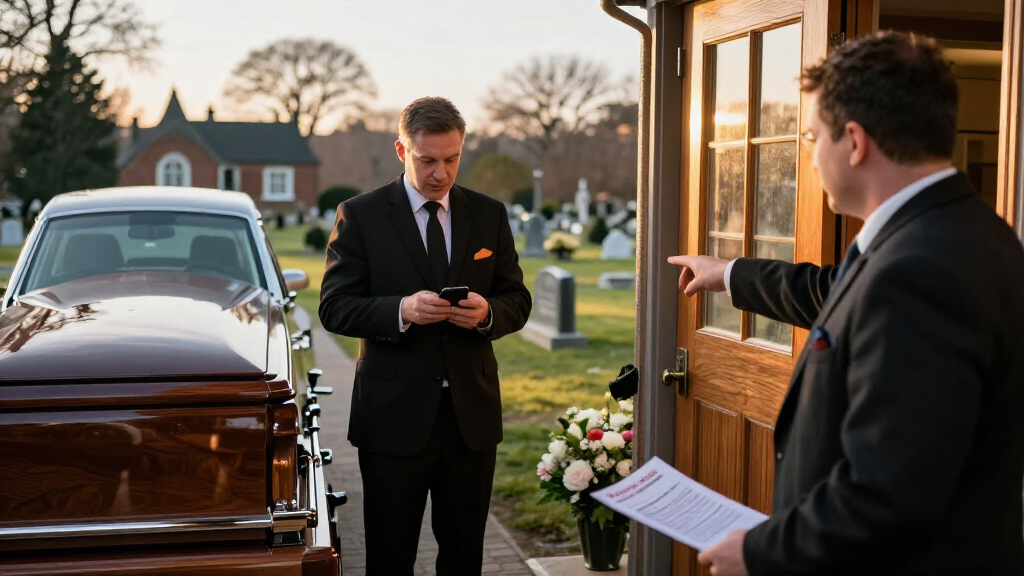
IdeaNavigator AI has proposed a software tool to help funeral homes track unsigned death certificates and remind medical certifiers. The concept is not a launched product: its proposed test would involve five funeral homes in Michigan or Virginia over 60 days.
IdeaNavigator AI has proposed a tracking and reminder service for funeral homes waiting on physicians or other certifiers to complete death certificates, framing it as a way to reduce manual follow-up and identify cases nearing state deadlines. The proposal, published on IdeaNavigator AI’s website, is a product concept—not an announcement of a working service or evidence that the approach has improved processing times.
In its proposal, IdeaNavigator AI says the tool would give funeral directors and office managers a case board showing each death record’s certification status. Staff could enter updates manually or use status information from a state electronic death registration system where that information is available. Each record could also hold a certifier’s office contact details and preferred method of communication.
The concept calls for scheduled reminders by email, fax and text message, with reminders escalating as a state deadline approaches. IdeaNavigator AI also proposes a log of contact attempts, flags for cases at risk of missing a legal window, and plain-language status updates for families. Its proposal includes a monthly report identifying slow certification patterns for funeral homes or state funeral director associations.
IdeaNavigator AI identifies an independent funeral home or small multi-location group as the proposed customer, with a funeral director or office manager as the likely user. The suggested business model is a monthly subscription for each funeral home location, with discounted rates for associations that enroll members in bulk. The proposal names no price, vendor, launch date or existing customer.
Death certificate chaser for funeral directors
IdeaNavigator AI has proposed a tool to track unsigned death certificates and remind certifiers. It remains a concept, with no launch or pilot results reported.
How the proposed service works
The concept aims to give staff a shared view of pending certifications and follow-ups.
A case board would show certification status and certifier contact details.
Scheduled email, fax and text reminders would escalate as deadlines approach.
Contact logs, deadline flags and monthly reports could help teams spot bottlenecks.
Potential operational impact
The proposal describes possible benefits, but provides no measured outcomes.
- See which certificates still need signatures.
- Reduce manual follow-up work if reminders help.
- Measure staff time spent chasing certifiers.
- Receive plain-language status updates.
- Get clearer information while certification is pending.
- Arrangements or claims may still be delayed.
State rules cited in the proposal
IdeaNavigator AI points to state requirements as a reason to test deadline tracking.
| State | Proposal cites | Potential relevance |
|---|---|---|
| Michigan | House Bills 4077 and 4078; 48-hour certification requirement | Track cases nearing a stated deadline |
| Virginia | House Bill 156; tutorial requirement for certain clinicians | Account for state-specific processes |
What the pilot would measure
The suggested test compares participating homes with their own preceding 60 days.
- Time from death to medical certification
- Staff minutes spent contacting certifiers
- Changes against each home’s previous 60 days
Reducing Manual Certificate Follow-Up
Death certificates are part of the administrative process that can hold up funeral arrangements and other matters after a death. IdeaNavigator AI’s proposal says funeral home staff can spend hours contacting doctors’ offices about certificates awaiting signatures, while lacking a shared view of which certifier has a particular case. A tracking board could make those outstanding cases easier for staff to see and follow up on, if it works as intended.
IdeaNavigator AI identifies cremation scheduling, life-insurance claims and benefit payments as areas that may be held up while certification is pending. Its proposed status updates for families could offer clearer information, but the concept does not establish that a reminder tool would speed up a certifier’s response or resolve other causes of delay.
The proposal suggests reports could help a funeral home identify recurring bottlenecks, but provides no data showing how often delays occur or how much time the software might save. A pilot would need to measure those outcomes before buyers could judge whether the tool merits a recurring subscription.
Popular right now

Breville Barista Express Espresso Machine with Built-In Grinder, Brushed Stainless Steel

Bose QuietComfort Wireless Noise Cancelling Headphones, Twilight Blue

Samsung 75-Inch QLED Q7F Series Smart TV (2025)
As an affiliate, we earn on qualifying purchases.
State Rules Shape the Proposal
IdeaNavigator AI’s proposal points to new or updated state requirements as a reason to test the service. It says Michigan House Bills 4077 and 4078 were signed on March 17, 2026, and require death certificates to be certified within 48 hours through the state’s secure web-based system. It also cites Virginia’s 2026 House Bill 156, which the proposal describes as requiring physicians, advanced practice registered nurses and physician assistants who expect to sign death certificates to complete the state’s electronic death registration system tutorial as part of licensing. These descriptions are claims in IdeaNavigator AI’s proposal; it provides no bill links or additional legal analysis.
The proposal argues that deadlines could give funeral homes a clear point for tracking overdue cases and sending reminders. That is IdeaNavigator AI’s rationale, not evidence that legislation has already caused demand for this software. The material does not explain how the service would connect to either state system, whether a private vendor could access them, or how state rules apply to specific cases.
IdeaNavigator AI recommends testing the concept with five funeral homes in Michigan or Virginia for 60 days. Its proposed evaluation would record time from death to medical certification and staff minutes spent chasing signatures, then compare those measures with each home’s previous 60 days. The proposal names no participating homes and reports no pilot findings.
Product and Pilot Status
No product launch, operating company or completed trial is described in IdeaNavigator AI’s proposal. The proposal does not identify a developer, provide a release timetable, list participating funeral homes or report measured results. It therefore remains unclear whether the suggested workflow can reduce certification times or staff workload compared with existing methods.
Several implementation questions are also unanswered in the proposal. It does not specify how status data would be obtained from state electronic registration systems, how sensitive personal information would be protected, or whether reminders could be sent through the channels certifiers actually use. It also gives no detail on what happens when a record is delayed for reasons a reminder cannot address.
Although the proposal describes state deadlines and requirements, it provides no legal guidance on exceptions or how the rules apply across different types of death records. Funeral homes would need to confirm applicable requirements with state authorities before treating automated alerts as a compliance tool.
Testing the 60-Day Workflow
IdeaNavigator AI’s proposed next step is a 60-day pilot at five funeral homes in Michigan or Virginia. The proposal says participating homes would compare the pilot period with their own preceding 60 days, tracking both time from death to medical certification and staff time spent contacting certifiers.
Those measurements could show whether the workflow changes follow-up effort or processing times, though a small before-and-after test would not by itself establish that the software caused any change. IdeaNavigator AI does not say when a pilot might begin, whether funeral homes have agreed to take part, or what results would trigger a commercial launch.
Until those details emerge, the proposal is best understood as an early-stage operational software idea. Funeral homes considering it would need information on pricing, state-system access, data handling and reminder reliability before assessing whether it fits their work.
Source: IdeaNavigator AI proposal
Key Questions
Has the death-certificate tracking service launched?
No launch is reported. IdeaNavigator AI describes a proposed product concept and recommends a pilot; it does not identify a released service or customers.
What would the proposed tool do?
According to IdeaNavigator AI’s proposal, it would track each case’s certification status, store certifier contact information, send scheduled reminders, log contact attempts and flag cases approaching a deadline. The proposal also includes family-facing updates and monthly reports.
Which state rules does the proposal cite?
IdeaNavigator AI’s proposal cites Michigan House Bills 4077 and 4078, described as setting a 48-hour certification requirement, and Virginia House Bill 156, described as requiring a state electronic death registration tutorial for certain clinicians who expect to sign certificates. The proposal does not provide detail on exceptions or individual case application.
How would the idea be tested?
IdeaNavigator AI suggests a 60-day pilot with five funeral homes in Michigan or Virginia. The proposal says it would compare certification times and staff follow-up minutes with each home’s previous 60 days. It reports no pilot participants or results.
Source: IdeaNavigator AI