📊 Full opportunity report: Driver Monitoring Cameras Become Mandatory For Every New EU Car on IdeaNavigator AI — validation score, market gap, and execution plan.

Get movie nights delivered free with Prime
- Fast, free delivery on millions of items
- Prime Video, Amazon Music and more included
- Member-only deals all year
TL;DR
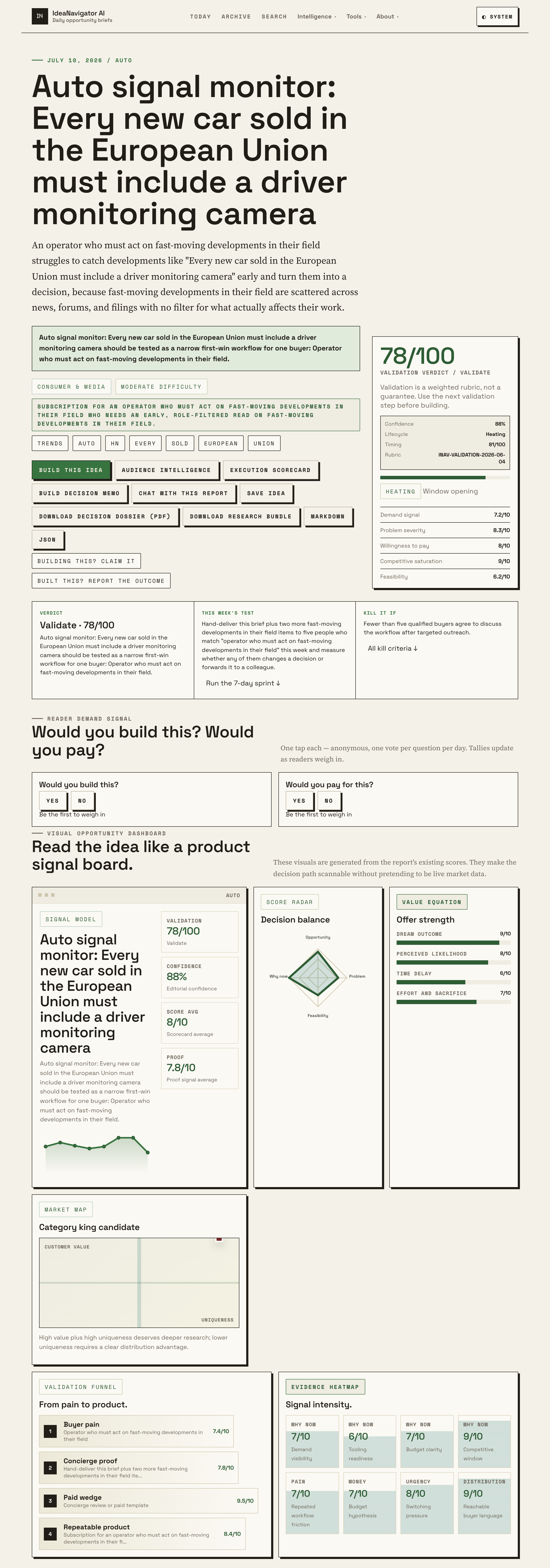
A high-signal development circulating on Hacker News claims every new car sold in the European Union must include a driver monitoring camera. The claim ties into the EU’s General Safety Regulation, which phases in driver drowsiness and attention warning systems, though the camera-specific framing is not fully confirmed by regulators.
A claim that every new car sold in the European Union must include a driver monitoring camera surfaced on Hacker News with a signal strength of 88/100, according to IdeaNavigator AI, which flagged the development for operators tracking fast-moving changes in the automotive sector. The claim aligns with the EU’s broader push toward mandatory vehicle safety technology, but the specific framing — that a camera is required in every new car — deserves scrutiny, because the underlying EU regulation allows manufacturers flexibility in how they meet driver-monitoring requirements.
The development centers on driver monitoring systems (DMS), technology designed to detect drowsiness, distraction, and inattention behind the wheel. These systems typically use either camera-based eye tracking or steering-input analysis to determine whether a driver is paying attention, and they can issue warnings or, in semi-autonomous vehicles, escalate alerts when the driver disengages.
The regulatory backdrop is the EU’s General Safety Regulation, which came into force in 2022 and phases in requirements for driver drowsiness and attention warning in new vehicles. From July 2024, the regulation’s provisions extended to substantially all new car registrations in the EU, and from July 2026, newly type-approved vehicle models face additional safety requirements. What the regulation mandates is the outcome — a functioning drowsiness and attention warning system — rather than a specific piece of hardware such as a camera.
According to IdeaNavigator AI, the Hacker News item was scored as an 88/100 signal, placing it among developments considered likely to affect operators who need to act quickly on changes in their field. The signal-monitoring framing matters here: the claim is circulating widely enough that businesses, fleet managers, and automotive suppliers are treating it as actionable, regardless of the fine print in the regulation itself.
Why Fleet Buyers and Carmakers Are Watching
If driver monitoring cameras become effectively universal in new EU cars, the consequences reach well beyond a single feature on the options list. For carmakers and suppliers, camera-based DMS represents a growing market segment, with suppliers of infrared cameras, eye-tracking software, and processing chips positioned to benefit from volume adoption across every new vehicle sold in the bloc.
For fleet operators and rental companies, the change raises practical questions about driver privacy, data storage, and workplace policy. A camera that watches the driver continuously generates personal data, and under the EU’s GDPR framework, employers and vehicle operators may face obligations around consent, retention, and access to that footage. Privacy advocates have repeatedly raised concerns about in-cabin cameras, and drivers in several EU countries have questioned who can view the recordings and for how long they are stored.
The safety case is the driving force behind the mandate. EU road safety statistics consistently identify driver inattention and fatigue among the leading causes of serious collisions, and regulators view automated warnings as a way to reduce fatalities without depending on driver discipline. Euro NCAP, the European vehicle safety assessment body, has signaled that camera-based monitoring will factor heavily into its future safety ratings, which effectively pushes manufacturers toward the technology even where the letter of the law permits alternatives.
How EU Safety Rules Reached This Point
The EU’s General Safety Regulation (EU) 2019/2144 was adopted in 2019 and began applying to new vehicle types in July 2022. It introduced a package of mandatory safety measures, including intelligent speed assistance, lane-keeping assistance, event data recorders, and driver drowsiness and attention warning. In July 2024, the drowsiness warning requirement extended to virtually all new cars registered in the EU, not just newly approved models.
The regulation’s text requires that vehicles warn the driver when fatigue or reduced attention is detected, but it does not prescribe a camera. Early implementations by several manufacturers used steering pattern analysis to infer drowsiness. However, industry momentum — driven in part by Euro NCAP’s rating roadmap, which calls for direct driver monitoring via cameras in its scoring from the mid-2020s — has pushed the industry toward camera-based systems as the default approach.
Separately, the rise of hands-free driving assistance systems, which are legal in some EU markets under controlled conditions, has made camera-based attention monitoring a practical necessity, because those systems must verify continuously that the driver is watching the road.
What the Regulation Does and Doesn’t Say
The central uncertainty is the word camera. The Hacker News claim states that a driver monitoring camera is mandatory for every new EU car, but the EU’s General Safety Regulation mandates a drowsiness and attention warning system, not a specific sensor type. It is not yet clear from the circulating claim whether it refers to a new regulatory amendment that explicitly requires cameras, or whether it reflects the practical reality that camera-based systems are becoming the de facto standard through a combination of regulation and Euro NCAP rating pressure.
Also unresolved: how driver data captured by these systems will be handled across EU member states, whether footage can be accessed by insurers or police after a collision, and what opt-out rights, if any, drivers will have. The original Hacker News discussion has not produced a citation to a specific new EU legal text, and no European Commission announcement confirming a camera-specific mandate was identified in connection with this signal.
Dates and Decisions Still Ahead
Key milestones to watch include the July 2026 deadline, when additional safety requirements apply to newly type-approved vehicle models under the General Safety Regulation, and the continued rollout of Euro NCAP rating protocols that reward direct camera-based driver monitoring. Carmakers launching new models in Europe will need to demonstrate compliant drowsiness and attention warning systems as part of type approval.
For operators and businesses affected by the change, the near-term steps are practical: fleet procurement teams should verify what monitoring hardware proposed vehicles carry, data protection officers should assess privacy implications for company drivers, and automotive suppliers should track demand for camera and eye-tracking components. Readers should watch for an official European Commission or regulation text confirming whether a camera-specific mandate exists beyond the general drowsiness-warning requirement, as that distinction determines the true scope of the obligation.
Source: IdeaNavigator AI
Key Questions
Does every new car in the EU legally require a driver monitoring camera?
The EU’s General Safety Regulation requires new cars to have a driver drowsiness and attention warning system, which can be implemented with or without a camera. The widely circulated claim that a camera is mandatory reflects the industry’s direction of travel, but the regulatory text does not, on its face, prescribe camera hardware for every vehicle.
When did the driver monitoring requirements take effect?
The requirements began applying to new vehicle types in July 2022 and extended to substantially all new car registrations in the EU from July 2024. Additional requirements for newly type-approved models phase in from July 2026.
What does a driver monitoring camera actually do?
It tracks the driver’s eye movement, gaze direction, and head position to detect drowsiness or distraction, issuing warnings when attention drops. In cars with hands-free driving assistance, it also confirms the driver is watching the road before those systems can operate.
Who can access the footage from these cameras?
That remains one of the most contested points. Under GDPR, in-cabin camera data is personal data, and rules on retention, employer access, and disclosure to insurers or police vary by member state and by manufacturer policy. Clear EU-wide rules on footage access have not been established.
Do these requirements apply to used or imported cars?
The requirements apply to new car registrations and new type approvals in the EU. Vehicles already on the road are not retrofitted, and the treatment of imports depends on when the vehicle was first registered and its type-approval status.
Source: IdeaNavigator AI
Halloween Picks
halloween
As an affiliate, we earn on qualifying purchases.