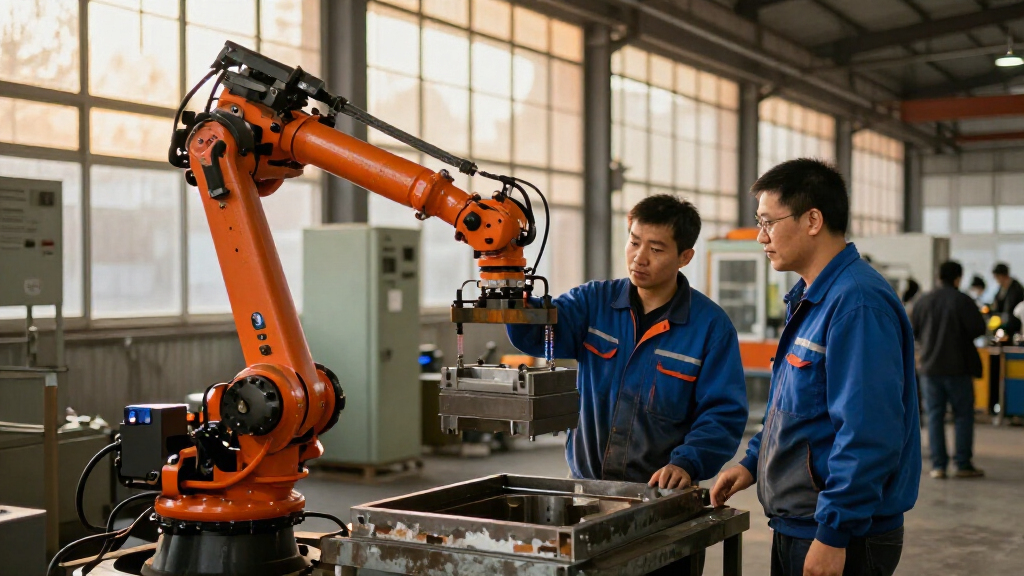

🔍 Read the full analysis: How AI Robots Are Changing Work In The Factory on ThorstenMeyerAI.com

Get movie nights delivered free with Prime
- Fast, free delivery on millions of items
- Prime Video, Amazon Music and more included
- Member-only deals all year
TL;DR
The International Federation of Robotics reported 5 million industrial robots operating worldwide in 2025, with China accounting for 59% of new installations. Research on employment finds robots can displace workers in some settings, while effects differ across countries and sectors; the supplied source does not include the full evidence or study details needed to settle the overall impact.
Industrial robots reached 5 million in factories worldwide in 2025, according to the International Federation of Robotics, as manufacturers continued automating tasks such as handling hot metal and welding. A report published by ThorstenMeyerAI.com on November 24, 2026, draws on that count and employment research to argue that robots’ effects on jobs differ by country and sector, rather than producing one uniform outcome.
The IFR’s World Robotics report, released on September 24, 2026, counted 5 million industrial robots in operation in 2025, 9% more than in 2024 and more than double the total seven years earlier. Factories installed more than 600,000 robots during 2025. China accounted for 354,000 installations, or 59% of the global total, the source article reports.
The installations were concentrated in a small group of major manufacturing markets. The United States added almost 38,500 robots, up 12%, while Japan installed 36,219, down 19%. South Korea installed 30,000, and Germany fewer than 25,000, down 8%, according to the figures cited in the report. These annual installation totals measure new equipment, not the total number of robots already operating in each country.
The article also cites IFR robot-density figures for 2024, published April 8, 2026. South Korea had 1,220 industrial robots per 10,000 manufacturing employees, ahead of Singapore at 818, Germany at 449, Japan at 446 and the United States at 307. The world average was 132. The source presents these measures alongside research on employment, but the supplied material ends before setting out the full study findings and methods.
Infographic 01 · Five million robots
Where the robots work
Sixty-five years after the first Unimate, five million industrial robots work in the world's factories. South Korea has by far the most per worker.
Robots per 10,000 employees in manufacturing · 2024
Where the new robots went · 2025
- China: 354,000 installed, 59% of the world total.
- United States: almost 38,500 (+12%), again the second-largest market.
- Japan 36,219 (−19%) · South Korea 30,000 · Germany fewer than 25,000 (−8%), Europe’s largest market.
Robot density = operational industrial robots per 10,000 employees in manufacturing. China (166 in 2024) is not compared here: the IFR switched to updated Chinese labour data in 2026, which changed the denominator.
Sources: IFR, robot density press release, 8 Apr 2026 (data 2024); IFR, World Robotics 2026 press release, 24 Sep 2026.
Powered by Thorsten Meyer AI
Automation’s Uneven Employment Effects
Robot counts show how quickly automation is spreading, but they do not by themselves show how many workers have lost jobs, found different work or benefited from higher production. Installation totals and employment outcomes are separate measures. The source article says that a widely cited study by economists Daron Acemoglu and Pascual Restrepo estimated that, from 1990 to 2007, each additional industrial robot displaced about 3.3 workers across the US economy, with an estimated total of about 400,000 jobs. Those figures are estimates from a defined period, not a count of current job losses.
The report contrasts that US estimate with Germany, saying that the country lost almost two factory jobs per new robot while gaining about as many jobs in services, leaving the total employment effect at about zero. Because the supplied source does not provide the underlying research details for this comparison, it should be read as the article’s account rather than a complete assessment of the evidence. The distinction matters: factory jobs can decline even when wider employment changes little, and workers who never enter an automated factory role may experience the shift differently from those already employed there.
For workers, manufacturers and policymakers, the question is not only how many machines are installed. It is also which tasks are automated, where new work appears and who can move into it. The figures provided do not establish whether the 2025 increase has caused a particular level of job loss or hiring.
Popular right now

Dyson V8 Cordless Vacuum

Vitamix 5200 Blender with 64 oz. Container, Black

Sony 65 Inch BRAVIA 5 Mini LED 4K HDR Smart Google TV (K-65XR50)
As an affiliate, we earn on qualifying purchases.
From Die-Casting to Robot Density
The first industrial robot in the account was designed for a hazardous, repetitive task. Inventor George C. Devol filed a patent in 1954 for a programmed machine that could transfer articles. With entrepreneur Joseph Engelberger, he founded Unimation, and the company’s Unimate began working at a General Motors plant in Trenton, New Jersey, in 1961, unloading a die-casting press. The IFR and The Henry Ford museum identify the site as GM’s Ternstedt plant; the museum holds the robot.
Robots later moved into welding. GM installed Unimate spot-welding robots at its Lordstown, Ohio, plant in 1969. The IFR says this allowed more than 90% of body welding there to be automated, compared with 20% to 40% at traditional plants. In Japan, Kawasaki licensed Unimation technology in 1968 and completed its first Kawasaki-Unimate 2000 in 1969. The company’s history describes demand for robots amid a shortage of workers for hard, dirty and dangerous jobs.
This history helps explain why early industrial robots were used for specific factory tasks, rather than replacing every role at once. Today’s IFR figures measure an expanding stock of industrial machines and new installations. They do not indicate that all robots use artificial intelligence: the source describes industrial automation broadly and gives no breakdown of installations by AI capability.
““More robots mean fewer jobs” is partly true.”
— Thorsten Meyer, ThorstenMeyerAI.com
What the Robot Counts Cannot Show
The IFR figures establish how many industrial robots were operating or newly installed under the report’s definitions. They do not show how many jobs were lost or created in 2025, which occupations were affected, or how many machines used AI rather than other forms of automation. The source article’s employment discussion is also incomplete in the supplied material: it names the Acemoglu-Restrepo study and gives headline estimates, but does not include the full explanation of methods, qualifications or other findings.
The Germany comparison likewise appears without enough detail here to assess its period, data or assumptions. The numbers should not be treated as a direct forecast for current workers. It remains unclear from the provided information how much of the recent robot growth has changed staffing, wages, working conditions or the creation of other jobs.
Further Evidence on Factory Jobs
The next step is to compare future IFR installation and operating-stock data with employment figures by industry and occupation. That would help distinguish the spread of machines from their effects on hiring and job displacement. The source material does not identify a forthcoming study, policy decision or company announcement, so no specific next milestone is confirmed.
Readers should also look for evidence that separates conventional industrial robots from systems described as AI-enabled, since the figures cited here do not make that distinction. Until more detailed data are available, the confirmed development is the continued growth of factory robotics; its precise employment consequences remain uncertain.
Key Questions
How many industrial robots were operating in factories in 2025?
The International Federation of Robotics counted 5 million industrial robots in operation worldwide in 2025, up 9% from 2024.
Which country installed the most robots in 2025?
China installed 354,000, or 59% of the more than 600,000 industrial robots installed worldwide that year, according to figures cited in the report.
Do the figures prove that robots are taking factory jobs?
No. Installation and robot-density figures count machines, not job losses. The source cites research estimating displacement in the United States during 1990–2007, but the supplied material does not provide enough detail to apply that estimate to current employment.
Are all the robots counted AI robots?
The report provides totals for industrial robots and does not give a breakdown by AI capability. The figures should not be interpreted as a count of AI-equipped machines alone.
Source: ThorstenMeyerAI.com