
📊 Full opportunity report: How To Grade Your Financial Advisor After An Inheritance on IdeaNavigator AI — validation score, market gap, and execution plan.

Get movie nights delivered free with Prime
- Fast, free delivery on millions of items
- Prime Video, Amazon Music and more included
- Member-only deals all year
TL;DR
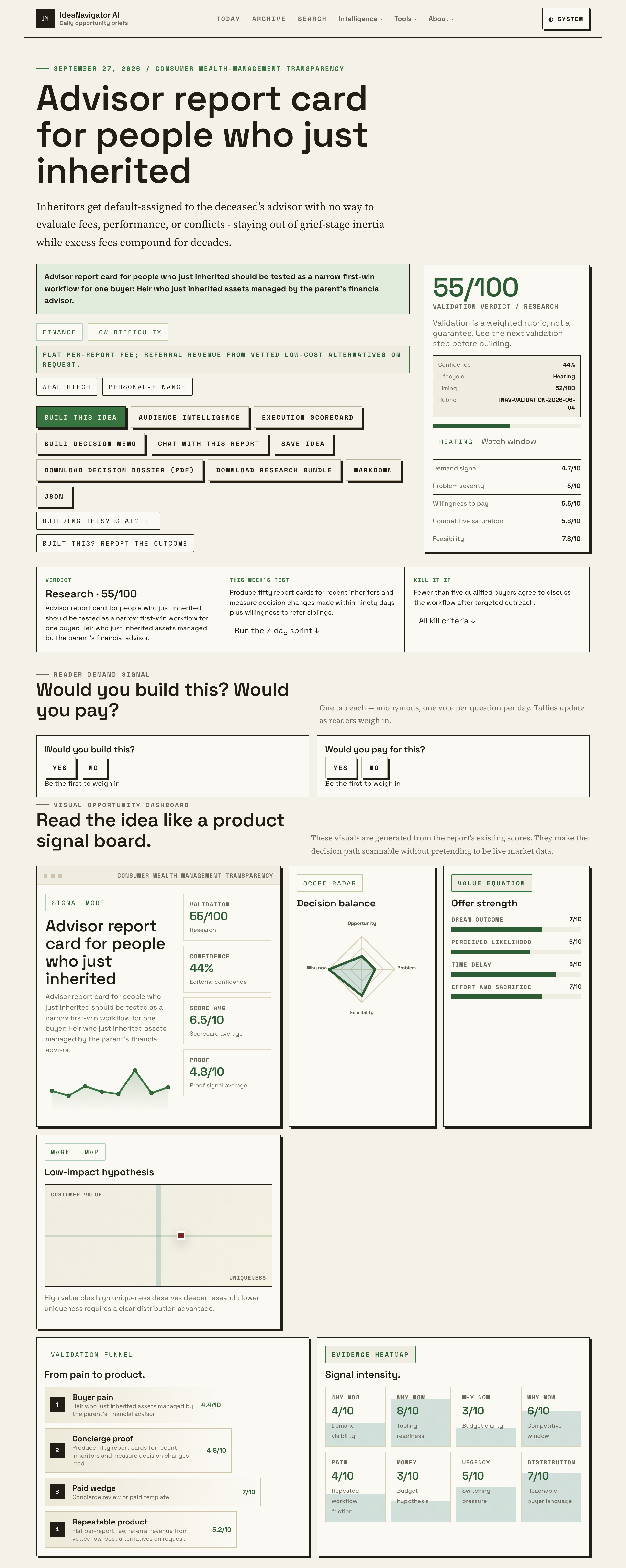
IdeaNavigator AI has outlined a proposed report card for people who inherit assets managed by a parent’s financial advisor. The concept would analyze statements and public disclosures, then offer options for staying, negotiating or switching; no product launch or validation results are reported.
IdeaNavigator AI has proposed a report card to help people who inherit assets managed by a parent’s financial advisor evaluate that relationship. The suggested tool would review fees, regulatory records and disclosed conflicts, then present stay, negotiate or switch options; the proposal does not report that a product has launched or been tested.
The concept targets a specific situation: an heir receives assets already managed by the deceased parent’s advisor and must decide whether to keep that arrangement. IdeaNavigator AI describes a possible problem in such cases: a beneficiary may remain with the existing advisor without comparing costs, performance or potential conflicts. The proposal presents that as a risk to investigate, not as a finding about all inheritors or advisors.
For an initial version, a user would enter an advisor’s name and upload account statements. The proposed service would gather regulatory history and disclosed conflicts, use document parsing to estimate the account’s all-in fees, and compare those fees with alternatives. It would then offer decision guidance and scripts for conversations with the advisor. The description does not specify which performance measures, comparison providers or fee assumptions the report would use.
The suggested business model combines a flat fee per report with possible referral revenue if a user requests vetted, lower-cost alternatives. That arrangement would make clear disclosures about compensation important to how readers assess the recommendations. IdeaNavigator AI proposes producing 50 reports for recent inheritors and tracking whether decisions change within 90 days, as well as whether users refer siblings. No completed pilot, customer findings or pricing are included in the proposal.
Testing Advice After an Inheritance
An inheritance can bring a financial decision at a difficult time: whether to continue working with the advisor who already manages the assets. A structured review could give heirs a clearer starting point for asking about charges, services and potential conflicts. The proposal’s relevance is practical, but its value remains unproven until users can see whether its analysis is accurate and useful.
The fee review is central to the idea because recurring charges reduce the amount left invested. But a report would need to show its calculations and explain what each fee covers. Comparing one account with alternatives also requires care: investment mix, services, taxes and account restrictions may differ. A lower stated fee alone would not establish that changing advisors is the right choice for a particular heir.
Referral revenue could create another consideration. If the service earns money when users move assets to a recommended provider, readers would need to know how those providers are selected and whether compensation affects their placement. The proposal mentions vetted alternatives and referrals on request, but gives no details about safeguards or how recommendations would be separated from revenue.
From Wealth Transfer to Pilot
IdeaNavigator AI frames the opportunity against what it calls a decade of substantial wealth moving to heirs, describing the total as trillions. The proposal supplies no timeframe beyond that decade, underlying estimate or geographic scope, so the figure should be understood as the concept’s stated rationale rather than a quantified forecast established here.
The suggested inputs are public regulatory filings and fee disclosures, alongside statements supplied by users. The idea is that document-parsing software could help translate those materials into an account-level review. The proposal does not identify a particular technology, explain how data would be protected, or describe how the report would handle incomplete or outdated records.
The proposed 50-report pilot would test whether recent inheritors act on the findings within 90 days and whether they recommend the service to siblings. Those measures could indicate whether the workflow changes decisions and earns referrals, but the outline gives no recruitment plan, definition of a decision change, or method for checking whether a user’s choice improved their financial outcome.
Evidence and Safeguards Still Missing
No launch, pilot results or user data are reported. It is also unclear who would review the analysis, how the service would verify its fee calculations, and what sources it would use to assess an advisor’s regulatory history and conflicts. Those details matter because a mistaken conclusion could affect decisions about substantial assets.
The concept does not explain how the tool would account for differences in investment strategy, taxes, account type, service needs or transfer restrictions. Nor does it state whether it would provide general information or personalized financial recommendations. Its proposed referral model raises questions about provider vetting, compensation disclosure and how users could compare options without using a referred firm.
Privacy and security procedures are not described, despite the plan to accept financial statements. The proposal also offers no pricing, launch timing or evidence that the intended users want this service. These points remain open rather than settled by the outline.
The Proposed 50-Report Test
The next step described by IdeaNavigator AI is to produce 50 report cards for recent inheritors. The team would track decisions made within 90 days and whether users refer siblings. No schedule or completed results have been announced, so it is not yet clear when that test might begin or whether the proposed service will proceed. Any eventual report would need to make its fee methodology, data sources and referral compensation clear to users.
Source: IdeaNavigator AI
Key Questions
Has the advisor report card launched?
No launch is reported. IdeaNavigator AI describes a proposed product and a possible pilot, without giving a launch date.
Who is the proposed service for?
It is aimed at an heir who has inherited assets managed by a parent’s financial advisor and wants to review the relationship.
What would a report examine?
The proposed report would use an advisor’s name and uploaded statements to review fees, regulatory history and disclosed conflicts, then present options for staying, negotiating or switching.
How would the service make money?
The outline proposes a flat fee for each report and possible referral revenue when users request lower-cost alternatives. It does not specify prices or how referral compensation would be disclosed.
What evidence is available about whether it works?
No pilot findings are provided. The proposed evaluation would cover 50 reports and track decision changes within 90 days, along with referrals to siblings.
Source: IdeaNavigator AI
Fall Picks
fall essentials
As an affiliate, we earn on qualifying purchases.