🔍 Read the full analysis: Inside Room 155 Of 175: How “Luciole — The Synchronous Fireflies Of Vallon Creux” Took Shape on ThorstenMeyerAI.com

Get movie nights delivered free with Prime
- Fast, free delivery on millions of items
- Prime Video, Amazon Music and more included
- Member-only deals all year
TL;DR
Room 155, “Luciole — The Synchronous Fireflies of Vallon Creux,” is an AI-built interactive exhibit featuring 96 simulated fireflies. Visitors can watch their flashes synchronize, disturb the pattern and observe it recover; the setting and fireflies are fictional, while the simulation draws on the Kuramoto synchronization model.
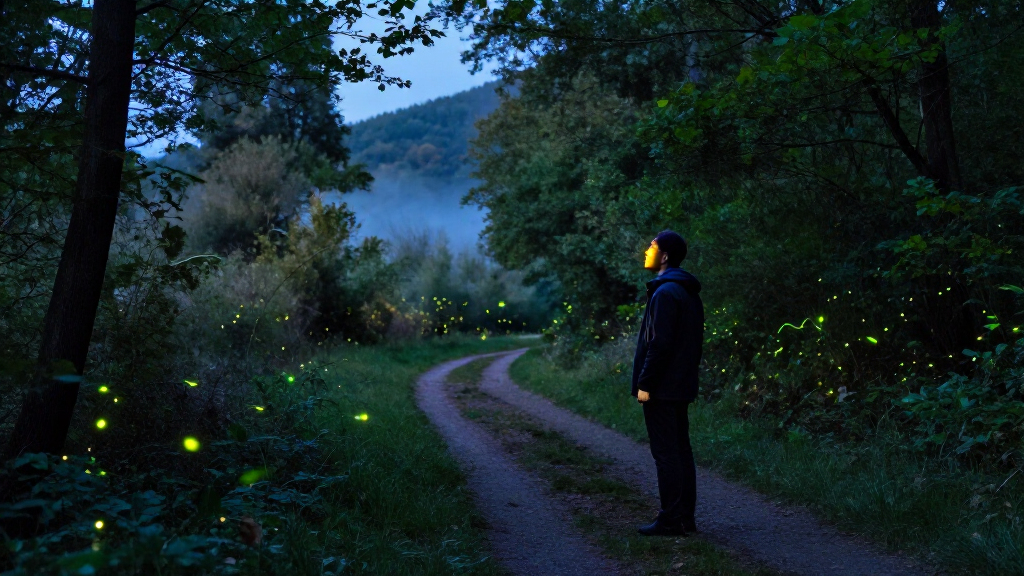
Room 155 of the FABLE/175 exhibition presents “Luciole — The Synchronous Fireflies of Vallon Creux,” an AI-built web exhibit where visitors can watch 96 simulated fireflies fall into a shared flashing rhythm, disrupt that pattern and see the simulation move back toward coherence, as described in the original project account. The fireflies, Vallon Creux and the field notebook are fictional; the interactive model is based on the Kuramoto synchronization model.
The exhibit represents each firefly as an oscillator with an individual phase and tempo. Each one is influenced by the signals of nearby oscillators, while retaining its own rhythm. A control changes how strongly the simulated fireflies affect one another. The page also displays a live coherence measure, a trace of changes in that measure and a phase diagram drawn from the simulation.
Visitors can use pointer interaction to scatter the fireflies’ phases and interrupt their apparent coordination. The same local rules continue to operate, allowing visitors to observe whether and how the pattern regains coherence. The exhibit’s central idea is not simply to show a synchronized animation, but to let visitors watch a pattern develop and respond to disturbance.
According to the supplied project description, the site’s visuals are made with HTML, CSS, SVG and canvas, rather than downloaded images or a prerecorded firefly sequence. The description also says the page pauses the simulation when relevant views are offscreen or the tab is hidden, and offers a reduced-motion presentation, focus styling and a compact mobile field map.
FABLE / 175 · Room 155
Inside Room 155 of 175: How Luciole Took Shape
Luciole — The Synchronous Fireflies of Vallon Creux is an AI-built interactive exhibit. Watch 96 simulated fireflies move toward a shared rhythm, disturb their pattern, and see how it recovers.
01 / How to watch
Order, interruption, recovery
The exhibit makes a changing pattern visible through the animation, a live coherence reading, its trace, and a phase diagram.
Watch the rhythm
Each firefly is modeled as an oscillator with its own phase and tempo. Nearby oscillators influence one another.
Change the coupling
A control changes how strongly the simulated fireflies respond to their neighbors, affecting how their flashes align.
Perturb and observe
Pointer interaction scatters phases. The same local rules keep running, so visitors can watch coherence shift and potentially return.
02 / The model
A fictional field, a named model
Luciole, Vallon Creux, and the naturalist’s field notebook are fictional. The exhibit is not a real company, place, or field study, and it does not report observations of real fireflies.
Its simulation is based on the Kuramoto synchronization model, a mathematical framework for studying coupled oscillators. Each simulated firefly keeps an individual rhythm while responding to nearby signals.
The project account describes the site’s visuals as made with HTML, CSS, SVG, and canvas rather than downloaded images or a prerecorded sequence.
The graphic is an explanatory illustration, not a live readout from the site.
03 / Project record
How the room took shape
The project description presents an AI-led making process and a science-inspired interactive artwork.
Initial build
The account describes a first implementation followed by self-critique.
External critique
A review pass was intended to identify and fix at least ten problems.
Art direction
A final pass focused on the exhibit’s visual direction. The supplied material does not independently document the finished implementation or review outcomes.
“CLICK anywhere to perturb — inject chaos and watch order re-emerge.”
Art-direction brief reproduced in the project material
“Luciole and Vallon Creux are fictional, created for the exhibit.”
Room 155 project description
“Not a real company, place, or field study.”
Project framing
04 / What remains open
Limits of the project record
The supplied description explains the intended experience, but leaves several details unconfirmed.
Unreported
No launch date, visitor figures, independent evaluation, or forthcoming milestone is provided.
Firefly count
The room overview says 96 simulated fireflies; the reproduced brief asks for “hundreds.” The material does not explain the difference or confirm the live count.
Testing
Reduced-motion support, focus styling, pausing offscreen or when hidden, and a compact mobile map are described, but no independent test results are supplied.
Implementation evidence
The description names intended controls and technologies, but provides no source code, independent technical review, or measured performance results.
05 / Trace the experience
06 / Key questions
Room 155, explained
What is Room 155?
An interactive web exhibit in FABLE/175 titled Luciole — The Synchronous Fireflies of Vallon Creux.
Are the fireflies and Vallon Creux real?
No. The project description identifies them as fictional and says the exhibit is not a real field study.
How does the simulation work?
Each of 96 described simulated fireflies has its own phase and tempo. Nearby oscillators influence one another, while a coherence measure tracks alignment.
Can visitors change the simulation?
The description says visitors can adjust coupling and use pointer interaction to scatter phases, after which the simulation continues under the same rules.
Has accessibility and performance been verified?
The source describes accessibility and efficiency features, but provides no independent test results. Those claims remain unverified in the supplied material.
Where can visitors find the live room?
Visit the Room 155 exhibit and inspect its footer for the project prompt link.
Watching Order Form and Recover
Room 155 turns an abstract idea—how separate agents can become coordinated through local interactions—into something visitors can observe and alter. The controls connect the model to visible consequences: changing coupling affects how strongly the fireflies respond to neighbors, while pointer input introduces a disturbance. The displayed coherence reading and trace give visitors a way to follow those changes rather than relying only on the animation.
The piece also makes its production method part of the exhibit. The supplied description identifies the site as AI-built and says the underlying creative brief is available through a “Prompt” link in the footer. That makes Room 155 both an interactive science-inspired artwork and a record of an AI-led web-making process. Its value depends on the experience and the accuracy of its explanation; it is not presented as a report of real firefly observations.
interactive firefly simulation toy
As an affiliate, we earn on qualifying purchases.
As an affiliate, we earn on qualifying purchases.
A Fictional Field, A Named Model
The project labels Luciole and Vallon Creux as fictional, not as a real company, location or field study. The naturalist’s notebook style, invented setting and firefly details provide the exhibit’s framing. The supplied material says the simulation uses the Kuramoto model, a mathematical framework for studying synchronization among coupled oscillators.
The exhibit is listed as Room 155 of 175 in the FABLE/175 pipeline. Its project description says the site was built in three passes: an initial build and self-critique, an external critique intended to identify and fix at least ten problems, and a final art-direction pass. The brief called for a self-contained site without frameworks or external requests, but the supplied material does not independently document the finished site’s technical implementation or the results of those review passes.
““Its signature move is to make patience visible.””
— Room 155 project description
synchronization model educational kit
As an affiliate, we earn on qualifying purchases.
As an affiliate, we earn on qualifying purchases.
What the Project Record Leaves Open
The supplied material does not give a launch date, visitor figures, independent evaluation or evidence that the finished site was tested at the requested screen widths and performance targets. It describes 96 simulated fireflies in the room overview, while the reproduced art-direction brief asks for “hundreds”; the information provided does not explain that difference or confirm which count appears in the live build.
The material describes the simulation and its intended controls, but does not provide source code, independent technical review or measured performance results. The exhibit should be understood as an interactive model, not evidence that real fireflies at a real Vallon Creux synchronize in this way. The project’s stated accessibility and efficiency features are descriptions from the source, not independently verified findings.
As an affiliate, we earn on qualifying purchases.
The Live Room and Its Prompt
Visitors can open the live Room 155 site at fable-25-830.netlify.app/sites/luciole/ to experience the simulation and inspect the project’s prompt link in the footer. The supplied material does not identify a forthcoming update, publication date or next milestone for the room. Any further claims about its implementation, accessibility testing or reception would need additional information from the project team or independent testing.
As an affiliate, we earn on qualifying purchases.
Key Questions
What is Room 155?
Room 155 is an interactive web exhibit in the FABLE/175 project. Its title is “Luciole — The Synchronous Fireflies of Vallon Creux.”
Are the fireflies and Vallon Creux real?
No. The source material says the fireflies and Vallon Creux are fictional and that the exhibit is not a real field study.
How does the firefly simulation work?
Each of the 96 simulated fireflies is represented as an oscillator with its own phase and tempo. Nearby oscillators influence one another, and the exhibit displays a coherence measure as their flashes become more or less aligned.
Can visitors change the simulation?
Yes. The project description says visitors can adjust the strength of coupling and use pointer interaction to scatter phases, disrupting the pattern. The simulation then continues under the same rules.
Has the site’s performance and accessibility been independently verified?
The source describes features such as reduced-motion support, focus styling and pausing when the page is hidden, but provides no independent test results. Those implementation claims remain unverified in the supplied material.
Source: ThorstenMeyerAI.com
Evergreen bestsellers Picks
bestsellers
As an affiliate, we earn on qualifying purchases.