
📊 Full opportunity report: Retirement Care Planner on IdeaNavigator AI — validation score, market gap, and execution plan.

Get movie nights delivered free with Prime
- Fast, free delivery on millions of items
- Prime Video, Amazon Music and more included
- Member-only deals all year
TL;DR
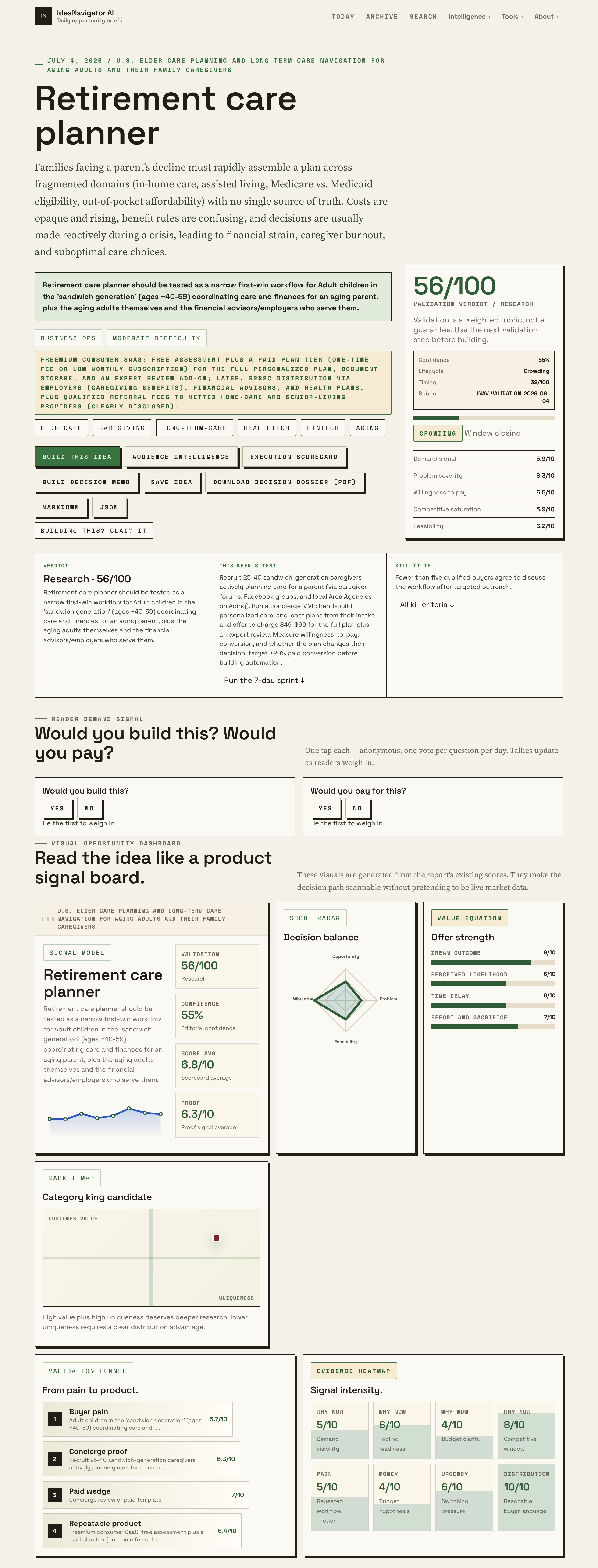
A prototype retirement care planner is being tested to assist adult children in the ‘sandwich generation’ with coordinating care and finances for aging parents. It offers personalized plans based on local data, aiming to reduce reactive decisions and financial strain.
A new web-based retirement care planner is currently being tested to help middle-aged adult children coordinate care and finances for aging parents. The tool aims to address the widespread challenge of fragmented decision-making, rising costs, and lack of clear guidance, offering a personalized plan based on local data and family circumstances.
The proposed care planning web app begins with a brief intake covering the parent’s health, location, and financial situation. It then generates a personalized care and cost plan, including comparisons of local options such as in-home care, assisted living, and nursing homes, along with explanations of Medicare and Medicaid eligibility. The app also provides affordability projections and a prioritized action checklist with vetted provider links. Currently, the testing phase involves recruiting 25-40 caregivers actively planning for a parent, offering a concierge version of the service for a fee of $49-$99 to assess willingness-to-pay and impact on decision-making.
Developers aim to validate whether users find the detailed plans useful enough to pay, with a target of over 20% paid conversion before automating the process. The initial focus is on a single high-cost state to manage data complexity, with future plans to expand nationally. Revenue models include freemium subscriptions, expert reviews, and referral fees from vetted providers, along with potential B2B distribution through employers and financial advisors.
Why a Retirement Care Planner Matters Now
This initiative addresses a critical gap in the elder care market, where families face rising costs, confusing benefit rules, and fragmented care options. As the U.S. population ages—with projections that nearly 73 million Americans will be 65+ by 2030—more middle-aged caregivers are under financial and emotional strain. A structured, data-driven planning tool could reduce reactive decisions, alleviate caregiver burnout, and improve care quality. The success of this pilot could lead to broader adoption, transforming how families approach long-term care planning and potentially lowering overall costs and stress.
in-home care assistance for seniors
As an affiliate, we earn on qualifying purchases.
As an affiliate, we earn on qualifying purchases.
Growing Demand for Structured Care Planning Solutions
The U.S. is experiencing a demographic shift toward an older population, with long-term care costs rising sharply in recent years. Assisted living median costs have reached approximately $6,200 per month, and nursing home expenses average around $115,000 annually. Meanwhile, the ‘sandwich generation’—adults aged 40-59—are increasingly responsible for managing care and finances for their aging parents, often with limited resources and fragmented information. Existing solutions are mostly reactive, often leading to costly crises and suboptimal decisions. This new effort builds on the recognition that proactive, personalized planning can mitigate these challenges and improve outcomes for families and providers alike.
“Families need accessible, data-driven tools to navigate the complex landscape of elder care options.”
— an anonymous researcher
As an affiliate, we earn on qualifying purchases.
Uncertainties in Adoption and Effectiveness
It remains unclear how widely the prototype will be adopted once testing concludes, and whether users will find the plans sufficiently actionable and accurate to influence decisions. The long-term impact on care quality and costs has yet to be measured, and there could be variations in local data availability or provider participation that affect the tool’s effectiveness.
As an affiliate, we earn on qualifying purchases.
Next Steps for Validation and Expansion
The development team plans to complete initial testing with the recruited caregiver group, analyze willingness-to-pay and decision impacts, and refine the platform accordingly. If results are positive, they aim to automate the process, expand data coverage nationally, and explore partnerships with employers, financial advisors, and elder care providers. Further research will focus on measuring actual improvements in care outcomes and cost savings over time.
As an affiliate, we earn on qualifying purchases.
Key Questions
How will the retirement care planner generate personalized plans?
The app will use intake data about the parent’s health, location, and finances to produce tailored cost comparisons, eligibility explanations, and action checklists based on local public data and vetted provider information.
Who is funding or developing this retirement care planner?
The project is being developed by a team of researchers and entrepreneurs aiming to pilot the tool with real users before broader rollout, with initial testing funded through a small fee-based service model.
When will the full version of the planner be available to the public?
It is not yet clear when the fully automated, widely accessible version will launch, as the current phase focuses on validation and refinement based on initial user feedback.
Will the tool be accessible to families in all states?
Initially, the pilot will focus on a single high-cost state to manage data complexity, but plans include expanding coverage nationally once validated.
How does this differ from existing elder care resources?
Unlike fragmented resources or reactive decision-making, this tool aims to provide a comprehensive, personalized plan based on local data, designed specifically for middle-aged caregivers managing multiple domains of care.
Source: IdeaNavigator AI
Evergreen bestsellers Picks
bestsellers
As an affiliate, we earn on qualifying purchases.