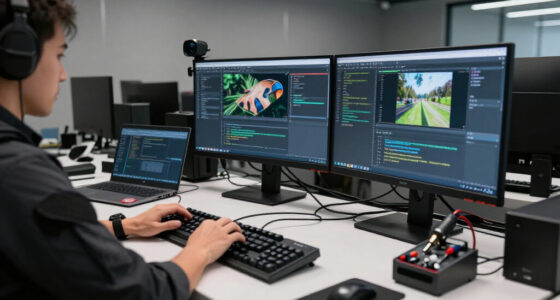

🔍 Read the full analysis: SenseTime Scientist Predicts Multimodal AI Breakthrough Within Two Years on ThorstenMeyerAI.com

Get movie nights delivered free with Prime
- Fast, free delivery on millions of items
- Prime Video, Amazon Music and more included
- Member-only deals all year
TL;DR
A senior scientist at Chinese AI firm SenseTime predicts a significant multimodal AI breakthrough by 2027. The statement, reported by KrASIA, signals accelerated AI development but remains unconfirmed by specific technical milestones.
A senior researcher at SenseTime, one of China’s leading AI companies, has predicted that a major breakthrough in multimodal AI could happen within two years. The forecast, reported by KrASIA, suggests that systems capable of understanding and reasoning across text, images, and audio with human-like flexibility may be achievable by 2027 as detailed in the original analysis. This prediction underscores the rapid pace of AI development and signals potential shifts in the industry’s trajectory.
The prediction was made by an unnamed scientist at SenseTime, a company that has shifted focus from computer vision to foundation and multimodal models in recent years. While no specific technical milestones, research results, or product timelines were provided, the forecast aligns with ongoing industry efforts to develop multimodal AI systems that seamlessly integrate multiple data modalities.
Currently, leading models can process multiple input types—such as images and text—but are largely composed of separate components stitched together rather than fully integrated systems. A true breakthrough would mean models that can reason across sight, sound, and language with human-like understanding, representing a significant step in AI development.
SenseTime has positioned multimodal AI as a strategic focus, especially after facing US sanctions that limited its access to American technology. The company’s recent investments in foundation models, such as its SenseNova series, aim to advance this goal. The prediction comes amid a global race among tech giants like OpenAI, Google, Alibaba, and Baidu to develop more capable multimodal systems.
Implications of the Predicted AI Advancement
If the forecast proves accurate, a major leap in multimodal AI could dramatically impact various sectors, including robotics, autonomous vehicles, healthcare imaging, and human-computer interaction. Systems with genuine cross-modal understanding could facilitate more natural and effective interfaces, enabling machines to interpret complex sensory data with human-like reasoning.
This acceleration could also influence industry investments, regulatory planning, and workforce development, as organizations prepare for the deployment of more advanced AI systems by 2027. The forecast underscores a shift toward models that integrate perception and language, potentially redefining the boundaries of artificial intelligence capabilities.
As an affiliate, we earn on qualifying purchases.
Industry Push Toward Multimodal AI
Over recent years, the AI industry has seen increasing focus on multimodal models that combine visual, auditory, and linguistic data. Leading companies like OpenAI, Google, and Chinese firms such as Alibaba and Baidu have released models capable of processing multiple data types. However, most current systems still rely on separate modules that are loosely connected, rather than unified architectures with genuine cross-modal reasoning.
SenseTime, founded in 2014 and initially known for computer vision applications like facial recognition, has transitioned toward foundation models emphasizing multimodality. The company’s strategic shift reflects broader industry trends, where integrating perception and language is viewed as the next frontier for artificial intelligence. The recent prediction by the SenseTime scientist aligns with this broader push and highlights the perceived rapid pace of progress in the field.
“A SenseTime scientist predicts that a significant breakthrough in multimodal AI could arrive within two years.”
— KrASIA report
As an affiliate, we earn on qualifying purchases.
Unconfirmed Aspects of the Prediction
The identity and role of the SenseTime scientist remain undisclosed, and the specific context of the statement—whether from a conference, interview, or internal communication—is unknown. No concrete benchmarks, technical results, or product release dates were provided to substantiate the forecast.
It is also unclear whether this prediction reflects internal research milestones, a broader industry trend, or a personal estimate. Given the history of optimistic forecasts in AI, caution is warranted until more detailed technical developments or official announcements are made.
audio visual text processing software
As an affiliate, we earn on qualifying purchases.
As an affiliate, we earn on qualifying purchases.
Monitoring Progress Towards the 2027 Milestone
Over the next two years, developments to watch include the release of new versions of SenseTime’s SenseNova models and their performance on multimodal benchmarks. Observing comparable advancements from OpenAI, Google, Alibaba, and Baidu will also be critical. Additionally, published research on unified architectures that move beyond stitched-together components will help gauge the likelihood of a true breakthrough.
Any formal announcement from SenseTime—such as a product launch, research paper, or earnings call—would significantly clarify the timeline and technical scope of their progress towards this predicted milestone.
As an affiliate, we earn on qualifying purchases.
Key Questions
What exactly is a multimodal AI breakthrough?
A multimodal AI breakthrough would involve developing systems that can understand, reason, and communicate across multiple data types—such as text, images, and audio—with human-like flexibility and coherence.
How credible is the prediction from SenseTime?
The prediction is based on an unnamed scientist’s forecast reported by KrASIA. While SenseTime has a strong research focus on multimodal models, no specific technical results or official statements support the forecast, so its credibility should be viewed cautiously.
Why does this timeline matter for industry and policy?
If a true multimodal AI system capable of human-like understanding emerges by 2027, it could reshape industries, influence regulatory frameworks, and accelerate AI deployment across sectors. Planning for such a development is already underway in some organizations.
What are the risks of overestimating this forecast?
Overestimating the pace of AI progress can lead to misaligned expectations, premature deployment of untested systems, and regulatory challenges. AI development often encounters unforeseen technical hurdles, so caution is essential.
What should we watch for to confirm this prediction?
Key indicators include the release of new SenseTime models, their performance on multimodal benchmarks, and published research on integrated architectures from major AI labs. Official announcements will provide the clearest confirmation.
Source: ThorstenMeyerAI.com
Evergreen bestsellers Picks
bestsellers
As an affiliate, we earn on qualifying purchases.