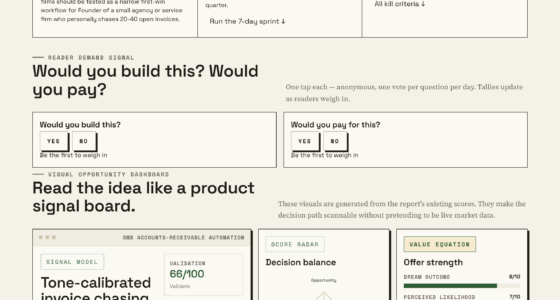

📊 Full opportunity report: Week Three — Foundation model vs Brownian motion. Kronos on five-minute BTC. on ThorstenMeyerAI.com — validation score, market gap, and execution plan.
Listen free for 30 days with Audible
Thousands of audiobooks and originals — cancel anytime.
Start your free trialAs an affiliate, we earn on qualifying purchases.
TL;DR
A recent test compared Kronos, a foundation model, to the traditional Brownian motion model for 5-minute Bitcoin price predictions. The results show Kronos does not outperform Brownian in out-of-sample tests, challenging assumptions about modern models’ advantages in short-term crypto forecasting.
Recent testing shows that Kronos, an open-source foundation model for financial time series, does not outperform the traditional Brownian motion model in predicting 5-minute Bitcoin price movements, according to a detailed analysis by Thorsten Meyer.
Over two weeks, a series of 497 trades on Polymarket’s 5-minute BTC markets were analyzed using a custom Python tool. The goal was to compare the predictive accuracy of Kronos-small, a foundation model trained on global exchange data, against the geometric Brownian motion baseline, which has been a standard approximation for market behavior since the early 1900s. The analysis measured model performance through Brier scores, log-loss, and hypothetical profit/loss if each model’s predicted probabilities had been used to decide trades.
The results showed that the Brownian motion model slightly outperformed Kronos on the full sample, with Brier scores of 0.193 versus 0.213. On the out-of-sample half, the difference was statistically insignificant, with scores of 0.188 for Brownian and 0.189 for Kronos. This indicates that, despite its modern architecture and training on extensive data, Kronos does not provide a measurable edge over the classical Brownian model in this specific short-term prediction task.
Implications for AI-Based Market Prediction
This finding challenges the assumption that large, learned models automatically outperform traditional mathematical approximations in short-term financial forecasting. It suggests that, at least for 5-minute Bitcoin price predictions, the classical Brownian motion remains competitive, and that current AI models may not yet provide a practical advantage in this domain. For traders and developers, this underscores the importance of rigorous out-of-sample testing before deploying complex models in live trading systems.
As an affiliate, we earn on qualifying purchases.
Background on Model Testing and Market Predictions
For the past two weeks, Thorsten Meyer has been running Polybot, an open-source trading bot that simulates trades based on different probabilistic models, against Polymarket’s 5-minute BTC markets. The bot’s baseline uses a geometric Brownian motion model, a standard assumption in financial mathematics, which estimates the probability of BTC closing above its open price within five minutes. Meyer questioned whether a modern foundation model like Kronos, trained on millions of candlestick data points from global exchanges, could outperform this traditional approach. The test was designed to be rigorous, using out-of-sample data to avoid overfitting and ensure real-world relevance.
“Despite the sophistication of Kronos, it does not outperform the classic Brownian motion model in short-term Bitcoin predictions, at least in this out-of-sample test.”
— Thorsten Meyer
financial time series prediction tools
As an affiliate, we earn on qualifying purchases.
As an affiliate, we earn on qualifying purchases.
Limitations and Unanswered Questions About Model Performance
It remains unclear whether different configurations, training data, or longer-term horizons could allow Kronos or similar models to outperform traditional methods. Additionally, the test focused solely on 5-minute intervals and Bitcoin; results may differ for other assets or timeframes. The potential for model improvements or hybrid approaches is still an open question.
cryptocurrency trading analysis software
As an affiliate, we earn on qualifying purchases.
As an affiliate, we earn on qualifying purchases.
Future Testing and Potential Model Improvements
Further research may explore longer prediction horizons, alternative assets, or hybrid models combining traditional and machine learning approaches. Developers might also refine training data or model architectures to enhance short-term predictive accuracy. Meanwhile, traders should interpret these findings as evidence that simple models remain competitive in certain short-term contexts, pending further advances.
short-term crypto prediction tools
As an affiliate, we earn on qualifying purchases.
As an affiliate, we earn on qualifying purchases.
Key Questions
Does this mean AI models are useless for crypto trading?
Not necessarily. This specific test shows that Kronos did not outperform a traditional model in a short-term prediction task. Other models, assets, or longer horizons might yield different results. Continuous research is needed.
Could different training data improve Kronos’s performance?
Potentially. The current model was trained on a broad dataset, but targeted or more recent data might enhance accuracy. Further experimentation is required.
Is the Brownian motion model still relevant?
Yes. Despite its age, the geometric Brownian motion model remains a competitive baseline for short-term crypto prediction, according to recent testing.
Will future models beat Brownian motion?
It’s possible. Advances in AI, larger datasets, or hybrid approaches could lead to outperformance, but current evidence suggests not yet.
Source: ThorstenMeyerAI.com
Fall Picks
fall essentials
As an affiliate, we earn on qualifying purchases.