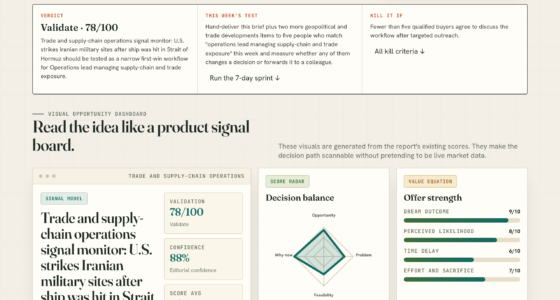

📊 Full opportunity report: Why AI Tokens Are Falling Behind Hidden Market Forces on ThorstenMeyerAI.com — validation score, market gap, and execution plan.

Get movie nights delivered free with Prime
- Fast, free delivery on millions of items
- Prime Video, Amazon Music and more included
- Member-only deals all year
TL;DR
AI tokens have dropped 40-60% amid market fears of demand destruction, but fundamental demand is actually increasing in private and open-source sectors. The decline reflects shifts in margins and unseen infrastructure growth, not reduced usage.
AI tokens have fallen by 40 to 60 percent from their recent highs over the past month, despite accelerating fundamentals in the AI industry, according to industry observer Thorsten Meyer. This divergence suggests that the market is misreading the underlying demand, which is actually increasing in areas not visible to public markets.
Thorsten Meyer, a builder and observer of open-weight inference models, notes that the recent sell-off in AI tokens is driven by a misinterpretation of open-source adoption. The rise of open weights like Kimi K3, GLM, and Qwen has shifted volume away from expensive frontier models toward cheaper open models. Meyer emphasizes that producing tokens from either model type requires similar compute resources, meaning demand for compute does not decline; instead, margins shift from high-cost labs to infrastructure providers and open-source deployments.
He explains that cheaper tokens lead to increased consumption, as users can afford to run more models at lower cost, which inflates total demand rather than diminishes it. This is supported by observed behavior in his own operations, where shifting from hosted frontier endpoints to open models reduces costs but increases total token usage. The market’s focus on demand destruction overlooks this margin redistribution, which is a key driver of current price declines.
Furthermore, Meyer highlights the existence of a hidden layer of demand—what he calls the ‘dark matter’ of the AI economy—comprising private frontier labs and open inference clouds. These sectors are growing rapidly but remain invisible to public market metrics like 10-K filings, leading to a mispricing of the underlying demand. The market’s failure to account for this unseen growth contributes to the current disconnect between fundamentals and token prices.
The speculative AI names fell 40–60% from their highs in a month. Every fundamental I can measure accelerated in the same weeks. My view: the market is selling a layer of the stack it was never able to see — and panicking about the two risks that matter least.
▲ Opinion & analysis · not investment adviceOpen source taking share spooked the market as demand destruction. That’s backwards. Producing a token costs the same compute whoever emits it — so open weights don’t destroy demand, they move margin and grow the pie.
The acceleration is happening where public equities have almost no telemetry. You infer the layer from its gravitational pull on the gauges you can read.
- A handful of listed hyperscalers
- The chipmakers
- Quarterly filings, weeks late
- Private frontier labs
- Open-source inference clouds monetizing served tokens
- Its pull: GPU scarcity, rising rents, memory spot, token growth — none on a balance sheet
The two things everyone panicked about are the two I worry about least. The risks worth respecting are quieter.
For the buildout to pay for itself, trillions in new operating cash flow must appear. It can come from exactly two places.
The truth, as usual, is still getting its boots on.
The recent decline in AI tokens does not reflect a drop in overall demand but rather a shift in where and how demand manifests. As open-source models gain share, margins compress for high-cost labs, and demand moves into infrastructure and private labs, which are not reflected in public data. This mispricing can lead to market volatility and misguided bearish sentiment, obscuring the actual growth trajectory of AI adoption.
Understanding these hidden forces is crucial for investors and industry participants, as it indicates that fundamental demand is still robust and that current price declines may be a misinterpretation of the industry’s true momentum.
As an affiliate, we earn on qualifying purchases.
Unseen Growth in Private Labs and Open Inference Clouds
The public markets primarily track hyperscalers and chipmakers, but the fastest-growing demand for AI compute now resides in private frontier laboratories and open-source inference services. These sectors are expanding rapidly, driven by the decreasing cost of tokens and the increasing adoption of open weights. Meyer notes that these layers are invisible in traditional financial metrics but exert significant influence through rising GPU availability, rental prices, and memory costs.
Historically, market prices have been set based on visible players, but the rapid growth of these hidden sectors creates a gravitational pull that is not captured in public filings. This leads to a disconnect, where prices fall despite underlying demand increasing, because the market cannot see the full picture.
"The demand for compute does not fall when open-source models take share; it shifts margins and redistributes demand to infrastructure and private labs."
— Thorsten Meyer
open-source AI model deployment tools
As an affiliate, we earn on qualifying purchases.
As an affiliate, we earn on qualifying purchases.
Unseen Demand and Market Mispricing Remain Unclear
It is still uncertain how long the market will continue to overlook these hidden demand sources and whether prices will eventually reflect this unseen growth. The precise impact of private lab expansion and open inference cloud scaling on token prices remains difficult to quantify due to lack of direct data.
AI compute infrastructure providers
As an affiliate, we earn on qualifying purchases.
As an affiliate, we earn on qualifying purchases.
Monitoring Industry Shifts and Market Reactions
Industry observers will continue to track GPU availability, rental prices, and token growth as proxies for hidden demand. Further analysis is needed to determine if market prices will eventually incorporate these unseen sectors or if continued mispricing will lead to volatility. Investors should watch for signs of recognition of these underlying forces in public market movements.
As an affiliate, we earn on qualifying purchases.
Key Questions
Why are AI token prices falling despite improving fundamentals?
The decline is driven by a shift in margins from high-cost labs to infrastructure providers and open-source sectors, not a reduction in overall demand. Cheaper tokens induce more usage, but market perception has not yet caught up.
What is the 'dark matter' of the AI economy?
The 'dark matter' refers to private frontier labs and open inference clouds that are experiencing rapid growth but are not reflected in public financial data, yet significantly influence demand and prices.
Will the market eventually recognize the hidden demand?
It is uncertain. Continued growth in private labs and open inference sectors may eventually be reflected in prices, but current signals suggest a lag due to lack of direct measurement.
How does the rise of multi-model routers affect demand?
Multi-model routers often reduce costs for users and increase total token volume, as orchestration itself consumes tokens. This can boost demand despite the appearance of cost savings.
What should investors watch for to understand this shift?
Investors should monitor GPU rental prices, token growth metrics, and infrastructure capacity expansion, as these are proxies for hidden demand in private and open-source AI sectors.
Source: ThorstenMeyerAI.com
Fall Picks
fall essentials
As an affiliate, we earn on qualifying purchases.