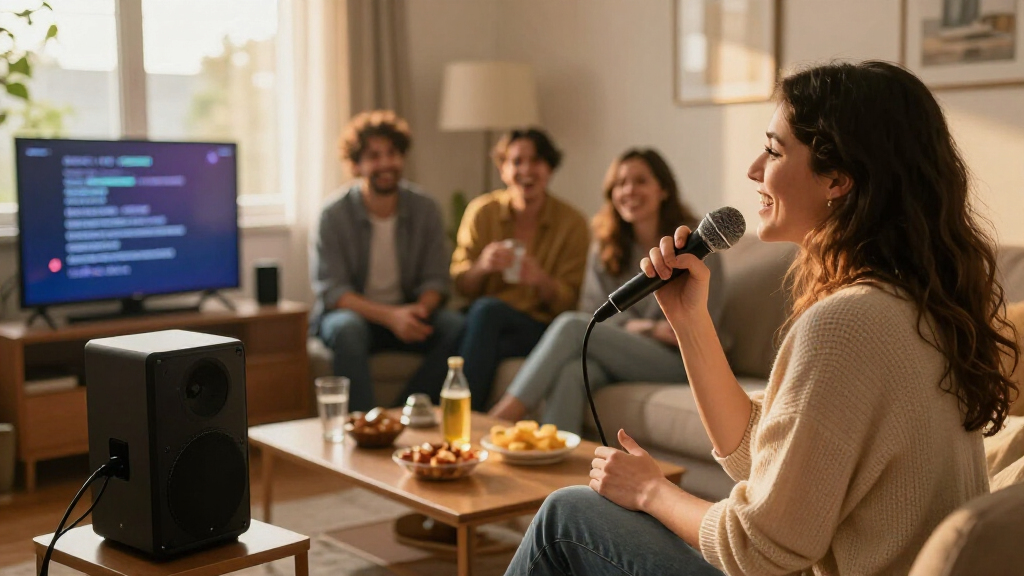

The best karaoke machines for home use balance sound quality, microphone performance, and ease of setup, and after comparing 15 popular models, the Ikarao Break X2 stands out as the top overall pick thanks to its built-in 10.1-inch screen that eliminates the need for a separate TV or tablet. For buyers who want lyrics without the premium price, the Ikarao Shell S2 offers a compact display-based alternative, while the Portable Karaoke Machine with 3 Wireless Microphones makes group singing the priority over screen features. The main tradeoff in this category is portability versus capability: small Bluetooth speaker-style machines travel well but rely on your phone for lyrics, while display-equipped machines act as self-contained karaoke stations. Battery life, microphone count, and whether a machine can fill a large living room versus a bedroom also separate these models. Keep reading for the full breakdown of each pick and who it suits best.

Get movie nights delivered free with Prime
- Fast, free delivery on millions of items
- Prime Video, Amazon Music and more included
- Member-only deals all year
Complete the kit

Key Takeaways
- Built-in lyric displays were the biggest differentiator in this lineup: the Ikarao Break X2 and Shell S2 are the only models that work without pairing a phone or tablet, which explains their top rankings despite their higher positioning.
- Most budget portables in this roundup are near-interchangeable Bluetooth speaker-and-microphone combos, so the deciding factors become battery runtime, microphone pairing stability, and included extras like lights or a third mic.
- Three-microphone options (the Portable Karaoke Machine with 3 Wireless Microphones and PPMIC MS75-T) only make sense if you regularly sing in groups; for solo or duet use, the extra mic adds cost without adding value.
- The 7-inch HD lyrics display model lands in an awkward middle ground — bigger than the mini portables but with a screen too small for a whole room to read comfortably, making it best for close-quarters use like kids’ rooms.
- Retro-styled and light-equipped machines trade some audio fidelity for atmosphere; the Portable Bluetooth Karaoke Speaker with lights suits party hosts more than serious singers.




| karaoke machines for home | Microphones | Weight | Bluetooth | Connectivity |
|---|---|---|---|---|
| CYY Portable Bluetooth Karaoke | — | 4.4 lbs | Version 5.2 | Bluetooth, AUX, USB flash drive, Micro TF card |
| VOSOCO Portable Karaoke Machin | — | 6.5 pounds | — | Bluetooth 5.2, USB, TF, AUX |
| Ikarao Shell S2 Portable Karao | 2 wireless, self-charging | 7.3 lbs | — | Wi-Fi, Bluetooth, HDMI, USB, Type-C, OTG, AUX in/out |
| PPMIC MS75 Karaoke Machine wit | 2 wireless | — | Version 5.3 | — |
| Portable Karaoke Machine with | 2 wireless | 1 kg (2.2 lbs) | — | Bluetooth, Micro TF card, USB, AUX-in |
| Portable Bluetooth Karaoke Mac | 2 wireless | 4.4 pounds (listed; product data also flags conflicting measurements) | Version 5.3 | Bluetooth, USB, TF card, AUX |
| Portable Karaoke Machine with | 2 wireless 2.4 GHz | — | — | — |
| Retro Portable Karaoke Machine | 2 wireless | 3.4 pounds | Version 5.3 | Bluetooth, USB-A/C, TF card, AUX, 6.35 mm MIC IN |
| Karaoke Machine with 7-Inch HD | 2 rechargeable wireless | 60.17 oz | — | Wi-Fi 6.0, Bluetooth 5.3, USB, TF card, AUX |
| Mini Portable Bluetooth Karaok | 2 wireless | 0.56 kg | — | Bluetooth, USB, 3.5 mm audio |
| Portable Karaoke Machine with | 3 rechargeable wireless | — | Version 5.3 | — |
| Ikarao Break X2 Karaoke Machin | 2 wireless, self-charging | — | — | — |
| PPMIC MS75-T Karaoke Machine w | 3 wireless | — | Version 5.3 | — |
| HWWR Portable Karaoke Machine | 2 wireless, 10 ms latency | — | Version 5.3 | — |
| Portable Bluetooth Karaoke Spe | 2 wireless, up to 50 ft range | Approximately 3.5 lbs | 5.3, 15-meter range | — |
More Details on Our Top Picks
CYY Portable Bluetooth Karaoke Machine with Two Wireless Microphones
For a no-frills party starter under a tight budget, the CYY keeps things simple: two wireless microphones, Bluetooth 5.2, and light modes that make a dim living room feel like a venue. Compared to the Ikarao Shell S2, it lacks any lyrics display, so you’ll be reading lyrics off your phone — but at a fraction of the complexity, that’s a fair trade for casual singers. The 6–8 hour battery holds its own against the VOSOCO’s 4–8 hour range, and TWS pairing means you can add a second speaker later if the crowd grows. The main annoyance is feedback when the mics get too close to the speaker, which younger singers will inevitably discover.
Pros:- Two wireless microphones included out of the box
- 6–8 hours of playback per charge
- Multiple inputs plus TWS pairing for expanding later
- Five light modes add party atmosphere cheaply
Cons:- No screen, so lyrics must come from a separate device
- Microphones need AA batteries that aren’t included
- Feedback occurs when mics are held near the speaker
Best for: Casual party hosts and budget shoppers who want two mics and lights without paying for a screen or software
Not ideal for: Anyone who wants to follow along with lyrics on the machine itself — there’s no display, so you’ll need a phone or tablet
- Speaker power:15 W
- Speaker size:6.5 inches
- Bluetooth:Version 5.2
- Connectivity:Bluetooth, AUX, USB flash drive, Micro TF card
- Battery life:6–8 hours per charge
- Weight:4.4 lbs
- Lighting:5 dynamic color modes
- Warranty:12 months
Our verdict“This pick makes the most sense for spontaneous, low-commitment karaoke nights where fun matters more than polish.”
VOSOCO Portable Karaoke Machine with Two Wireless Microphones
The VOSOCO earns its spot by balancing sound, features, and price better than most budget portables. Its 6.5-inch subwoofer gives it noticeably fuller low-end than the 8W compact model elsewhere in this lineup, while adjustable echo lets you dial in vocals that sound less flat than on the CYY, which has no such control. The 24-month warranty is double what the CYY offers, which suggests the manufacturer stands behind the build. Where it falls short is versatility of vocal processing — there’s no pitch correction like the PPMIC MS75 provides — and the 4–8 hour battery range means louder parties will drain it fast. Still, for a do-everything family speaker, this is the most sensible middle ground.
Pros:- 6.5-inch subwoofer delivers fuller sound than smaller budget units
- Adjustable echo for better-sounding vocals
- Both handle and shoulder strap for easy carrying
- 24-month warranty, double the typical budget coverage
Cons:- Battery life drops toward 4 hours at higher volumes
- No built-in screen for lyrics
Best for: Families who want one speaker that handles karaoke nights, backyard hangouts, and everyday music without a premium price
Not ideal for: Serious singers who want pitch help or vocal tuning — echo is the only vocal effect on board
- Output wattage:15 watts
- Speaker:6.5-inch subwoofer
- Connectivity:Bluetooth 5.2, USB, TF, AUX
- Battery life:4–8 hours
- Dimensions:9 x 5.11 x 11.81 inches
- Weight:6.5 pounds
- Features:Adjustable echo, TWS pairing, LED lights
- Warranty:24 months
Our verdict“The best bang-for-buck choice if you want solid sound and flexibility without stepping up to a display-equipped system.”
Ikarao Shell S2 Portable Karaoke Machine with Lyrics Display and Two Wireless Microphones
This is the option I’d point most home singers toward, because it solves the single biggest frustration of budget karaoke machines: squinting at lyrics on a phone. The built-in display, combined with a six-month KaraFun subscription covering over 50,000 songs, means you’re singing within minutes of unboxing — something the VOSOCO and CYY can’t match without a separate device juggling act. The two self-charging microphones dock right into the speaker, so unlike the CYY you’ll never hunt for AA batteries, and HDMI output lets you push lyrics to a TV for bigger gatherings. The honest tradeoff: that 140W figure is peak, not continuous power, so expect loud-but-not-concert volume, and once the KaraFun trial ends, you’ll need a paid plan or your own library.
Pros:- Built-in lyrics display eliminates the phone-on-the-coffee-table routine
- Self-charging microphones store and charge in the speaker
- HDMI output connects to a TV for group sing-alongs
- Six months of KaraFun with 50,000+ songs included
Cons:- 140W is peak power, so sustained volume is more modest
- KaraFun subscription is only free for six months
Best for: Households that want a true sing-out-of-the-box experience with real lyrics and a curated song catalog
Not ideal for: Buyers unwilling to eventually pay for a streaming subscription after the six-month trial runs out
- Peak power:140W
- Speakers:Two 2.7-inch full-range speakers
- Display:Built-in lyrics display
- Connectivity:Wi-Fi, Bluetooth, HDMI, USB, Type-C, OTG, AUX in/out
- Battery life:Up to 8 hours
- Microphones:2 wireless, self-charging
- Included software:6-month KaraFun subscription (50,000+ songs)
- Weight:7.3 lbs
Our verdict“If karaoke is a regular household activity rather than an occasional gimmick, this is the system worth the extra spend.”
PPMIC MS75 Karaoke Machine with Two Wireless Microphones
Where most machines in this lineup treat your voice as-is, the PPMIC MS75 actually tries to improve it. Pitch correction assistance nudges off-key notes toward the melody, which is a confidence-saver for shy singers, and the woofer-plus-tweeter layout produces clearer high frequencies than the woofer-only VOSOCO. The 6000 mAh battery and TWS stereo pairing also make it a capable plain music speaker between karaoke nights. The catch is total reliance on your own gear: no screen, no song library, no Wi-Fi streaming — you supply the phone, the app, and the lyric display. Compared to the Ikarao Shell S2, that’s a real workflow gap, so this model suits singers who already have a karaoke app they like and mainly want their voice to sound better through it.
Pros:- Pitch correction helps hesitant singers stay on key
- Dedicated tweeter adds vocal clarity lacking in budget models
- 6000 mAh rechargeable battery for portable use
- TWS pairing enables true wireless stereo with a second unit
Cons:- No screen or built-in song library whatsoever
- Bluetooth and AUX are the only inputs — no USB or TF card playback
Best for: Aspiring or self-conscious singers who want pitch help and echo control while using their own phone-based karaoke setup
Not ideal for: Anyone expecting an all-in-one experience — you’ll need a separate device for music and lyrics every single time
- Power:Up to 200W
- Drivers:6.5-inch woofer + 2-inch tweeter
- Bluetooth:Version 5.3
- Audio input:Bluetooth or AUX
- Battery:6000 mAh rechargeable
- Microphones:2 wireless
- Features:Pitch correction, adjustable echo, TWS pairing
- Screen / song library:None
Our verdict“A strong choice for singers who care more about how their voice sounds than about built-in convenience features.”
Portable Karaoke Machine with Bluetooth Speaker and 2 Wireless Microphones
Of everything in this roundup, this is the one I’d hand to a seven-year-old. At 8W and roughly 2.2 pounds, it’s light enough for small hands to carry solo, and the five voice effects — the kind of chipmunk and robot gimmicks kids adore — are something none of the adult-oriented models like the PPMIC MS75 offer. Six light modes keep the spectacle going, and with two mics included, siblings can perform duets without a fight. The obvious compromise is volume and clarity: next to the 15W CYY or VOSOCO, vocals sound thinner and the speaker strains in bigger rooms. Battery life is also a moving target at 4–10 hours depending on how hard the lights and volume are pushed. As a toy-first karaoke machine, though, those limits barely matter.
Pros:- Ultra-light 1 kg build easy for kids to carry anywhere
- Five voice effects that children find genuinely entertaining
- Two mics for sibling or friend duets
- Multiple inputs including TF card and USB for offline playlists
Cons:- 8W output is the weakest in this lineup
- Battery life swings from 4 to 10 hours depending on lights and volume
Best for: Parents buying for young kids who want a fun, light, effect-heavy machine rather than a serious sound system
Not ideal for: Teens or adults doing real karaoke — the 8W speaker lacks the volume and vocal clarity for genuine performances
- Speaker power:8W
- Microphones:2 wireless
- Light modes:6
- Voice effects:5
- Connectivity:Bluetooth, Micro TF card, USB, AUX-in
- Battery playback:4–10 hours
- Dimensions:7.48 × 7.08 × 4.72 inches
- Weight:1 kg (2.2 lbs)
Our verdict“A great first karaoke machine for children, as long as nobody expects room-filling sound.”
Portable Bluetooth Karaoke Machine with Two Wireless Microphones
Flexible playback is the main reason I’d choose this compact machine for home karaoke: Bluetooth 5.3 works for phone streaming, while USB, TF card, and AUX inputs offer alternatives when one source is inconvenient. The two wireless microphones make duets easy, and TWS pairing can add a second speaker for a wider sound setup. Compared with the Retro Portable Karaoke Machine, this model claims longer battery life, up to 10 hours versus 6–8, though its listed maximum is not a guaranteed runtime. Its 15W output is a modest fit for a living room rather than a large gathering. The product data also gives conflicting weight and dimension measurements, so I’d be cautious about relying on its portability figures. It suits casual home sessions where connection options matter more than room-filling volume.
Pros:- Two wireless microphones support duets
- Bluetooth, USB, TF card, and AUX playback
- TWS pairing can connect a second speaker
- Battery-powered design lists up to 10 hours of playtime
Cons:- 15W output is better suited to smaller rooms than loud parties
- Listed weight and dimensions conflict
- Up to 10 hours is a maximum claim, not a confirmed typical runtime
Best for: Households that want multiple ways to play songs and two microphones for casual duets
Not ideal for: Buyers who need strong sound for a large room or dependable, clearly documented size and weight
- Output:15 watts
- Bluetooth:Version 5.3
- Microphones:2 wireless
- Battery life:Up to 10 hours
- Connectivity:Bluetooth, USB, TF card, AUX
- TWS stereo pairing:Supported
- Weight:4.4 pounds (listed; product data also flags conflicting measurements)
- Power source:Battery powered
Our verdict“Choose this for flexible playback and casual two-mic singing at home, provided modest output suits your room.”
Portable Karaoke Machine with Two 2.4 GHz Wireless Microphones
For a home party that needs more presence than a mini speaker, I’d look at this model first. Its 6.5-inch woofer and 200W peak-power claim suggest a larger setup than the 15W Portable Bluetooth Karaoke Machine, although peak power alone does not establish continuous loudness. Two 2.4 GHz microphones with a stated 10 ms latency, plus karaoke and mic priority modes, make switching between songs and announcements more practical. Playback covers Bluetooth, AUX, USB, TF card, and TV connection, while a shoulder strap helps when moving it between rooms. The tradeoff is that its claimed coverage and runtime are not firmly established by the supplied details; the 24-hour play claim lacks a specific runtime basis. It is a better match for energetic gatherings than quiet, compact singing sessions.
Pros:- Two 2.4 GHz microphones with stated 10 ms latency
- Karaoke and mic priority modes support singing and announcements
- Bluetooth, AUX, USB, TF card, and TV playback options
- Shoulder strap and TWS pairing add portability and expansion options
Cons:- 200W is a peak-power figure, not a continuous output rating
- The claimed 24-hour runtime is not supported by a specific runtime detail
- Its larger woofer makes it less compact than smaller home karaoke speakers
Best for: Hosts who want a larger speaker, two low-latency microphones, and several ways to play music at home
Not ideal for: Buyers seeking a very small speaker or relying on a confirmed all-day battery runtime
- Woofer:6.5-inch alloy
- Peak power:200 W
- Microphones:2 wireless 2.4 GHz
- Microphone latency:10 ms
- Battery:6800 mAh rechargeable
- Playback:Bluetooth, AUX, USB, TF card, TV connection
- Lighting:7 adjustable RGB modes
- Additional features:Karaoke mode, mic priority mode, USB recording, TWS pairing
Our verdict“Pick this for home gatherings where speaker size, dual microphones, and flexible inputs matter more than compactness.”
Retro Portable Karaoke Machine with Two Wireless Microphones
If a karaoke speaker will stay visible in your living room between singalongs, the wood-and-leather retro styling gives this one a clearer design identity than the straightforward black Portable Bluetooth Karaoke Machine. Its two 3-inch speakers and pair of wireless microphones provide a self-contained setup, while Bluetooth 5.3, USB, TF card, AUX, and a 6.35 mm mic input support several sources and accessories. The shoulder strap and 3.4-pound weight also make it easy to carry to another room. Battery life is listed at 6–8 hours, shorter than the up-to-10-hour claim for the black model. The compact build may suit close-up home use better than filling a big room, and microphones can produce sharp sound when held too near the speaker. I’d choose it for style and portability, with some care around mic placement.
Pros:- Distinctive wood, leather, and woven-front design
- Two wireless microphones and two built-in 3-inch speakers
- Bluetooth, USB, TF card, AUX, and 6.35 mm mic input
- Shoulder strap and 3.4-pound weight aid portability
Cons:- 6–8-hour listed battery life is shorter than the up-to-10-hour claim of the black portable model
- Microphones may produce sharp sound when used close to the speaker
- Compact speakers may be less suited to filling a large room
Best for: Design-conscious buyers who want a portable two-microphone setup for living-room singing and small gatherings
Not ideal for: Large-room hosts who need stronger room-filling sound or singers who tend to hold microphones close to speakers
- Speakers:2 built-in 3-inch speakers
- Microphones:2 wireless
- Bluetooth:Version 5.3
- Connectivity:Bluetooth, USB-A/C, TF card, AUX, 6.35 mm MIC IN
- Battery life:6–8 hours
- Stereo pairing:TWS
- Dimensions:9.9 x 5.7 x 4 inches
- Weight:3.4 pounds
Our verdict“Choose this if retro styling and easy carrying matter more than longer claimed runtime or large-room output.”
Karaoke Machine with 7-Inch HD Lyrics Display and 2 Wireless Microphones
The 7-inch HD lyrics display gives this machine a practical advantage for singers who don’t want lyrics taking over a phone screen. With 60W sound and two rechargeable wireless microphones, it is a more self-contained home setup than the Mini Portable Bluetooth Karaoke Machine, which relies on a connected device for song content. Wi-Fi, Bluetooth, USB, TF card, and AUX give it broad source options; sound modes add some variety for family use. The key limitation is the song experience: streaming from YouTube or Spotify requires Wi-Fi, and there is no offline library or built-in karaoke subscription app. That makes it less dependable for homes with weak connectivity or buyers expecting songs ready to go out of the box. Choose it when the built-in lyrics screen matters and Wi-Fi is available.
Pros:- 7-inch HD display shows lyrics without relying on a phone screen
- Two rechargeable wireless microphones are included
- 60W sound output and several sound modes
- Wi-Fi, Bluetooth, USB, TF card, and AUX connectivity
Cons:- YouTube and Spotify streaming require Wi-Fi
- No preloaded offline song library or built-in karaoke subscription app
- 6–8-hour battery life may limit longer sessions away from power
Best for: Families who want lyrics displayed on the machine and have reliable Wi-Fi for streaming songs
Not ideal for: Buyers who need offline songs or expect a built-in karaoke catalog without streaming
- Display:7-inch HD
- Sound output:60W
- Microphones:2 rechargeable wireless
- Microphone range:50 feet
- Connectivity:Wi-Fi 6.0, Bluetooth 5.3, USB, TF card, AUX
- Battery life:6–8 hours
- Charging:Type-C; full charge in 2 hours
- Weight:60.17 oz
Our verdict“Pick this for a built-in lyrics screen and Wi-Fi streaming, but skip it if you need an offline song collection.”
Mini Portable Bluetooth Karaoke Machine with 2 Wireless Microphones
For tight storage or spontaneous singing in a bedroom, this mini machine’s 3.15 × 3.5 × 3.5-inch footprint is its strongest argument. It includes two wireless microphones, five voice effects, colorful lights, and Bluetooth, USB, and 3.5 mm audio connections. Compared with the Retro Portable Karaoke Machine, it is much smaller by its listed dimensions and adds voice effects, but it does not list the retro model’s TWS pairing or its broader set of playback inputs. The claimed 8–10 hours of battery life is useful for portability, though it is a maximum range rather than a guaranteed session length. Its compact plastic enclosure is better suited to close listening than a large room, and the microphones may feed back sharply when held too close. I’d pick it for easy storage, not party-scale sound.
Pros:- Very compact listed dimensions make it easy to store
- Two wireless microphones support duets
- Five voice effects and colorful lights add variety
- Bluetooth, USB, and 3.5 mm audio connections
Cons:- Microphones may produce sharp feedback when held close to the speaker
- Small plastic enclosure is less suited to large-room gatherings
- Its input options are narrower than the retro model’s USB, TF card, AUX, and mic input
Best for: Apartment dwellers, families with limited storage, and buyers who want a small karaoke speaker for casual singing
Not ideal for: Hosts who need louder sound for a large room or want extensive built-in playback options
- Dimensions:3.15 × 3.5 × 3.5 inches
- Weight:0.56 kg
- Microphones:2 wireless
- Battery life:Up to 8–10 hours
- Connectivity:Bluetooth, USB, 3.5 mm audio
- Voice effects:5
- Audio channels:2
- Enclosure material:Plastic
Our verdict“Choose this when small size and easy storage matter more than room-filling sound or broader playback support.”
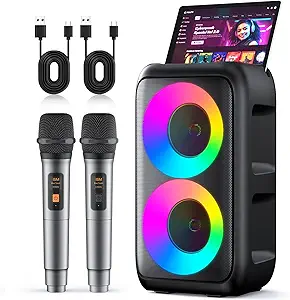
Portable Karaoke Machine with 3 Wireless Microphones
This option stands out for one thing most competitors don’t offer: three wireless microphones in the box. Where the HWWR and most two-mic machines limit you to duets, this one handles trio performances and family sing-offs without buying extras. The 20-hour battery is the standout endurance figure in this batch — roughly double what the Ikarao Break X2 delivers — making it a better fit for all-day gatherings or events far from an outlet. The built-in tablet holder conveniently positions lyrics, though you supply the tablet itself. Compared with the PPMIC MS75-T, which also includes three mics, this model trades raw power for longer runtime and more playback sources.
The tradeoff: a single 6.5-inch full-range driver won’t match a dedicated woofer-and-tweeter setup for vocal clarity at high volume, and the listing’s conflicting microphone counts mean you should confirm contents before ordering.
Pros:- Three rechargeable wireless microphones included for group performances
- Over 20 hours of battery life outlasts nearly every alternative in this roundup
- Multiple playback sources including Bluetooth, USB, TF card, and AUX
- Built-in tablet holder keeps lyrics at eye level
Cons:- Single full-range driver lacks the low-end punch of woofer-based rivals
- Listing gives conflicting microphone counts, so verify before purchase
Best for: Families and party hosts who want three people singing at once without buying extra microphones
Not ideal for: Audiophiles wanting deep bass and crisp vocal separation — a single full-range driver limits sound quality at high volume
- Speaker:6.5-inch full-range
- Microphones:3 rechargeable wireless
- Battery capacity:6000mAh
- Playback time:Over 20 hours
- Bluetooth:Version 5.3
- Tablet holder:Fits tablets up to 11 inches
- Audio features:DSP, vocal effects, vocal removal, adjustable echo, TWS pairing
- Portability:Shoulder strap and handle
Our verdict“This pick makes the most sense for households where three or more people want to sing together for long stretches without recharging.”
Ikarao Break X2 Karaoke Machine with 10.1-Inch Display and Two Wireless Microphones
Most machines here are speakers that expect you to bring your own screen and songs. The Break X2 flips that: its rotatable 10.1-inch touchscreen plus Wi-Fi access to YouTube and a karaoke app means it works as a complete karaoke system out of the box, closer in spirit to the Ikarao Shell S2 than to bare speakers like the PPMIC MS75-T. The self-charging microphone docks are a genuinely thoughtful touch — the mics top up whenever stored, so dead batteries stop being a pre-party scramble. With 300W peak power, it also outguns compact options like the two-mic Bluetooth speaker from B0FB8QTZL6.
The compromises are structural: song streaming depends entirely on a stable Wi-Fi connection, which makes it a shaky choice for backyards, cabins, or anywhere with spotty internet. And the 8-hour battery, while respectable, sits well below the 20-hour runtime of the three-mic portable model.
Pros:- Built-in rotatable 10.1-inch touchscreen eliminates the need for a separate device
- Wi-Fi song access through YouTube and a karaoke app provides a huge library
- Microphones charge automatically when docked in the speaker
- 300W peak power is among the loudest in this lineup
Cons:- Song streaming requires a stable Wi-Fi connection
- Charging time for the battery is not specified
Best for: Buyers who want lyrics, songs, speaker, and microphones in one system with no extra devices needed
Not ideal for: Anyone planning karaoke away from reliable Wi-Fi — the song library stops working offline
- Display:10.1-inch HD touchscreen, rotates 180 degrees
- Microphones:2 wireless, self-charging
- Peak power:300 W
- Song access:YouTube and karaoke app via Wi-Fi
- Battery life:Up to 8 hours
- DJ lights:4
Our verdict“The closest thing to a plug-and-play karaoke system here — ideal for home users with solid Wi-Fi who don’t want to juggle phones and tablets.”
PPMIC MS75-T Karaoke Machine with 3 Wireless Microphones
While other portables in this roundup lean on convenience, the MS75-T leans on raw output and vocal processing. The two-way driver pairing — a 6.5-inch woofer with a dedicated 2-inch tweeter — reproduces vocals more accurately than the single full-range driver in the B0G5198NW9, and up to 300W of output fills larger rooms. The pitch correction is the differentiator: nervous singers get a safety net that no basic two-mic speaker like the HWWR offers. Three included microphones match the B0G5198NW9 for group capacity, and TWS pairing lets you build a stereo setup later.
What you give up is self-sufficiency. With no screen or song library, you must supply a phone, tablet, or TV for music and lyrics — which is exactly the gap the Ikarao Break X2 fills at a higher tier. The 7,000mAh battery is solid but doesn’t reach the 20-hour class of some rivals.
Pros:- Dedicated woofer and tweeter deliver clearer vocal reproduction than single-driver rivals
- Pitch correction helps less confident singers stay on key
- Three wireless microphones included for group performances
- TWS pairing supports a two-speaker stereo setup
Cons:- No built-in screen or song library — requires a separate device for lyrics and music
- Battery capacity trails the longest-running models in this roundup
Best for: Vocal-focused singers who want loud, clear sound and pitch correction for confident performances
Not ideal for: Buyers expecting an all-in-one system — it has no screen or songs and always needs a companion device
- Model:MS75-T
- Microphones:3 wireless
- Audio output:Up to 300W
- Drivers:6.5-inch woofer and 2-inch tweeter
- Battery capacity:7,000 mAh rechargeable
- Bluetooth:Version 5.3
- Features:Pitch correction, adjustable echo, TWS pairing
- Screen or song library:None
Our verdict“The strongest choice here for sound quality and singer assistance, provided you’re comfortable supplying your own lyrics device.”
HWWR Portable Karaoke Machine with Two Wireless Microphones
This model earns its place through sheer input versatility. Beyond the usual Bluetooth, USB, and AUX, it accepts musical instruments and TV connections — a combination that turns it into a small PA for guitar-backed singalongs or a TV-sound karaoke rig, roles the B0FB8QTZL6 speaker can only partly fill. The stated 10 ms microphone latency matters more than it sounds: low latency keeps your voice aligned with the music, avoiding the distracting echo effect that plagues cheaper wireless setups. TWS mode and a shoulder strap round out a genuinely flexible, portable package.
Two drawbacks temper the appeal. Microphone feedback near the speaker requires careful mic placement during energetic performances, and the unspecified battery runtime makes it hard to plan for events away from power — unlike the clearly rated 10- and 20-hour rivals here.
Pros:- Accepts instruments, TV, USB, TF card, AUX, and Bluetooth inputs
- Low 10 ms microphone latency keeps vocals synchronized with music
- Shoulder strap makes it easy to carry between rooms or venues
- TWS mode allows pairing a second speaker for wider sound
Cons:- Microphone feedback occurs when mics are held close to the speaker
- Battery playtime is not specified, complicating off-grid planning
Best for: Musicians and TV-based karaoke fans who need instrument and TV inputs alongside standard playback
Not ideal for: Buyers who need guaranteed all-day portability — battery playtime is not specified
- Speaker:5.25-inch subwoofer system
- Microphones:2 wireless, 10 ms latency
- Bluetooth:Version 5.3
- Connections:USB, TF card, AUX, instruments, TV
- Wireless pairing:TWS mode
- Lighting:Music-synced LED lights
- Warranty:12 months
Our verdict“A strong pick for creative setups involving guitars or TVs, though runtime uncertainty makes it better for near-outlet use.”
Portable Bluetooth Karaoke Speaker with Two Wireless Microphones and Lights
At roughly 3.5 pounds with a built-in handle, this is the easiest machine in the batch to grab and go — lighter and more travel-friendly than the three-mic portables from PPMIC and B0G5198NW9. The dual subwoofers and music-reactive lights give it real party presence for its size, and the connection list is surprisingly broad: Bluetooth, AUX, USB, TF card, plus 6.35mm jacks for wired mics and instruments. A 10-hour battery rating makes it dependable for an evening outdoors where the Ikarao Break X2’s Wi-Fi dependency would fail.
Realism is required, though: 10W output (80W peak) is modest next to the PPMIC MS75-T’s 300W, so this suits living rooms and patios rather than big gatherings. The 10-minute auto shutoff can interrupt breaks between songs, and inconsistent listed weight and dimensions suggest loose quality control in the listing itself.
Pros:- Lightweight design with carry handle travels easily to outdoor events
- Up to 10 hours of playback supports full-evening use
- Music-reactive lights add atmosphere without setup
- 6.35mm inputs accept wired microphones and instruments
Cons:- 10W output is far quieter than higher-wattage rivals in this lineup
- Auto shutoff after 10 minutes of inactivity can be disruptive
- Weight and dimensions are listed inconsistently, suggesting sloppy documentation
Best for: Casual singers and picnic or patio hosts who prioritize portability over volume
Not ideal for: Large parties — modest 10W output can’t fill a big room the way the 300W PPMIC can
- Audio output:10 W (80 W peak)
- Microphones:2 wireless, up to 50 ft range
- Battery capacity:3,600 mAh
- Playback time:Up to 10 hours
- Bluetooth:5.3, 15-meter range
- Connections:TWS, AUX, USB, TF card, 6.35 mm mic and instrument inputs
- Weight:Approximately 3.5 lbs
- Lighting:Music-reactive color lights
Our verdict“The most convenient take-anywhere option here for small, casual gatherings — just don’t expect it to power a large party.”

How We Picked
I evaluated each machine against the four factors that matter most for home karaoke: sound output (whether the speaker can fill a living room or only a bedroom), microphone performance (wireless range, pairing stability, and how well vocals cut through backing tracks), lyrics handling (built-in display, app support, or TV connectivity), and ease of setup (how quickly a non-technical household can start singing). Because most of these machines share a similar portable-speaker foundation, small differences — battery runtime, whether the mics recharge in the machine, included cables — carried a lot of weight in the final ordering.
The ranking logic is straightforward: machines that stand alone without needing your phone rank highest, group-friendly three-mic setups come next for their social value, and the compact budget portables fill out the lower tier as strong picks for kids, travel, or casual duets. I also factored in durability and portability, since a karaoke machine that gets dragged between rooms and parties takes more abuse than one that lives on a shelf.
Factors to Consider When Choosing Karaoke Machines For Home
Before settling on a specific model, it helps to understand what actually separates a satisfying home karaoke setup from one that gathers dust after a month. These are the factors I weighed across the lineup, and the mistakes buyers most often make.Decide Whether You Need a Built-In Lyrics Screen
The single biggest decision in this category is whether the machine displays lyrics itself or depends on your phone, tablet, or TV. Screen-equipped machines like the Ikarao Break X2 cost more but create a self-contained experience — no fiddling with Bluetooth casting, no dead phone battery mid-song, no arguing over who holds the tablet. Phone-dependent machines are cheaper and often sound just as good, but someone has to manage the device all night, which gets old fast at a party. A common mistake is assuming any screen will do: a 7-inch display only works if the singer is standing right in front of it, while a 10-inch tilt-adjustable screen can serve a whole couch. If your household already sings along to YouTube karaoke channels on the living room TV, a speaker-only machine paired to that TV may serve you better than paying for a redundant screen.
Match Speaker Power to Your Room Size
Output power determines whether the machine sounds full in a large living room or strained and distorted when you push the volume. Small cylinder-style portables are genuinely great for bedrooms, dorms, and kids’ playrooms, but they struggle to compete with a room full of singing, laughing people. A frequent buyer mistake is choosing the smallest, cutest machine and then being disappointed at a birthday party with fifteen guests. Conversely, overspending on maximum wattage for a small apartment means paying for volume you can never legally use. Think honestly about your typical singing scenario — two people on the couch versus a house party — and size accordingly. Machines in the middle of this lineup handle both scenarios acceptably, which is part of why they rank where they do.
Microphone Count and Wireless Reliability
Duet-friendly two-microphone setups are the standard here, and for most households that is the right number. Three-mic machines earn their place only if group singing is a regular event — kids’ sleepovers, family gatherings — otherwise the third mic is an accessory that sits in a drawer. More consequential than count is wireless stability: 2.4 GHz microphones generally hold their connection more reliably across a room than cheaper Bluetooth-based mics, and machines that recharge the microphones in the main unit spare you the battery-buying cycle. Check whether the mics have independent volume controls, because balancing a loud singer against a quiet one is one of those small features that dramatically improves the experience. Dropouts and feedback are the fastest way to kill a karaoke night, so I weighted mic reliability heavily in the rankings.
Battery Life and Portability Tradeoffs
Runtime claims in this category tend to be optimistic, usually measured at low volume with the lights off. Realistically, expect party-level playback to drain a battery roughly a third faster than advertised, so a machine rated for six hours may realistically deliver four. If you sing mostly at home near an outlet, battery life barely matters and you can prioritize sound and features instead. If you haul the machine to friends’ houses, backyard barbecues, or camping trips, aim for the longest runtime you can get and confirm the machine charges over common cables rather than a proprietary adapter. The mini portables in this lineup win decisively on grab-and-go convenience, but several sacrifice bass response and mic range to get there — that is the core portability tradeoff.
Extra Features: Lights, Voice Effects, and App Ecosystems
Disco lights, voice-changing effects, and echo controls can transform the vibe for kids and party crowds, but they are not substitutes for clean audio. Lights drain battery noticeably and can feel gimmicky within a few sessions, though for children’s machines they genuinely add value. App ecosystems matter more than buyers expect: some machines work seamlessly with popular karaoke apps while others require awkward workarounds, so verify compatibility with the app or streaming service you already use. Voice effects are fun for about twenty minutes, so do not let them drive your decision. The pattern I saw across this roundup is that machines investing in display quality and audio tuning age better than machines investing in flashing lights.
Who Is Actually Singing?
The most useful filter is the singer themselves. Kids need durability, simple controls, and forgiving echo effects more than audio fidelity — the retro-styled and light-equipped models suit them well. Teens and adults who sing casually want phone connectivity and decent volume. Aspiring performers care about mic sensitivity, echo adjustment range, and whether the machine distorts at high volume, which points toward the display-equipped Ikarao units or the more powerful speaker models. Multi-generational households get the most value from three-mic machines with big buttons that grandparents and kids can both operate. Buying for the wrong singer is the most common mistake in this category, and no feature list compensates for a mismatch there.
Frequently Asked Questions
Do I need a karaoke machine with a built-in screen if I have a smart TV?
Not necessarily, and this is where many buyers overspend. If your smart TV already runs YouTube or a karaoke app, a speaker-and-microphone machine paired to that TV gives you big, readable lyrics and often better sound than an all-in-one unit — the Ikarao Break X2’s main advantage disappears in that setup. A built-in screen earns its cost when you sing in rooms without a TV, want to take the machine to parties and backyard gatherings, or dislike the hassle of casting from your phone every session. Screen size matters too: a 7-inch display is fine for the person holding the mic but poor for a room of people following along, whereas the Break X2’s 10.1-inch screen serves a small crowd. If your karaoke nights are always in the living room, save the money and put it toward a machine with better speakers instead.
Are two wireless microphones enough, or should I get a three-mic machine?
For most households, two mics cover realistic use — duets are the most common karaoke format, and solo singers with a spare mic for a friend have their needs met. Three-mic machines like the PPMIC MS75-T and the Portable Karaoke Machine with 3 Wireless Microphones make sense when group singing is routine: families with multiple kids, sleepovers, or parties where whole songs get sung by three or four people at once. The tradeoff is not just price — coordinating three open microphones increases feedback risk and forces the machine to split its processing across more inputs, which can thin out each vocal. If you occasionally have a third singer, passing a mic works fine. Buy the third mic for your lifestyle as it actually is, not the parties you imagine hosting.
Can these home karaoke machines double as regular Bluetooth speakers?
Yes, and that versatility is one of the best arguments for this category over a dedicated karaoke console. Nearly every machine here functions as a standard Bluetooth speaker for everyday music, which means it is not sitting idle between singing sessions — the higher-wattage models can genuinely serve as a room’s main speaker. The caveat is that karaoke tuning and music listening tuning differ: machines optimized for vocal clarity sometimes sound leaner on bass than a pure music speaker of similar size, and party lights may blink along to your podcasts unless you can disable them. Battery drain also applies, so a machine pulling double duty as a daily speaker needs convenient charging placement. If music listening is half your motivation, prioritize the models with larger drivers and skip the light-heavy units.
What do I need besides the machine to actually get lyrics and songs?
A phone or tablet with a karaoke app or YouTube access is the baseline for every screen-less machine in this roundup — you pair the device via Bluetooth, play the lyric video, and sing through the wireless mics while the machine handles amplification. Free YouTube karaoke channels cover an enormous song catalog, which is why so many home users never pay for anything beyond the machine itself. Subscription karaoke apps add better scrolling lyrics, key adjustment, and scoring, and they are worth it for regular singers. Display-equipped machines like the Ikarao models still typically stream content but show lyrics on their own screen, removing the pass-the-phone problem. Before buying, confirm your chosen app works with the machine’s connectivity, since a few apps only cast audio or lyrics separately.
Why do cheaper karaoke machines sometimes sound better than expensive ones?
Because price in this category tracks features, not raw audio quality — a budget machine that spends its entire cost on a good driver can out-sing a pricier unit whose money went into a screen, lights, and voice effects. The mini and mid-tier portables in this lineup frequently punch above their price on pure sound, which is why several rank ahead of feature-laden competitors for audio-first buyers. What cheap machines give up is convenience: stable multi-mic pairing, long batteries, and the self-contained lyric experience. Feedback suppression and echo quality are also where costs get cut, and muddy echo is the most common complaint about low-cost units. Decide whether you are buying an amplifier with a screen attached or a screen with a speaker attached, and spend accordingly.
Conclusion
After comparing all fifteen machines, the right choice comes down to how you sing and who you sing with. For the best overall home karaoke experience, the Ikarao Break X2 is the clear leader — its 10.1-inch display, solid speakers, and self-contained operation justify the premium for anyone serious about regular karaoke nights. The Ikarao Shell S2 takes the best premium-compact slot for buyers who want lyrics on board without the Break X2’s footprint.
For best value, the portable two-mic machines in the middle of this roundup deliver the core Bluetooth-speaker-plus-wireless-mics formula at its most sensible, and the CYY Portable and VOSOCO models represent that sweet spot well. Beginners and casual singers should start with the Portable Karaoke Machine with Bluetooth Speaker and 2 Wireless Microphones or the Mini Portable — simple, forgiving, and inexpensive enough to test whether karaoke sticks in your household. Group-focused buyers get the most from the PPMIC MS75-T or the 3-Wireless-Microphone model, while the lights-and-vibes crowd will love the Portable Bluetooth Karaoke Speaker with Lights, and kids gravitate naturally to the Retro Portable and the 7-inch display model. Match the machine to your actual singing habits, and you will not go wrong with any of these picks.
Halloween Picks
halloween
As an affiliate, we earn on qualifying purchases.