
🔍 Read the full analysis: 9 Best AI Mini PCs For Local AI Workloads In 2027 on ThorstenMeyerAI.com

Get movie nights delivered free with Prime
- Fast, free delivery on millions of items
- Prime Video, Amazon Music and more included
- Member-only deals all year
TL;DR
ThorstenMeyerAI.com ranks nine mini PCs for local AI workloads, placing the MINISFORUM MS-S1 MAX first for its listed 128GB of RAM, 2TB SSD and workstation-focused ports. The ranking is based on published configurations, not reported benchmark testing; buyers should check software compatibility, cooling and upgrade options before choosing.
ThorstenMeyerAI.com has ranked nine mini PCs for local AI workloads, naming the MINISFORUM MS-S1 MAX its top overall pick based on its listed Ryzen AI Max+ 395 processor, 128GB of RAM, 2TB SSD and workstation-oriented connectivity, as detailed in the original analysis. The ranking compares stated configurations rather than benchmark results, so it offers a specification-based shortlist, not proof of how quickly the machines run particular AI models; buyers can also consult this guide to choosing an AI mini PC.
The source identifies three models with the Ryzen AI Max+ 395 and 128GB memory configurations: the MS-S1 MAX, GMKtec EVO-X3 and BOSGAME M5. It describes those systems as the clearest candidates in the group for memory-hungry local work. The MS-S1 MAX is distinguished in the ranking by its stated dual 10GbE ports, USB4 V2 connectivity and two M.2 PCIe 4.0 slots, alongside its 2TB SSD.
The GEEKOM A9 Max is presented as an alternative with a Ryzen AI 9 HX 470 processor, 32GB of RAM and 2TB of storage. The source positions it as a newer-platform system for general use rather than a match for the 128GB configurations when large memory capacity is the priority, a consideration also relevant when comparing AI mini PCs to watch. It also describes the GMKtec K15 as a simpler option for lighter workloads.
The remaining models in the nine-device roundup are GEEKOM IT13 MAX, Glorlin, MINISFORUM MS-S1 MAX, GMKtec EVO-X3, BOSGAME M5 and GMKtec K15, along with the A9 Max and two additional entries whose names and specifications are not included in the supplied source material. The source flags the Glorlin’s 16GB of RAM and the K15 and IT13 MAX’s smaller listed SSDs as capacity limits buyers should weigh against their intended use.
The 9 picks
- 1
 MINISFORUM MS-S1 MAX Mini AI Workstation PC, AMD Ryzen AI Max+ 395, 128GB RAM…View on Amazon →
- 2
 GMKtec EVO-X3 Mini PC with AMD Ryzen AI Max+ 395, 128GB LPDDR5X, and 2TB PCIe…View on Amazon →
- 3
 BOSGAME M5 AI Mini PC with AMD Ryzen AI Max+ 395, 128GB LPDDR5X, 2TB SSDView on Amazon →
- 4
 GMKtec EVO-X2 AI Mini PC with AMD Ryzen AI Max+ 395View on Amazon →
- 5
 GEEKOM A9 Max Top AI Mini PC, AMD Ryzen AI9 HX470, 32GB DDR5, 2TB SSDView on Amazon →
- 6
 MINISFORUM AI X1 Pro-370 Mini PC with AMD Ryzen AI 9 HX 370, 32GB DDR5, 1TB P…View on Amazon →
- 7
 GEEKOM IT13 MAX AI Mini PC 2026, Intel Ultra 9 185H, 24GB LPDDR5, 500GB SSDView on Amazon →
- 8
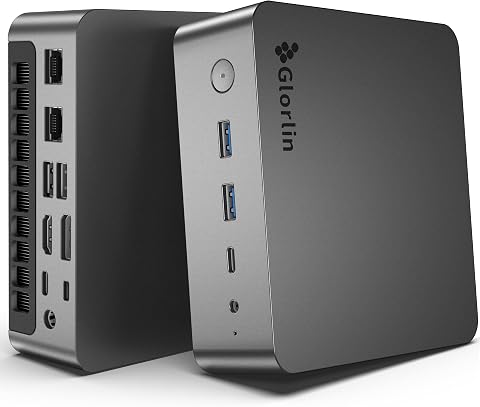 Glorlin AI Mini PC AMD Ryzen 7 Pro 8845HS, 16GB DDR5, 1TB SSD, Gaming & Offic…View on Amazon →
- 9
 GMKtec K15 AI Mini PC Oculink Intel Ultra 5 125U 32GB DDR5 512GB SSD, Desktop…View on Amazon →
Memory Shapes Local AI Choices
For people running models on their own computers, the main practical question is whether the machine has enough memory and storage for the models, datasets and software they intend to use. A 128GB configuration offers more capacity headroom than the 16GB and 32GB configurations identified in the source, but capacity alone does not establish speed, compatibility or the size of model a system can handle successfully.
The roundup also underscores the tradeoff between a high-capacity workstation and a smaller everyday desktop. A buyer doing development or experiments with memory-intensive models may value RAM, graphics capability and fast connectivity; someone using a PC for lighter tasks may not need that expense or footprint. The appropriate choice depends on workload, not simply on whether a processor carries an AI label.
How the Ranking Was Built
ThorstenMeyerAI.com says it ranked the machines by how their stated components match likely uses, weighing processor tier, RAM capacity and type, graphics information, SSD capacity and ports. It says the positions reflect capability for uses such as local models, development, creative work and everyday computing—not price comparisons. The supplied material does not provide prices, so its use of “value” means fit between configuration and need.
The source also cautions that specifications do not establish real-world performance. It reports no workload-specific benchmarks, sustained cooling tests or software-compatibility results. Those gaps matter because model performance can depend on memory bandwidth, thermal behavior, software support and whether an application can use a system’s CPU, integrated graphics or neural processing unit.
“I ranked these AI mini PCs by how well their stated configurations match likely workloads, rather than treating an AI-capable processor as a guarantee of strong local AI performance.”
— ThorstenMeyerAI.com
Performance Data Still Missing
The supplied source does not establish how fast any of the nine systems runs a specific model, how they perform under sustained load, or whether their cooling keeps performance steady. It also does not give complete specifications for every model in the ranking, including the names and details of two entries, so a full nine-way comparison cannot be verified from the material provided.
Other purchase details remain unclear, including prices, memory upgradeability, exact storage expansion options and software compatibility across all models. The source lists some storage and port specifications, but does not provide a common test method or independent results. A processor family or RAM figure should not be treated as a substitute for checking support for the buyer’s intended framework and model.
Check Tests Before Buying
Readers considering one of these systems should compare the full manufacturer configuration with their planned workload, then seek independent benchmarks using the same models and software. They should also confirm memory type and upgrade options, storage slots, network and display connections, cooling behavior, and whether their preferred AI tools support the hardware.
The source provides a ranking and selection advice, but no later testing or price update is included in the supplied material. Until those details are available, the list is best used as a starting shortlist, with final choices based on verified specifications and workload-specific evidence.
Key Questions
Which mini PC does the source rank first?
ThorstenMeyerAI.com names the MINISFORUM MS-S1 MAX its best overall pick, citing its listed Ryzen AI Max+ 395 processor, 128GB of RAM, 2TB SSD and workstation-focused connectivity.
Does the ranking prove which PC runs AI models fastest?
No. The source says its ranking is based on stated configurations and likely workload fit. It does not provide benchmark results or sustained cooling tests for the machines.
Why does RAM capacity matter for local AI?
Memory can limit the models and datasets that fit on a system, particularly when a mini PC relies on integrated graphics. More RAM can provide additional capacity headroom, but does not guarantee faster performance or compatibility.
Is the GEEKOM A9 Max a better choice than a 128GB system?
That depends on the workload. The source lists the A9 Max with a Ryzen AI 9 HX 470, 32GB of RAM and a 2TB SSD, while three other named models have 128GB configurations. The source does not provide benchmark data to settle performance comparisons.
What should buyers check before choosing a model?
Confirm the complete configuration, target software support, memory upgradeability, SSD expansion, ports and workload-specific benchmarks. The source notes that prices and some configuration details are not provided in its supplied material.
Source: ThorstenMeyerAI.com
Halloween Picks
halloween
As an affiliate, we earn on qualifying purchases.