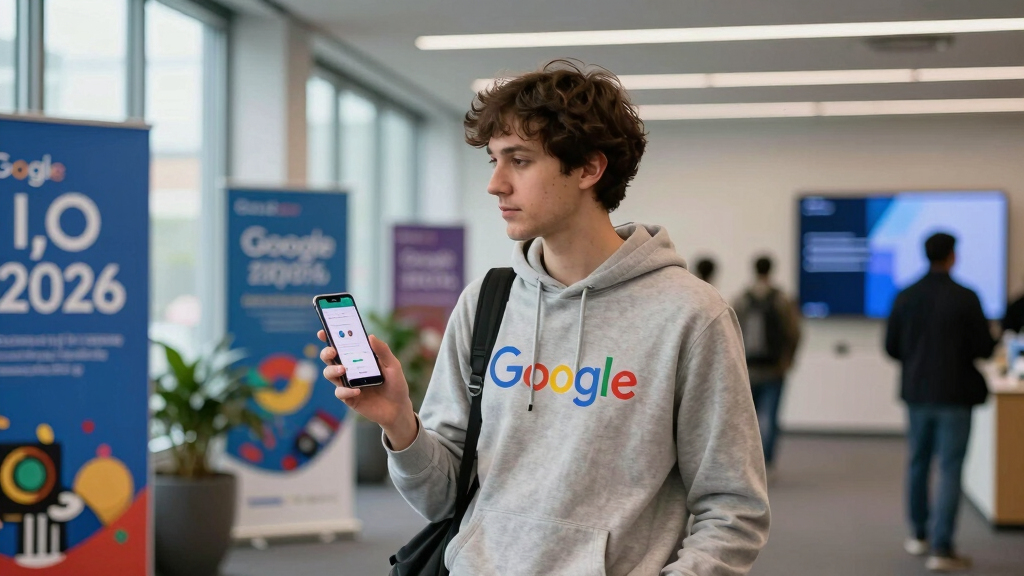

📊 Full opportunity report: The Google I/O 2026 Preview: What May 19-20 Will Reveal About Google’s Agentic Bet on ThorstenMeyerAI.com — validation score, market gap, and execution plan.
TL;DR
Google’s I/O 2026 will showcase major updates on Gemini 4.0, multi-agent protocols, and new XR glasses. Confirmed developments suggest a focus on deploying agentic AI at scale, but live multi-step task demonstrations remain unconfirmed.
Google is set to unveil significant updates on its agentic AI platform during the I/O 2026 developer conference on May 19-20, with confirmed plans including the launch of Gemini 4.0 and expanded multi-agent protocols. These developments are intended to support the transition of AI from demonstrations to practical applications at scale, impacting both enterprise and consumer markets.
Google’s pre-I/O activities, notably the April Cloud Next 2026, confirmed the release of the Gemini Enterprise Agent Platform, an ‘operating system for AI agents’ that supports orchestration, governance, and identity management for enterprise-scale AI. The platform’s capabilities include handling billions of tokens per minute and supporting thousands of agents simultaneously, indicating a robust infrastructure foundation.
At I/O, the company is expected to announce Gemini 4.0, which may feature enhanced agentic capabilities, and an expansion of the A2A (Agent-to-Agent) Protocol, facilitating multi-agent collaboration. Hardware announcements include XR glasses designed for display-free interactions, with a confirmed launch in 2026, and potentially the Aluminum OS for laptops, signaling Google’s cross-platform consumer ambitions.
While the infrastructure and platform updates are confirmed, the demonstration of live, multi-step, agentic task execution remains unverified. The key question is whether Google will showcase real-time, operational agents completing complex tasks on stage, which would support the company’s deployment objectives.
Demo or deployment.
Cloud Next 2026 already shipped the infrastructure. May 19-20 reveals whether consumer-product demonstrations match back-end capability.
Gemini 4.0 expected centerpiece. A2A (Agent-to-Agent) Protocol. Android XR display-free smart glasses confirmed for 2026 launch. Android 17 (Aluminum) general release. Gemini API at 16B tokens/min · 60% QoQ growth · Gemini Enterprise paid MAU +40% QoQ. Five variables reveal deployment-phase thesis credibility.
May 12 · T-7 days
Ten announcements. Five variables.
The most consequential variable: live demonstrations of agentic Gemini completing real multi-step tasks under uncontrolled conditions. The credibility gap between “agent demos” and “production agent deployment” is wide.

XREAL 1S AR/XR Glasses, 500" Virtual Screen Smart Glasses with 52° FOV, Native 3DoF, REAL 3D, Powered by X1 Chip, Supports All USB-C DP Devices Including iPhone 17/16 and Handhelds, like ROG/SteamDeck
Giant Virtual Screen – Immersive Theater Anywhere: Step into a breathtaking virtual screen up to 500 inches, transforming…
As an affiliate, we earn on qualifying purchases.
As an affiliate, we earn on qualifying purchases.
Three scenarios. One event.
30/50/20 probability allocation. Base case represents normal-execution outcome where some announcements deliver and others slip. Cloud Next infrastructure foundation is locked in regardless.
- Live demos succeedRealistic multi-step tasks complete.
- Smart glasses ship Q3-Q4Display version early 2027.
- Aluminum OS concreteSpecific launch timeline.
- Revenue numbers disclosedSpecific Gemini Enterprise scale.
- Outcome: Stock +3-5%. Capex thesis demand-pull validated.
- Some demos succeedSome scenarios pre-recorded.
- Display-free shipsDisplay version unconfirmed.
- Aluminum directionalNo specific launch date.
- Growth-rate disclosureContinued QoQ%, not absolute.
- Outcome: Stock neutral. Continuation trajectory.
- Gemini 4.0 delayedOr scoped down to 3.5.
- Demos pre-recordedConspicuously controlled.
- Smart glasses pushed 2027Apple wins the timing.
- Aluminum stays conceptualNo launch path.
- Outcome: Stock -3 to -7%. Bubble bear case gains evidence.
I/O 2026 either confirms or undermines the agentic deployment thesis at consumer scale. Cloud Next 2026 already established the infrastructure baseline. I/O reveals whether consumer-product deployment substantiates the infrastructure investment.

BNCF 10.1 inch Android 16 Tablet with Gemini AI丨120Hz HD in-Cell Screen丨16(4+12) GB RAM 128GB ROM 1TB TF丨Octa-Core丨Widewine L1丨2.4G/5G WiFi+BT 5.0+GPS丨6000mAh丨Bpad 10 SE
【Latest Android 16 with Built-in Gemini AI】Experience the cutting-edge Android 16 and the power of Gemini AI. Enjoy…
As an affiliate, we earn on qualifying purchases.
As an affiliate, we earn on qualifying purchases.
Four assignments. By role.
Position based on demonstration quality.
Headline announcements primarily affect long-term product positioning rather than near-term financials. Position based on demonstration-quality variables (live demos, revenue disclosure, case studies). The deeper read: I/O provides forward signal on Q3-Q4 2026 Cloud revenue growth trajectory and the hyperscaler capex thesis demand-pull validation.
Watch Firebase / Antigravity / Flutter GenUI.
Developer-toolchain announcements determine ecosystem stickiness. Specific pricing transparency, production deployment patterns, and security guarantees are the criteria. Production-ready announcements vs framework-with-future-shipping signal different competitive trajectories. Gemma open-model expansion vs Llama / DeepSeek positioning matters.
Read announcements for positioning effects.
Strong I/O demonstrations compress addressable space for non-Google players (Anthropic, OpenAI). Weak demonstrations create competitive opening. The Anthropic IPO positioning particularly affected — strong Google announcements raise the bar for enterprise messaging; weak announcements give Anthropic competitive opening into Q3-Q4 2026.
Integrate I/O signal into multi-vendor sourcing.
Cloud Next infrastructure announcements established platform readiness; I/O announcements about consumer/SMB agent deployment establish ecosystem viability beyond enterprise-only positioning. Multi-vendor sourcing strategies should incorporate I/O signal alongside the bubble question dispatch framework for differentiating durable-value from frothy providers.

PROTOCOL FOR LIFE BALANCE Ortho Multi Softgels for Women – Multivitamin with Cranberry, Green Tea & Evening Primrose Oil – Magnesium & Biotin – Egg Free & Halal – 90 Softgels
Comprehensive Softgels for Women: Ortho Multi Softgels for Women supplies a full spectrum of vitamins A, C, D,…
As an affiliate, we earn on qualifying purchases.
As an affiliate, we earn on qualifying purchases.
Implications of Google’s Agentic AI Strategy
This event marks a notable point in Google’s development of AI deployment capabilities, as the company transitions from research demonstrations to practical applications. Confirmed platform enhancements suggest a readiness to support enterprise and consumer AI at advanced levels, potentially influencing digital interactions and productivity tools. The presence or absence of live demonstrations will be observed for insights into the company’s progress.
SMISEACOW Triple Laptop Screen Extender 15.6", 1080P FHD IPS 0.18" Ultra-Slim & 3.9 lbs, Plug-Play Portable Triple Monitor for Laptops Fits 13-17.3" Laptops, Compatible with Win/Mac/Android
【15.6" FHD Screen – Ultra-Slim & Travel Ready】 15.6-inch 1080P IPS display with 1000:1 contrast ratio and 300…
As an affiliate, we earn on qualifying purchases.
As an affiliate, we earn on qualifying purchases.
Pre-I/O Developments and Strategic Positioning
Leading up to I/O, Google’s April Cloud Next 2026 revealed a comprehensive infrastructure foundation, including the Gemini Enterprise Agent Platform, eighth-generation TPUs, and new governance tools. These updates underscore Google’s preparations for scaling agentic AI deployment. The broader industry context involves competition from OpenAI, Apple, Meta, and other tech companies investing in agentic and multimodal AI capabilities, making I/O an important event for Google’s strategy validation.
Previous announcements and industry leaks suggest a focus on multi-agent orchestration, multimodal assistants, and hardware integrations, aligning with Google’s goal of embedding agentic AI into everyday devices and workflows.
“Google’s upcoming I/O will assess whether its infrastructure can support real-time, multi-agent AI deployments at scale, transitioning from demonstrations to operational systems.”
— Thorsten Meyer, May 2026
“Our platform now handles billions of tokens per minute and supports thousands of agents, establishing a foundation for broader deployment.”
— Google executive, April 2026
Unconfirmed Live Multi-Step Agent Demonstrations
It remains uncertain whether Google will present live, multi-step agentic tasks during I/O, as most demonstrations to date have been pre-recorded or simulated. The key question is whether the company can convincingly demonstrate agents executing complex tasks in real time, which is relevant for validating their deployment objectives.
Next Steps After I/O 2026 Announcements
After the event, Google is likely to focus on deploying new hardware such as XR glasses and the Aluminum OS, along with updating Gemini 4.0 and expanding multi-agent protocols. The company may also conduct further live demonstrations or pilot programs to evaluate real-world agentic AI capabilities. Industry analysts will monitor Google’s progress in translating infrastructure advancements into consumer and enterprise products.
Key Questions
Will Google demonstrate live multi-step AI tasks at I/O 2026?
It has not been confirmed. While there may be demonstrations, whether real-time, multi-step tasks will be shown remains uncertain.
What hardware products are expected at I/O 2026?
Confirmed products include XR glasses designed for display-free interactions and potentially the Aluminum OS for laptops, reflecting Google’s cross-platform ambitions.
How significant is Gemini 4.0 for Google’s AI strategy?
Gemini 4.0 is expected to be a significant upgrade, potentially supporting advanced agentic capabilities that could facilitate large-scale deployment of AI agents across various domains.
What does the expansion of the A2A Protocol imply?
The expansion aims to enable multi-agent collaboration, which could lead to more complex, autonomous AI systems working together in real-world applications.
How might these developments affect consumers and enterprises?
For consumers, new hardware and multimodal assistants could improve daily interactions; for enterprises, scalable agent platforms could enhance automation and productivity workflows.
Source: ThorstenMeyerAI.com