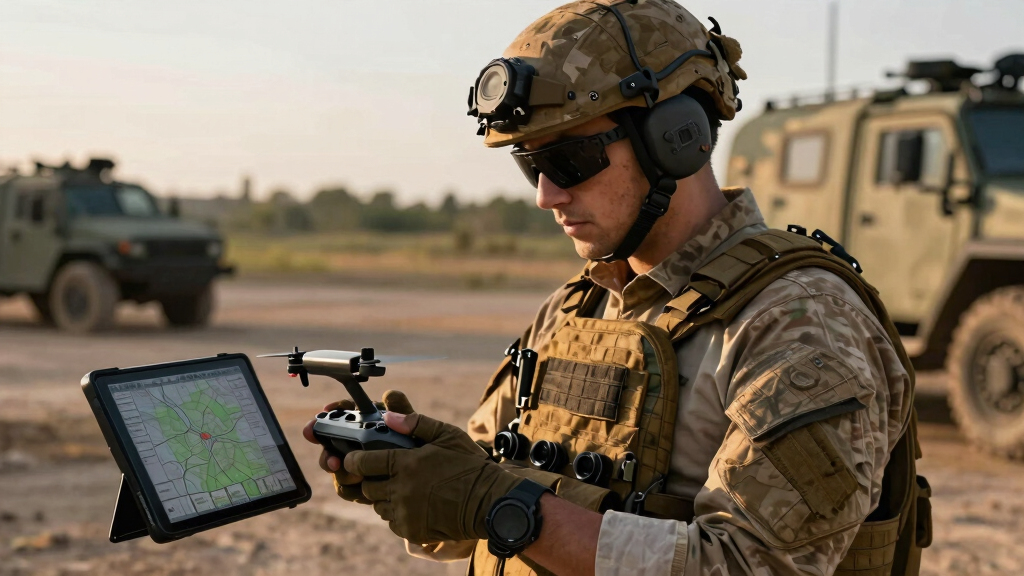

📊 Full opportunity report: Software-Defined Warfare: How Ukraine’s Delta Turned The Battlefield Into A Shared, Real-Time Map on ThorstenMeyerAI.com — validation score, market gap, and execution plan.

Get movie nights delivered free with Prime
- Fast, free delivery on millions of items
- Prime Video, Amazon Music and more included
- Member-only deals all year
TL;DR
Ukraine has deployed Delta, a cloud-based, browser-accessible battlefield management system, marking a shift toward software-defined warfare. It fuses real-time intelligence from diverse sources to improve operational speed and resilience. The system is credited with significantly aiding Ukraine’s recent counteroffensive efforts.
Ukraine has officially deployed Delta, a cloud-native battlefield management system that runs on standard web browsers, providing real-time situational awareness to frontline troops. This move exemplifies the emerging concept of software-defined warfare, shifting advantage from hardware platforms to data and software agility, and is considered a significant technological breakthrough in modern military operations.
Delta was developed through a collaboration between Ukraine’s military, NGO Aerorozvidka, the Defense Ministry’s innovation center, and the Ministry of Digital Transformation. It integrates inputs from drones, satellite imagery, sensor networks, and intelligence sources, all geolocated and displayed in a unified, real-time map accessible via any device with a browser. The system’s backend is hosted outside Ukraine to safeguard against missile and cyber threats, ensuring operational resilience.
During Ukraine’s recent counteroffensive near Kyiv, the Defense Ministry reported Delta helped identify approximately 1,500 enemy targets daily, though this figure is based on wartime claims and cannot be independently verified. Its tight integration with drone operations and sensor data allows for rapid decision-making, reducing the time from observation to action.
Software-defined warfare: how Ukraine’s Delta turned the battlefield into a shared, real-time map
A soldier opens a browser and sees the fused war — drones, satellites, sensors and vetted reports on one live map. The backend is a cloud deliberately hosted abroad so a missile can’t take it down. The clearest case yet of treating warfare as software.
Optical sensors go blind in cloud & dark; an all-weather SAR radar layer — the kind VigilSAR produces — slots into a picture like this as one resilient, sovereign input. vigilsar.com · And note the paradox: to survive missiles & cyberattack, Ukraine hosted its crown-jewel cloud outside its own borders — trading physical sovereignty for operational survivability. Resilience through distribution.
Delta’s lasting lesson isn’t a piece of software — it’s a model of how to build: commodity clients, cloud backend, open standards, relentless iteration, fusion over hardware, and resilience through distribution. It’s why a wartime NGO out-shipped procurement bureaucracies on a fraction of the budget. The platform mattered less than the picture — and the picture is software. Own the fusion layer, own the sovereign feeds into it, and get it to the edge.
Impact of Cloud-Based, Browser-Accessible Battlefield Management
Delta’s deployment demonstrates a major shift in military technology, emphasizing software-defined warfare where data and software agility provide strategic advantage. The system’s cloud-hosted architecture and use of commodity hardware enable widespread frontline access, democratizing battlefield intelligence and coordination. This approach could influence future military designs by reducing reliance on proprietary, hardware-locked systems and increasing resilience against cyber and missile attacks.
Furthermore, Delta’s success highlights a new organizational model—collaborative, rapid, and adaptable—potentially redefining how militaries develop and deploy battlefield software globally. It underscores the importance of fusion and real-time data integration in modern combat, especially in contested environments where traditional systems may be vulnerable.
Popular right now

Philips 4400 Series Fully Automatic Espresso Machine with LatteGo Milk System

De'Longhi Dinamica Plus Fully Automatic Espresso Machine

KitchenAid Classic Series 4.5-Quart Tilt-Head Stand Mixer, Onyx Black
As an affiliate, we earn on qualifying purchases.
Development and Significance of Ukraine’s Digital Battlefield Approach
The concept of software-defined warfare traces back to NATO initiatives in 2017 aimed at breaking down information silos inherited from Soviet-era systems. Ukraine’s Delta system emerged from this lineage, representing a shift toward interoperability, rapid development, and open standards. Its creation involved a startup-like collaboration among military, civilian, and NGO actors, emphasizing speed and flexibility over traditional procurement cycles.
Prior to Delta, Ukraine relied on legacy systems that were hardware-dependent and siloed, limiting frontline access to intelligence. The new system’s cloud-based architecture and browser compatibility have enabled broader deployment and faster updates, giving Ukrainian forces a tactical edge during recent operations. The decision to host critical components outside Ukraine was driven by the need to protect against missile and cyber threats, reflecting a strategic approach to sovereignty and resilience.
“Delta is a game-changer. It shortens the decision cycle and democratizes access to battlefield intelligence.”
— Mykhailo Fedorov, Ukrainian Minister of Digital Transformation
Unverified Claims and Operational Security Details
While Ukraine reports high target identification figures and operational success, independent verification is limited. Details about the exact integration with drone operations and the full scope of Delta’s capabilities remain undisclosed due to security reasons. The precise impact on battlefield outcomes, beyond official claims, is still emerging.
Future Deployment and Potential Global Influence of Delta
Ukraine plans to expand Delta’s deployment and refine its capabilities, potentially integrating more sensors and AI-driven analytics. Other militaries are closely studying Ukraine’s approach, and similar systems could influence NATO and allied forces’ future battlefield software strategies. Monitoring how Delta adapts to evolving threats and operational needs will be key in the coming months.
Key Questions
How does Delta differ from traditional battlefield systems?
Delta runs on a cloud backend accessible via standard browsers, unlike legacy systems that rely on proprietary, hardware-locked consoles. It integrates diverse data sources in real time, enabling faster decision-making and broader frontline access.
Is Delta’s success confirmed by independent sources?
Most claims are based on Ukrainian official reports; independent verification is limited. The system’s operational impact is acknowledged but not fully independently confirmed.
Why did Ukraine host Delta’s cloud outside the country?
Hosting outside Ukraine was a strategic decision to protect the system from missile and cyber attacks, ensuring resilience and continuous operation during conflict.
Could similar systems be adopted by other countries?
Yes, other militaries are studying Ukraine’s approach, and the concept of software-defined warfare is gaining interest globally, especially for enhancing interoperability and resilience.
What are the limitations of Delta currently?
Details about integration specifics and full operational capabilities remain classified. The system’s real-world impact, beyond official claims, is still being assessed.
Source: ThorstenMeyerAI.com