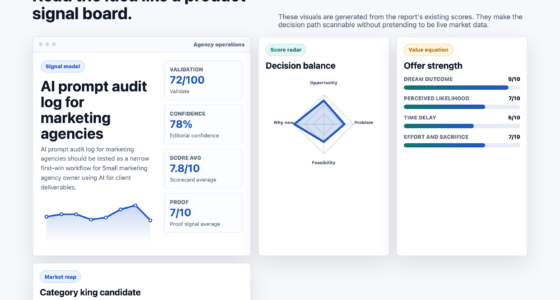

📊 Full opportunity report: How Benchmark Partners View AI Differently Than The Zero-Sum Crowd on ThorstenMeyerAI.com — validation score, market gap, and execution plan.
TL;DR
Benchmark partner Eric Vishria warns against zero-sum thinking in AI markets, highlighting the potential for multiple large winners across layers. He emphasizes the importance of differentiation and the unique value of hardware expertise, contrasting this with common misconceptions.
Eric Vishria, a General Partner at Benchmark, has publicly challenged the common perception that AI markets are zero-sum, emphasizing instead that the market is large and capable of supporting multiple significant winners. His insights, shared in a recent interview, suggest that the conventional wisdom of one dominant player or a few winners is misleading and risks misallocating resources.
Vishria draws a parallel between the evolution of cloud computing and AI, highlighting how early skepticism about Amazon Web Services (AWS) was eventually replaced by recognition of a multi-vendor oligopoly, with companies like Snowflake, Databricks, and Cloudflare emerging as large, independent players. He argues that this pattern applies to AI, where many layers—models, hardware, inference providers—will host several large winners rather than a single dominant entity.
He emphasizes that the entire AI ecosystem is not a fixed pie, but an expanding one, with different companies excelling at different layers. Vishria warns against the trap of assuming that one company will capture all value, citing the cloud era as proof that multiple firms can thrive simultaneously. This perspective encourages investors and companies to focus on differentiation and niche strengths rather than chasing monopolistic ambitions.
Additionally, Vishria highlights the misconception that open-source models and commodity hardware are purely interchangeable. His example of Fireworks demonstrates that specialized expertise can yield significant efficiency advantages, creating durable moats even in seemingly commoditized segments. He also underscores the importance of control over hardware, exemplified by Cerebras, which develops chips that outperform general-purpose hardware through tailored design, illustrating how hardware innovation remains a critical competitive advantage.
Distilled from Eric Vishria (Benchmark) on Invest Like the Best. Less a set of predictions than a set of disciplines for reading this moment clearly rather than emotionally. Not investment advice.
The error that runs through every wrong AI prediction: carving up a fixed pie when the pie is exploding. The cloud era is the cautionary tale.
Why Multiple Winners in AI Change Investment Strategies
This perspective shifts how investors and companies should approach AI. Instead of betting on a single winner or assuming markets are limited, stakeholders should recognize the potential for many large, profitable firms across different layers. This reduces the risk of overconcentration and encourages innovation at various points of the AI stack, fostering a more resilient ecosystem that can adapt to rapid technological progress.
Furthermore, understanding the importance of differentiation and hardware control can lead to more sustainable business models. Companies that develop specialized expertise or control critical infrastructure will be better positioned to withstand competitive pressures, ensuring long-term viability in a rapidly evolving market.
As an affiliate, we earn on qualifying purchases.
Evolution of Cloud and Lessons for AI Market Structure
The cloud industry's history demonstrates how initial skepticism about dominant players like Amazon shifted as multiple vendors carved out significant market shares. From 2007 to 2026, the cloud market evolved from a perceived threat of monopoly to a competitive oligopoly, with no single company controlling the entire landscape. Companies like Snowflake, Databricks, and Cloudflare emerged as large, independent entities, illustrating that a large, multi-winner ecosystem is sustainable.
This history informs Vishria's view that AI will follow a similar path. The market for AI infrastructure, models, and inference services is too large to be monopolized by one firm, and multiple companies will thrive by focusing on their unique strengths and niches.
"The market was simply too big for one vendor to consume. Snowflake built a $100B+ company on top of Amazon, competing directly with Amazon's own Redshift — 'out-Amazoning Amazon on Amazon.'"
— Eric Vishria
As an affiliate, we earn on qualifying purchases.
Unclear Aspects of AI Market Evolution and Competition
It remains uncertain how quickly different layers of the AI ecosystem will consolidate or diversify. While Vishria advocates for multiple winners, the pace of hardware innovation, model development, and infrastructure differentiation could accelerate or slow, impacting market dynamics. Additionally, regulatory developments and geopolitical factors might influence how many firms can sustainably operate and compete at large scale.
Further, the specific composition of future dominant players and their strategic focus areas are still emerging, making precise predictions difficult at this stage.

The Machine Learning Solutions Architect Handbook: Practical strategies and best practices on the ML lifecycle, system design, MLOps, and generative AI
As an affiliate, we earn on qualifying purchases.
As an affiliate, we earn on qualifying purchases.
Next Steps for Investors and Companies in AI Ecosystem
Stakeholders should focus on differentiating their offerings and developing expertise in niche areas or hardware innovation. Monitoring how existing large players expand across layers will be critical, as will investments in specialized hardware and infrastructure that can create barriers to entry. Additionally, observing regulatory and geopolitical shifts will inform strategic positioning in this expanding landscape.
Continued analysis of how multiple firms carve out sustainable, large-scale positions will be essential for understanding the evolving AI market structure.

Local AI Engineering with Ollama: Run, understand, customize, fine-tune, and build agentic apps on your own hardware
As an affiliate, we earn on qualifying purchases.
As an affiliate, we earn on qualifying purchases.
Key Questions
Does this mean there will be no AI monopolies?
Vishria suggests that the AI market, like cloud, is more likely to support multiple large winners rather than a single monopoly, due to its vast size and layered structure.
Why is differentiation so important in AI businesses?
Because many segments and layers can look similar or commoditized, strong differentiation—through expertise, hardware control, or niche focus—is key to building durable, profitable businesses.
How does hardware control influence AI competitiveness?
Hardware control allows companies to optimize performance and efficiency, creating barriers to competitors and enabling sustained advantage, as exemplified by Cerebras' specialized chips.
Will the AI market follow the cloud's evolution?
Most likely, yes. The cloud's evolution from skepticism to a multi-vendor oligopoly demonstrates that AI will similarly support multiple large, sustainable winners across different layers.
Source: ThorstenMeyerAI.com