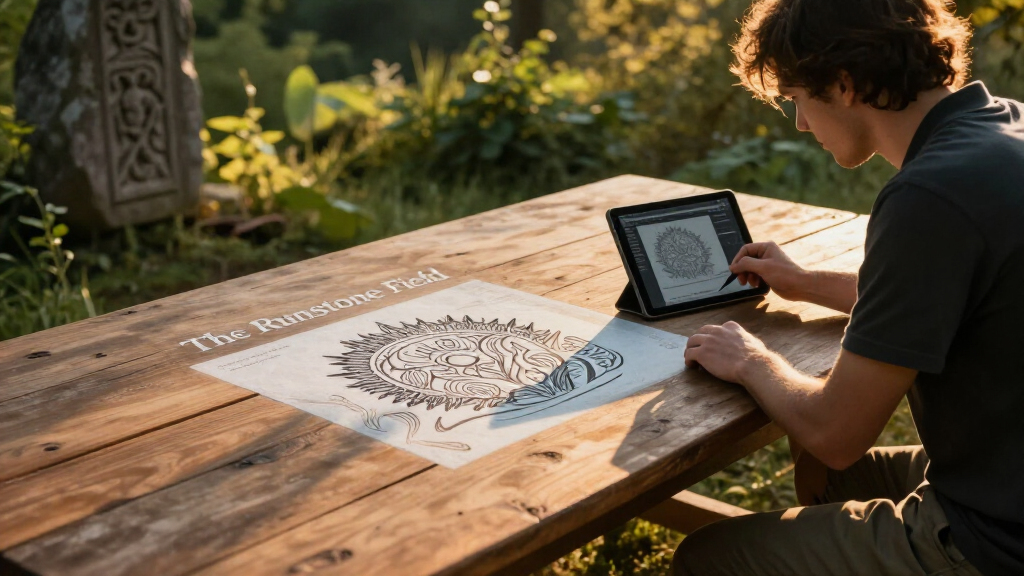

🔍 Read the full analysis: Exploring AI In SVG Carving Animation: Inside 'The Runestone Field' Project on ThorstenMeyerAI.com
TL;DR
The ‘Runestone Field’ project employs AI-powered SVG carving animation to animate ancient runic carvings, creating an immersive digital storytelling experience. This innovative approach bridges history and technology, showcasing new possibilities in visual design.
‘The Runestone Field’ project has successfully integrated artificial intelligence with SVG carving animation to bring ancient runic inscriptions to life. Developed by Thorsten Meyer’s team, this immersive digital experience transforms static historical carvings into dynamic narratives, highlighting the potential of automation in storytelling and visual art. The project demonstrates how modern technology can enhance appreciation of traditional craftsmanship while opening new avenues for digital art and cultural preservation.
The project, titled ‘The Runestone Field’, employs advanced SVG (Scalable Vector Graphics) techniques combined with AI-driven automation to animate the intricate carvings found on ancient runestones. By meticulously designing SVG paths that mimic the carvings’ textures and contours, the team created fluid animations that make the runes appear as if they are speaking or moving. This approach allows viewers to explore every detail of the carvings, almost as if the stones themselves are narrating their stories anew.
According to Thorsten Meyer, the process involved developing a step-by-step workflow where AI algorithms assisted in generating precise SVG paths based on scanned images of real runestones. The automation reduced manual effort while maintaining high fidelity to the original carvings. The project also integrated fluid animation techniques to simulate the carving process, creating a seamless visual experience. The team showcased the final piece in a live digital environment, inviting viewers to interact with the animated runes and explore their historical context.
While the project’s technical foundation is confirmed, details about the specific AI models used and the scalability of this method for broader applications remain under development. The team emphasizes that this is a proof of concept demonstrating the synergy between AI, SVG animation, and traditional storytelling, rather than a commercial product at this stage.
Exploring AI in SVG Carving Animation: Inside ‘The Runestone Field’
How Thorsten Meyer’s team fused artificial intelligence with Scalable Vector Graphics to make millennium-old runic inscriptions move, speak, and tell their stories again — a proof of concept bridging ancient craft and modern automation.
Ancient Runestones Meet Digital Innovation
Runestones are Scandinavian monuments carved with runic inscriptions, historically serving as memorials, markers, and storytelling devices. Where earlier digital reconstruction stopped at static images or 3D models, ‘The Runestone Field’ animates the carvings themselves — giving viewers a sense of movement and life.
Living Archive
A new way to digitally archive and animate artifacts, making history more accessible and engaging for diverse audiences.
Stones That Speak
Fluid SVG animation makes the runes appear as if narrating their own stories — each texture and contour explored in full detail.
A New Benchmark
The immersive experience sets a precedent for blending traditional craftsmanship with cutting-edge technology in cultural heritage.
From Stone Scan to Speaking Rune
Meyer describes a step-by-step pipeline in which AI algorithms generate precise SVG paths from scanned images, reducing manual effort while maintaining high fidelity to the original carvings.
Scan Runestone
High-quality digital captures of real carved stones feed the pipeline.
AI Path Generation
Algorithms convert scans into precise SVG paths mimicking textures and contours.
Carving Simulation
Fluid animation techniques simulate the carving process itself.
Live Showcase
Viewers interact with animated runes and explore their historical context.
Confirmed vs. Under Development
What’s Confirmed
AI-assisted SVG path generation from scans, fluid carving simulation, an interactive live digital environment, and demonstrated synergy between AI, SVG animation, and traditional storytelling.
What’s Undisclosed
Specific AI models and training data are not public. Scalability across larger artifact collections, different carving styles, and long-term archival integration remain under discussion.
Straight Answers
| Question | Answer | Status |
|---|---|---|
| How does AI improve the SVG carving process? | It auto-generates precise SVG paths from carving images, reducing manual effort and increasing accuracy in recreating textures and contours. | ✓ Confirmed |
| Usable for other historical artifacts? | Yes — adaptable to various carvings and artifacts, provided suitable digital scans or images feed the AI system. | ✓ Yes |
| Available for public viewing? | Showcased in a live digital environment with interactive exploration of the animated runes. | ✓ Live |
| Current limitations? | Undisclosed AI models, potential scalability issues, and reliance on high-quality scans for optimal results. | ~ Partial |
| Will it replace traditional methods? | No — a complementary digital tool for storytelling and preservation, not a substitute for physical artifacts. | ✗ No |
Future Applications & Broader Adoption
The team plans to extend the technique to other historical carvings, build a more automated pipeline for larger datasets, integrate interactive and augmented-reality features, and publish detailed methodology papers for the digital art and archaeology communities.
Innovative Fusion of Ancient Art and Modern Tech
This project highlights a significant advancement in digital storytelling, where AI and SVG animation can revitalize historical artifacts. It demonstrates how automation can streamline the recreation of detailed carvings, making it easier to produce high-quality visualizations at scale. For cultural preservation, this approach offers a new way to digitally archive and animate artifacts, making history more accessible and engaging for diverse audiences. The immersive experience also sets a precedent for future projects blending traditional craftsmanship with cutting-edge technology, potentially transforming how we interact with cultural heritage online.
As an affiliate, we earn on qualifying purchases.
Traditional Runestones Meet Digital Innovation
Runestones are ancient monuments carved with runic inscriptions, primarily from Scandinavia, dating back over a millennium. Historically, these carvings served as memorials, markers, or storytelling devices. In recent years, digital artists have sought new ways to interpret and preserve these artifacts. The use of SVG (Scalable Vector Graphics) for animation is a recent development, allowing detailed, scalable visualizations that can be animated without loss of quality. The integration of AI into this process is a novel step, enabling automated generation of complex SVG paths from images or scans of real runestones. This development aligns with broader trends in digital archaeology and cultural preservation, where technology aids in both analysis and presentation.
Previous efforts in digital reconstruction focused mainly on static images or 3D models. The ‘Runestone Field’ project pushes this further by animating the carvings, giving viewers a sense of movement and life. The project builds on existing digital art techniques but introduces AI as a tool to significantly reduce manual effort and increase accuracy, marking a notable evolution in the field.
As an affiliate, we earn on qualifying purchases.
Unconfirmed Details About AI and Animation Techniques
While the project’s overall success is confirmed, specific details about the AI models employed and their training data are not publicly disclosed. It remains unclear how scalable this approach is for larger collections of artifacts or different styles of carvings. Additionally, the long-term durability of the digital animations and their integration into broader cultural archives are still under discussion. Further technical disclosures are expected as the project progresses.
As an affiliate, we earn on qualifying purchases.
Future Applications and Broader Adoption of Technology
Thorsten Meyer’s team plans to expand the project by applying the AI SVG carving technique to other types of historical carvings and artifacts. They aim to develop a more automated pipeline that can handle larger datasets, making digital preservation more efficient. Additionally, there are discussions about integrating interactive features, such as user-driven exploration or augmented reality overlays, to enhance engagement. The team also intends to publish detailed technical papers to share their methodology with the wider digital art and archaeology communities.
As an affiliate, we earn on qualifying purchases.
Key Questions
How does AI improve the SVG carving animation process?
AI assists by automatically generating precise SVG paths from images of carvings, reducing manual effort and increasing accuracy in recreating detailed textures and contours.
Can this technique be used for other historical artifacts?
Yes, the approach is adaptable to various types of carvings and artifacts, provided there are suitable digital scans or images to feed into the AI system.
Is this project available for public viewing?
Yes, the project has been showcased in a live digital environment, allowing viewers to explore the animated runes interactively.
What are the limitations of the current technology?
Limitations include the lack of detailed disclosure about the AI models used, potential scalability issues, and the need for high-quality digital scans of artifacts for optimal results.
Will this approach replace traditional carving or preservation methods?
No, it is intended as a complementary digital tool for storytelling and preservation, not a replacement for physical artifacts or traditional methods.
Source: ThorstenMeyerAI.com