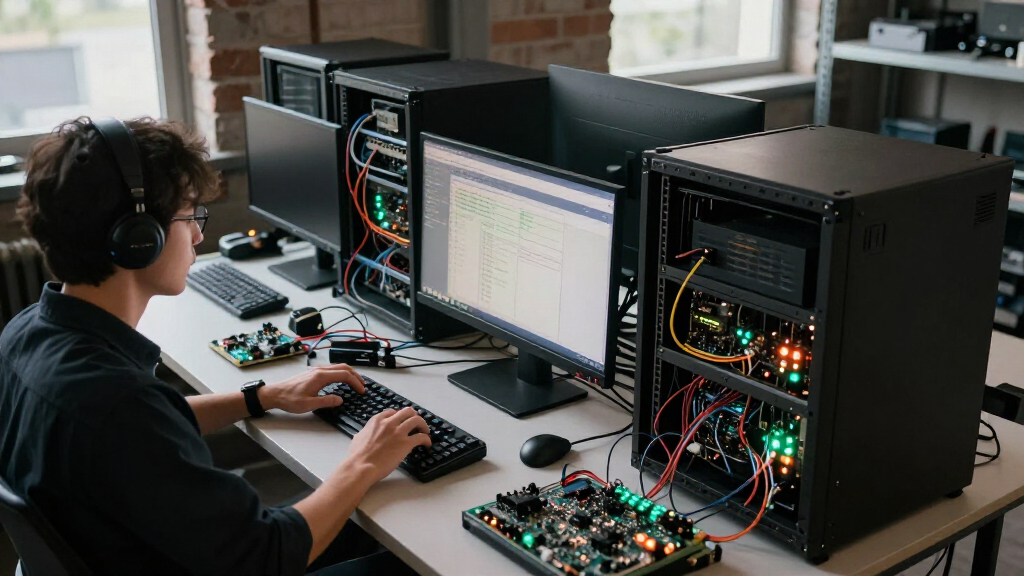

🔍 Read the full analysis: Unveiling AI II: Exploring The Engine Room Behind Twelve Machines on ThorstenMeyerAI.com

Get movie nights delivered free — and shop member deals
- Fast, free delivery on millions of items
- Access to Prime Big Deal Days deals on October 6–7
- Prime Video, Amazon Music and more included
TL;DR
The ‘Inside AI II’ series introduces twelve machines that explain how AI chatbots work internally. It offers a detailed look at the processes behind language understanding, with insights accessible in your browser. The series clarifies complex AI concepts for a broader audience.
The ‘Inside AI II’ series has been released, providing an interactive exploration of the engine room behind twelve key AI models used in chatbots. Developed by Thorsten Meyer, this series offers a detailed, accessible look at how AI processes language, running directly in browsers without sign-up or tracking. This release aims to demystify AI’s inner workings for a broad audience, from tech enthusiasts to curious newcomers.
The series features twelve virtual machines, each answering specific questions about AI’s internal processes, such as tokenization, word meaning, attention mechanisms, and model size. These models operate entirely in the browser, requiring no downloads or personal data collection, and are designed to run on phones, tablets, and computers alike.
Each machine illustrates a core aspect of AI language models. For example, one demonstrates how words are broken into tokens, while another explains how models map words onto high-dimensional spaces called embeddings. The series emphasizes that these models perform inference — generating responses by predicting the next word based on learned patterns — rather than understanding in a human sense.
Developed as Part 2 of the ‘Inside AI’ series, it builds on the first part, which answered foundational questions about AI, by providing a more technical, hands-on view of the processes involved in chatbot responses. The initiative is aimed at increasing transparency and understanding of AI technology among the general public and developers alike.
Unveiling AI II: Exploring the Engine Room Behind Twelve Machines
Step inside the stages behind chatbot responses. Twelve browser-based machines make language processing easier to explore, from breaking words into tokens to predicting what comes next.
Twelve windows into how language models work
01 / Inside the engine roomThe series turns abstract ideas into hands-on visual explanations. Each machine focuses on a core part of language processing; together, they show how a prompt becomes a generated reply.
Tokenization
See how text is divided into smaller units a model can process.
Word meaning
Explore how words are mapped into high-dimensional embedding spaces.
Attention
Visualize how a model weighs relationships across the input.
Model size
Consider how model scale relates to capability and computation.
Conversation limits
Understand why earlier parts of a long conversation can fall out of context.
Language in motion
Explore additional concepts behind the steps from prompt to response.
From a prompt to a predicted next word
02 / A simplified flowThese visualizations offer a guided view of the process. Real systems contain far more stages and parameters than a compact diagram can show.
Prompt
A person enters text.
Tokens
Text is split into processable units.
Patterns
Representations and context shape predictions.
Inference
The model scores likely continuations.
Response
Tokens are generated into an answer.
What the series can—and cannot—show
03 / Read the model carefullyMake hidden ideas visible
Interactive examples help newcomers and developers build intuition about language processing and ask better questions about AI systems.
- Explains key concepts without requiring technical background
- Runs across common personal devices in a browser
- Offers a hands-on complement to foundational AI explanations
A teaching aid, not a replica
The machines simplify systems that may involve hundreds of stages and billions of parameters. They do not reproduce every detail of commercial models.
- Does not fully explain errors, bias, or safety concerns
- Cannot capture every nuance of language or reasoning
- Visual clarity does not guarantee a complete account
Think of it as a map, not the territory.
The series illustrates selected mechanics to build understanding. Its diagrams are not measurements of how closely a visualization matches a particular commercial system.
Illustrative spectrum only; bar lengths are not empirical scores.
From basic questions to a clearer view
04 / Why transparency mattersBuild from foundations
The first “Inside AI” installment answers foundational questions. Part II moves toward a more technical, hands-on look at the processes behind chatbot replies.
Broaden the learning path
Future directions include more advanced models, user feedback, more accurate representations, and possible partnerships with educators and industry.
Curiosity is a good place to start.
Explore the machines to see how language models process text—and keep their simplifications in mind when drawing conclusions.
Questions readers ask
05 / Quick answersCan I use it on a phone or tablet?
Yes. The series is designed to run in a browser on phones, tablets, and computers, without sign-up or tracking.
Are these exact copies of real AI models?
No. They are simplified educational versions that illustrate concepts rather than reproduce the complexity of systems such as GPT-4.
Will it explain why AI makes mistakes?
Partly. The visualizations clarify some processing steps, but specific errors and biases need deeper analysis.
Is it suitable for non-technical readers?
Yes. It aims to make complex processes approachable without requiring prior technical knowledge.
What does the series leave out?
It simplifies the scale and intricacy of commercial systems and does not cover ethical or safety issues in depth.
Why make AI more transparent?
Clearer explanations can help people understand capabilities and limitations as AI becomes part of everyday life.
Understanding AI’s Inner Workings Is Key to Transparency
This series matters because it offers a rare, detailed look inside AI models, helping users understand how chatbots generate responses. As AI becomes more integrated into daily life, transparency about its processes can foster trust and inform responsible use. It also serves as an educational tool, demystifying complex concepts that often seem opaque or inaccessible to non-experts.
By exploring these twelve machines, users gain insight into the limitations and capabilities of current AI technology, such as how models forget earlier parts of long conversations or how size and training data influence performance. This understanding is crucial as AI continues to evolve and expand into new applications.
As an affiliate, we earn on qualifying purchases.
From Basic Questions to Complex Processes in AI Development
The ‘Inside AI’ series originates from a desire to answer common questions about AI, starting with simple explanations in Part 1. Part 2 advances this effort by providing interactive models that simulate the internal stages of language processing. These developments align with broader trends in AI research, which aim to make models more interpretable and accessible.
Historically, AI models grew larger and more complex, with billions of parameters enabling more nuanced language understanding. However, the inner mechanisms remained largely opaque. This series offers a practical way to visualize and understand those mechanisms, making advanced AI concepts more tangible for a wider audience.
The series also reflects ongoing industry efforts to improve AI transparency, as organizations recognize the importance of explaining how models work to users, regulators, and developers.
“Our goal is to make the inner workings of AI models understandable and accessible, so everyone can see what happens behind the scenes.”
— Thorsten Meyer, series creator
As an affiliate, we earn on qualifying purchases.
What Aspects of AI Processing Are Still Simplified or Unknown
While the series offers valuable insights, it simplifies some complex processes. For example, the models are approximations of real AI, which involve hundreds of stages and billions of parameters that are difficult to fully visualize or explain. The series does not cover every detail of large-scale models like GPT-4 or GPT-3, nor does it address emerging issues such as biases or safety concerns.
It remains unclear how accurately these interactive machines reflect the full complexity of commercial AI systems, and whether they can capture all nuances of language understanding or reasoning capabilities. Additionally, the long-term implications of increased transparency through such tools are still being explored.
As an affiliate, we earn on qualifying purchases.
Expanding Transparency and Educational Outreach in AI
Next steps include expanding the series to cover more advanced models and integrating user feedback to improve interactivity. Developers may also incorporate these visualization tools into broader AI literacy initiatives, helping users better understand and trust AI systems.
Further research may focus on making these models more accurate representations of commercial AI, including explanations of biases and safety features. Additionally, there is potential for collaboration with educational institutions and industry to foster wider AI literacy.
As an affiliate, we earn on qualifying purchases.
Key Questions
How accurate are these interactive machines in representing real AI models?
The machines are simplified, educational versions that illustrate key concepts but do not capture all complexities of large-scale AI systems like GPT-4. They serve as visual aids rather than exact replicas.
Can I run these models on my phone or tablet?
Yes, the series is designed to run directly in your browser on phones, tablets, and computers without sign-up or tracking, making it accessible for a wide audience.
Will this help me understand how AI makes mistakes?
Partially. The visualizations clarify how models process language, but understanding specific errors or biases requires deeper analysis beyond these simplified models.
Is this series suitable for non-technical audiences?
Yes, the series aims to make complex AI processes accessible to all, with explanations that do not require prior technical knowledge.
What are the limitations of this series?
While informative, it simplifies many aspects of AI, especially the vast scale and intricacies of commercial models. It also does not cover ethical or safety issues in depth.
Source: ThorstenMeyerAI.com
Fall Picks
fall essentials
As an affiliate, we earn on qualifying purchases.