
📊 Full opportunity report: How To Audit Your Workflow For Automation Readiness on IdeaNavigator AI — validation score, market gap, and execution plan.

Get movie nights delivered free with Prime
- Fast, free delivery on millions of items
- Prime Video, Amazon Music and more included
- Member-only deals all year
TL;DR
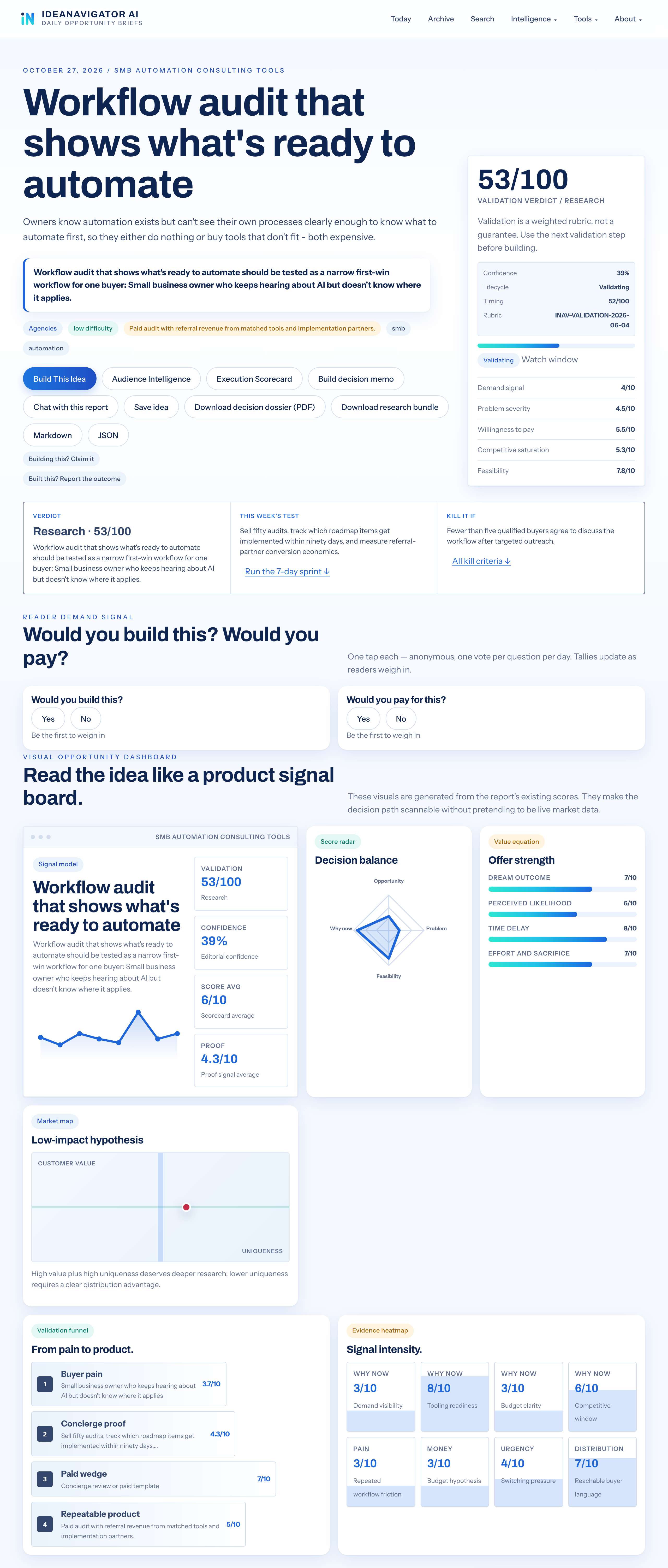
IdeaNavigator AI describes a proposed paid audit that interviews small-business owners about their operations and ranks processes by automation readiness, potential return and difficulty. It is a product concept, not a reported launch or proven service; the proposed test is to sell 50 audits and track implementation and referral conversions over 90 days.
IdeaNavigator AI has proposed a workflow-audit service for small-business owners who are unsure where automation fits in their operations. In the concept description published on IdeaNavigator AI’s website, the service would use a guided interview to map business processes, score potential automation opportunities and produce a sequenced 90-day roadmap. The description does not report a launch or validation results.
IdeaNavigator AI says the proposed service is aimed at owners who hear about AI and automation but cannot readily identify which of their own tasks are suitable candidates. The company says this uncertainty can leave businesses either doing nothing or purchasing tools that do not fit their processes. These are claims in the product description, not findings from a published customer study.
In the proposed minimum viable product, an owner would answer guided questions about how the business operates, much like the planning involved in building an AI workflow automation checklist. According to IdeaNavigator AI’s description, the service would turn those responses into a process map and assess each candidate workflow for automation readiness, potential return on investment and difficulty. It would then recommend an order of work over 90 days and suggest AI workflow automation tools for individual steps.
IdeaNavigator AI proposes combining a paid audit with possible referral revenue from recommended software and implementation partners. For validation, the company proposes selling 50 audits and tracking which roadmap items are implemented within 90 days, as well as the economics of referrals to partners. The description supplies no prices, partner agreements, conversion results or implementation figures.
Small business · Product concept
How To Audit Your Workflow For Automation Readiness
IdeaNavigator AI proposes a guided audit to map business processes, rank automation opportunities and create a sequenced 90-day roadmap. The concept has not been reported as launched or validated.
01 / The proposed audit
From owner interview to action plan
The service is aimed at owners who see automation options but need help identifying suitable work inside their own operations.
Guided interview
Ask how the business operates and where routine work happens, then use the answers to map processes.
Rank candidates
Evaluate workflows for automation readiness, potential return on investment and implementation difficulty.
90-day roadmap
Recommend an order of work and suggest tools for individual steps, with possible partner support.
02 / Intended customer journey
Make the decision process visible
Process mapping is the proposed bridge between broad interest in AI tools and specific business decisions.
Describe work
Owner answers guided questions about operations and recurring tasks.
Map processes
Responses become a view of how work currently moves through the business.
Score options
Candidate workflows are assessed for readiness, return potential and difficulty.
Recommend next steps
Roadmap priorities and possible tools are arranged across a 90-day period.
03 / The business model
Two proposed revenue paths
The description outlines possible revenue sources but provides no prices, partner agreements or conversion figures.
Audit fee
Customers would pay for an operational interview, process map, opportunity assessment and sequenced recommendations.
Pricing and delivery details are not disclosed. It is also unclear whether a human specialist would review each audit.
Tools and implementation
IdeaNavigator AI proposes possible referral revenue from software and implementation partners suggested in the roadmap.
No partner relationships are reported. Referral disclosures and safeguards against recommendation bias remain open questions.
04 / Proposed validation
What the 50-audit test could show
The company proposes selling 50 audits, then following implementation and referral economics. No start date or results are reported.
Roadmap implementation
Track which recommendations customers put into practice within 90 days. This could indicate whether owners act on the plan.
Referral conversion
Assess whether recommendations lead to partner conversions and whether referral revenue supports the model.
05 / Evidence still needed
Open questions before the idea is proven
Useful recommendations depend on a credible process map, transparent scoring and fit with each business’s systems and constraints.
How will readiness and potential return be defined and calculated?
How will interview answers be checked, and who reviews the resulting audit?
How will business size, workflow complexity and existing systems affect recommendations?
How will referral relationships be disclosed and recommendation incentives managed?
06 / Key questions
What is known—and what is not
Has the audit launched?
The available description outlines a concept and validation plan. It does not report a launch, operating service or customer results.
How would it make money?
The proposal combines a paid audit with possible referral revenue. No prices or partner agreements are reported.
What is the proposed test?
Sell 50 audits, track roadmap implementation within 90 days and measure referral-partner conversion economics.
What would prove business value?
Evidence would need to go beyond adoption and referrals to show customer outcomes and whether automation improved performance.
A Practical Test for Automation Advice
The proposal addresses a practical gap between the growing number of automation tools and a business owner’s ability to choose where to use them. A process-by-process assessment could give owners a clearer starting point than a general list of AI products, particularly when they lack time or internal expertise to map routine work themselves.
Whether that would produce useful decisions remains unproven. The audit’s value would depend on the accuracy of its process map, the quality of its readiness and return assessments, and whether recommendations match the business’s existing systems and constraints. Tracking implementation over 90 days could show whether customers act on the roadmap, while referral conversion data could reveal whether tool recommendations generate revenue. Neither measure alone would establish that automation improved business performance.
Popular right now

Dyson V8 Cordless Vacuum

Philips 5500 Series Fully Automatic Espresso Machine with LatteGo

KitchenAid Artisan 5-Quart Tilt-Head Stand Mixer, Almond Cream
As an affiliate, we earn on qualifying purchases.
From AI Tool Overload to Process Mapping
IdeaNavigator AI frames the concept against a rapid expansion of AI tools, which it says has contributed to decision paralysis among small-business owners. The company also argues that large language models may make guided process-mapping interviews easier to automate. These points come from IdeaNavigator AI’s product description; it provides no market-size estimates, independent research or evidence that owners are already paying for this specific kind of audit.
IdeaNavigator AI describes the opportunity as part of the small-business automation consulting tools market. Its proposed distinction is to start with the owner’s operations, then connect potential process improvements to tools and implementation support. The available description presents the idea at the concept-and-validation stage, not as an established product with demonstrated customer outcomes.
Product Evidence Still Missing
No test results are reported. IdeaNavigator AI presents the target of 50 audits as a proposed validation method, not a count of audits already sold. The description does not explain how the service would verify interview answers, define an automation-readiness score, calculate return on investment or account for differences in business size and workflow complexity.
Other open questions include pricing, the tools and implementation partners that might be recommended, and how referral relationships would be disclosed to customers. IdeaNavigator AI’s description also does not say whether audits would be reviewed by a human specialist or delivered entirely through software. Those details matter because recommendations could influence business spending, while referral income could create incentives around which products are suggested.
The Proposed 90-Day Validation
IdeaNavigator AI’s stated next step is to sell 50 audits and follow whether customers implement items from their roadmaps within 90 days. The plan also calls for measuring referral-partner conversion economics. These are proposed measures, not reported results; the description gives no timetable for starting the test or publishing findings.
Until the proposed test is conducted and its results are shared, the workflow audit should be understood as a product concept rather than a validated automation service. Evidence on implementation, customer outcomes, pricing and referral performance would help clarify whether the approach works for small businesses beyond the initial proposition.
Source: IdeaNavigator AI’s concept description
Key Questions
What is the proposed workflow audit?
IdeaNavigator AI describes it as a proposed service that would interview a small-business owner, map operational processes, assess automation candidates and provide a sequenced 90-day roadmap with suggested tools.
Has the audit launched?
IdeaNavigator AI’s available description outlines a concept and a validation plan. It does not report a launch, an operating service or customer results.
How would the proposal be tested?
IdeaNavigator AI proposes selling 50 audits, tracking which roadmap recommendations are implemented within 90 days and measuring referral-partner conversions.
How might the service make money?
IdeaNavigator AI proposes combining payment for the audit with potential referral revenue from recommended tools and implementation partners. Its description reports no prices or partner arrangements.
Source: IdeaNavigator AI