
📊 Full opportunity report: AI compliance brief generator for small clinics on IdeaNavigator AI — validation score, market gap, and execution plan.

Get movie nights delivered free with Prime
- Fast, free delivery on millions of items
- Prime Video, Amazon Music and more included
- Member-only deals all year
TL;DR
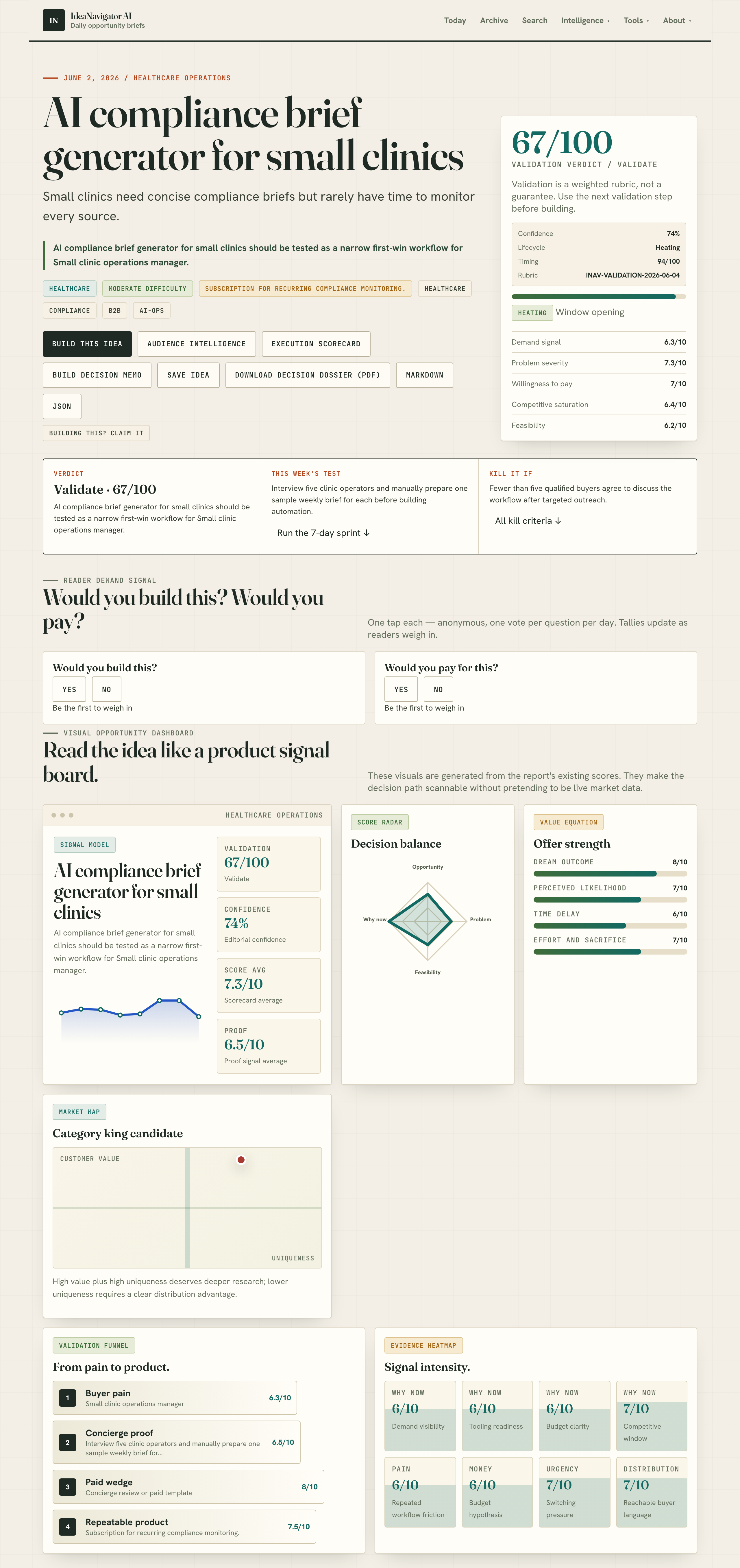
A new AI compliance brief generator is being tested for small clinics to automate regulatory updates. The tool aims to save time for clinic managers and improve compliance monitoring. Validation involves interviews and manual brief creation before automation.
IdeaNavigator AI is testing a new AI compliance brief generator designed specifically for small clinics. The tool aims to automate weekly regulatory updates, helping clinic managers stay compliant without extensive manual effort. This development could address a key operational challenge faced by small healthcare providers.
The proposed AI compliance brief generator will produce weekly summaries of relevant regulatory changes, include source links, and generate a concise action checklist for clinic staff. The initial testing phase involves interviewing five clinic operators and manually preparing sample briefs for each before fully automating the process. The platform plans to operate on a subscription model, offering recurring compliance updates to small clinics.
This initiative responds to the need for efficient compliance monitoring in small healthcare settings, where staff often lack time to track multiple sources of regulatory information. The tool leverages AI summarization technology, which has become more viable due to the increasing frequency of regulatory updates and advances in natural language processing.
Potential Impact on Small Clinic Operations Efficiency
If successful, the AI compliance brief generator could significantly reduce the time and effort small clinics spend on regulatory monitoring. By providing concise, timely updates, it enables clinic managers to focus more on patient care while maintaining compliance. The subscription model offers a recurring revenue stream for the developers and could set a new standard for compliance tools tailored to small healthcare providers.
Popular right now

KitchenAid Artisan 5-Quart Tilt-Head Stand Mixer, Almond Cream

Dyson Airsmooth Styling Brush

Apple AirPods Pro (2nd Generation) Wireless Earbuds with USB‑C Charging, Up to 2X More Active Noise Cancelling, Transparency Mode, Adaptive
As an affiliate, we earn on qualifying purchases.
Growing Need for Automated Compliance Solutions in Healthcare
Small clinics often lack dedicated compliance teams, making it difficult to monitor frequent regulatory changes manually. Current practices rely on manual research or ad hoc updates, which can lead to oversight or delays. The rise of AI summarization tools offers an opportunity to automate this process, especially as healthcare regulations become more complex and frequent.
Previous efforts in healthcare compliance automation have focused on larger institutions. This initiative targets small clinics, where operational simplicity and cost-effectiveness are critical. The testing phase aims to validate whether a narrow, workflow-specific AI tool can meet this need effectively.
“Automating compliance updates could save small clinics valuable time and reduce errors.”
— an anonymous researcher
Unclear Aspects of AI Effectiveness and Adoption
It is not yet confirmed how accurately the AI will summarize complex regulatory updates or how well clinic operators will adopt and integrate the tool into their workflows. The success of the validation phase remains uncertain, and technical challenges may arise in automating the process fully.
Next Steps in Validation and Potential Deployment
The project will proceed with interviews and manual brief creation for five clinics, followed by developing an automated version. If validation is successful, a pilot launch is expected within the next six months, with further iterations based on user feedback. Broader adoption will depend on demonstrated effectiveness and ease of use.
Key Questions
How will the AI generate compliance briefs?
The AI will analyze regulatory sources, summarize key updates, and produce a weekly report with source links and an action checklist tailored for small clinics.
What is the target market for this tool?
The primary target is small healthcare clinics that need efficient compliance monitoring but lack dedicated compliance staff.
When will the tool be available for wider use?
Following successful validation, a pilot launch is expected within six months. Full commercial availability will depend on pilot results and user feedback.
How will clinics pay for this service?
The service will operate on a subscription basis, providing recurring weekly compliance updates for a fee.
What challenges might the AI face in this application?
Potential challenges include ensuring accurate summarization of complex regulations and gaining user trust and adoption in busy clinic environments.
Source: IdeaNavigator AI