
📊 Full opportunity report: Backyard Home Reports: ADU Construction And Improvement News on IdeaNavigator AI — validation score, market gap, and execution plan.

Get movie nights delivered free with Prime
- Fast, free delivery on millions of items
- Prime Video, Amazon Music and more included
- Member-only deals all year
TL;DR
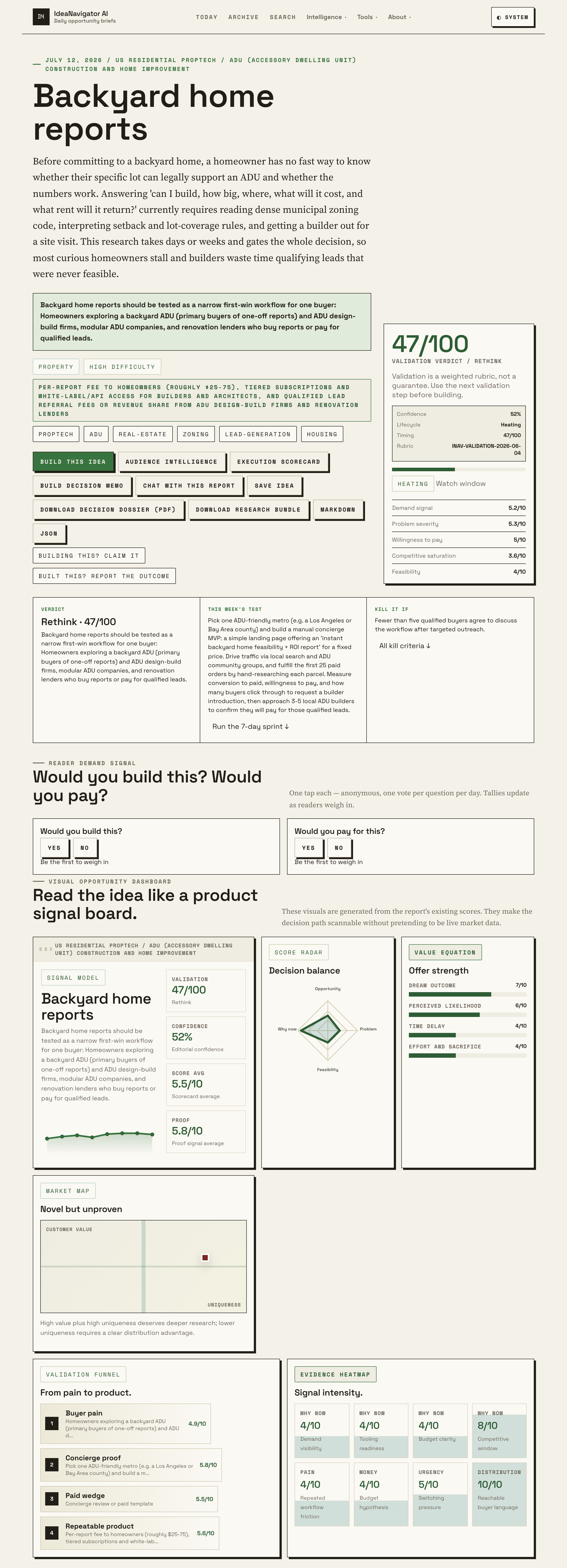
A market analysis from IdeaNavigator AI proposes paid per-address feasibility reports for homeowners considering backyard ADUs. ADU permitting has surged in California, but the proposed product itself is untested and unlaunched.
A new market analysis from IdeaNavigator AI proposes paid per-address backyard home feasibility reports — web-delivered PDF documents that would tell a homeowner within minutes whether their lot can legally support an accessory dwelling unit (ADU), how big it could be, what it would cost to build, and what rent it might return. The analysis frames these reports as a narrow first-win workflow for the fast-growing US ADU market, monetized through per-report fees to homeowners and qualified-lead referrals to builders. No such product has been launched or validated; the analysis is a proposal, not a report on an existing service.
According to the analysis, the core problem is that homeowners exploring a backyard ADU currently have no fast way to determine lot-specific feasibility. Answering the basic questions — can I build, how big, where on the lot, what will it cost, and what rent will it return — requires reading dense municipal zoning code, interpreting setback and lot-coverage rules, and scheduling a builder site visit. The analysis states this research takes days or weeks and gates the entire decision, so most curious homeowners stall while builders spend time qualifying leads that were never viable.
The proposed minimum viable product is a web app where a homeowner enters a property address and pays — roughly $25 to $75 per report — for a homeowner-ready PDF. The system would ingest county parcel data, including boundaries, lot size and existing footprint, and evaluate the lot against state ADU law plus a manually curated rule set for a single launch market, such as a few California counties. Each report would cover allowed ADU types, maximum size, setback and lot-coverage constraints, a buildable-area estimate, a build-cost band, and projected rental income from local rent comps. A ‘connect me with a vetted ADU builder’ button would capture lead-generation revenue.
Proposed revenue streams include per-report fees from homeowners, tiered subscriptions and white-label API access for builders and architects, and qualified lead referral fees or revenue share from ADU design-build firms and renovation lenders.
Why Feasibility Reports Target the ADU Bottleneck
The proposal matters because it targets what the analysis identifies as the single largest friction point in the ADU market: the pre-commitment research gap. If feasibility and cost questions can be answered in minutes for under $100, the analysis argues, more homeowners would move from curiosity to actual construction, and builders would stop wasting sales cycles on infeasible lots. The analysis cites a persistent US housing shortage estimated in the millions of units, positioning ADUs as a meaningful incremental supply channel that is currently throttled by slow, manual zoning research.
For industry readers — ADU design-build firms, modular ADU companies, and renovation lenders — the lead-generation angle is the commercial hook: the analysis proposes that firms would pay for pre-qualified leads who have already paid for a feasibility report and therefore demonstrated intent and a vetted lot.
California’s Decade of ADU Legalization
California legalized ADUs statewide starting in 2016 and has loosened rules nearly every year since, with other states and cities following, according to the analysis. The permitting data cited is substantial: Los Angeles County alone permitted over 45,000 ADUs in 2023, and ADUs now represent roughly one in five new housing units produced in California. The analysis also points to two enabling conditions that make the timing newly practical: mature parcel and zoning data sources, and LLM-based parsing of zoning code, which reduces the cost of encoding municipal rules.
What Is Unproven in the Proposal
No product described in the analysis has been built, sold, or validated — the piece is a business idea evaluation, not a report on an operating company. Key open questions include whether homeowners will actually pay $25-75 for a feasibility report, whether hand-curated zoning rules can be maintained accurately as regulations change, and whether builders will pay for leads generated this way. The analysis itself prescribes a validation path — a manual concierge MVP in one ADU-friendly metro, fulfilling the first 25 paid orders by hand — which has not, according to the material, been carried out.
It is also not clear how liability for zoning errors would be handled, how build-cost bands and rent projections would be sourced and kept current, or whether a homeowner-ready report would be accepted by lenders or jurisdictions as a basis for decisions. The 45,000-permit figure for Los Angeles County and the one-in-five share of California housing production are cited in the analysis without named primary sources.
The Prescribed Validation Path Forward
According to the analysis, the next step for anyone pursuing the idea is to pick one ADU-friendly metro — a Los Angeles or Bay Area county is suggested — and launch a simple landing page offering an ‘instant backyard home feasibility + ROI report’ at a fixed price. Traffic would come from local search and ADU community groups. After the first 25 paid orders, the operator would measure conversion to paid, willingness to pay, and builder-introduction click-through, then approach three to five local ADU builders to confirm they would pay for qualified leads. Whether any operator acts on this plan remains to be seen.
Source: IdeaNavigator AI
Key Questions
Is backyard home feasibility report service already available?
No. The IdeaNavigator AI analysis is a proposal for an unbuilt product. It prescribes a manual validation phase before any automated service would exist.
How much would a report cost under the proposal?
The analysis proposes roughly $25 to $75 per report for homeowners, with additional revenue from builder subscriptions, white-label API access, and lead referral fees.
What would the report include?
Allowed ADU types, maximum size, setback and lot-coverage constraints, a buildable-area estimate, a build-cost band, and projected rental income based on local rent comps.
Why is the ADU market considered timely right now?
California legalized ADUs statewide in 2016 and has loosened rules repeatedly since; per the analysis, Los Angeles County permitted over 45,000 ADUs in 2023, and ADUs represent roughly one in five new California housing units.
How would the idea be tested before building software?
By launching a landing page in one metro and hand-fulfilling the first 25 paid orders, then measuring paid conversion, willingness to pay, and builder-introduction requests before approaching builders about paying for leads.
Source: IdeaNavigator AI
Fall Picks
fall essentials
As an affiliate, we earn on qualifying purchases.