Shopping for espresso machines for beginners means balancing three things: simplicity, shot quality, and price. After comparing 15 of the most popular entry-level models, the CASABREWS 3700 Essential earns the best overall spot for pairing a genuine 20-bar pump system with a stainless steel build and a steam wand that actually textures milk without a steep learning curve. Budget shoppers should look at the De’Longhi Stilosa, which delivers credible espresso from a trusted brand at an entry price, while the AMZCHEF Espresso Machine with Grinder stands out as the only option here with a built-in grinder and precise temperature control for buyers ready to grow into the hobby. The main tradeoff in this category is between ultra-cheap steam-driven machines (the 3.5-bar models) that are easy but not true espresso, and pump-driven machines that require a little practice but produce the real thing. Keep reading for the full ranked breakdown, complete with who each machine is for and who should skip it.

Get movie nights delivered free with Prime
- Fast, free delivery on millions of items
- Prime Video, Amazon Music and more included
- Member-only deals all year
Complete the kit


Key Takeaways
- The CASABREWS 3700 Essential takes best overall because it is the only entry-level pick that combines a 20-bar pump, stainless steel construction, and a usable steam wand without a confusing control scheme — the three things a beginner actually needs on day one.
- Every 3.5-bar machine in this lineup (the generic 4-Cup model and the KEENSTAR) uses steam pressure rather than a pump, which means easier operation but coffee closer to strong drip than true espresso — I ranked them lowest despite their low learning curve.
- The AMZCHEF with built-in grinder and 44 grind settings is the clear grow-into pick, but it is also the most demanding machine here; beginners who want zero fuss should skip it in favor of the Chefman CraftBrew’s digital presets.
- Three of the fifteen machines are XIXUBX models in different colors and sizes, and they perform nearly identically — the differences come down to capacity and kitchen aesthetics, not capability.
- Across the lineup, removable water tanks and steam wands with adjustable angles were the features that most consistently separated satisfying machines from frustrating ones, more so than raw bar-pressure claims.





| espresso machines for beginner | Pressure | Water tank capacity |
|---|---|---|
| CASABREWS 3700 Essential Stain | — | 43.9 oz removable |
| De’Longhi Stilosa Compact Manu | — | — |
| Atatix Espresso Machine with M | 20 bar | — |
| 3.5-Bar Espresso Machine | 3.5 bar | — |
| XIXUBX Espresso Machine with M | 20 bar | 42 oz |
| AMZCHEF Espresso Machine with | — | 60 oz |
| Aromaster 1400W Espresso Machi | 20-bar pump | 37 oz (removable) |
| XIXUBX Semi-Automatic Espresso | 20 Bar | — |
| Chefman CraftBrew Digital Espr | — | 1.5 liters |
| 20 Bar Espresso Machine with M | 20 bar | 34 oz |
| XIXUBX Compact Espresso Machin | 20 bar | — |
| Arecovas Espresso Machine with | 20 bar | — |
| KEENSTAR 3.5 Bar Espresso Mach | 3.5 bar | — |
| CHULUX Slim Espresso Machine w | — | 40 oz |
| CASABREWS CM5418 Compact Espre | — | 34 oz removable |
More Details on Our Top Picks
CASABREWS 3700 Essential Stainless Steel Espresso Machine with Steam Wand
CASABREWS 3700 Essential hits a sweet spot that few beginner machines manage: a stainless steel body, a genuine 20-bar pump, and a steam wand capable of latte-art-quality microfoam, all in a footprint small enough for an apartment or office. Compared with the De’Longhi Stilosa, this model offers a larger 43.9-ounce removable tank and a more premium exterior, which makes it the better long-term anchor for a home coffee corner. The tradeoff is that it skips any pressure gauge or automatic shot programming, so beginners learn extraction entirely by eye and taste. I’d pair it with a scale and timer to compensate. For a buyer who wants real espresso fundamentals without paying for a grinder-in-one unit like the AMZCHEF, this pick makes the most sense.
Pros:- True 20-bar pump with 1350W heating for proper extraction and crema
- Steam wand froths milk well enough for latte art
- Large 43.9 oz removable tank cuts down refill frequency
- Stainless steel construction feels more durable than plastic rivals
Cons:- No pressure gauge, so judging extraction quality is guesswork at first
- Requires a full priming cycle before first brew, which adds setup friction
Best for: Beginners who want a durable, genuinely capable espresso machine for daily drinks and are willing to learn dialing-in by eye
Not ideal for: Buyers who want guided, automatic brewing — there are no preset shot volumes or pressure readouts to lean on
- Brand:CASABREWS
- Type:Semi-automatic espresso machine
- Pump pressure:20 bar
- Wattage:1350 watts
- Water tank capacity:43.9 oz removable
- Material:Stainless steel
- Included filters:One-cup and two-cup
- Accessories:Portafilter, tamper with spoon
Our verdict“The smartest all-around purchase for a beginner who plans to grow into the hobby rather than outgrow the machine.”
De’Longhi Stilosa Compact Manual Espresso Machine with Manual Milk Frother
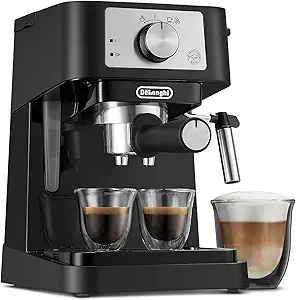
The De’Longhi Stilosa stands out for brand reliability at an entry price — a stainless steel boiler from the most established name in this lineup, wrapped in one of the smallest footprints here. Compared with the CASABREWS 3700, it sacrifices tank size and premium styling, but it matches the core promise: single and double shot filters and a manual frother that pulls its weight for cappuccinos. The two-level cup holder is a small touch that genuinely matters, accommodating everything from a demitasse to a taller mug. The honest tradeoff is effort — this is a fully manual machine, so every shot and every froth session depends on your technique. This option makes the most sense for a first-time buyer who values a proven brand and simple operation over advanced controls.
Pros:- Durable stainless steel boiler built for long-term daily use
- Very compact footprint frees up counter space
- Manual milk frother handles cappuccinos and lattes
- Ergonomic portafilter with both single and double filters
Cons:- Fully manual operation demands more skill and patience than automatic rivals
- Smaller capacity than the CASABREWS makes it less suited to serving guests
Best for: First-time espresso buyers who want a recognized brand and a no-frills manual machine for occasional drinks
Not ideal for: Anyone wanting automatic shots or fast back-to-back drinks — manual operation means every cup is a small project
- Brand:De’Longhi
- Model:Stilosa
- Type:Manual espresso machine
- Boiler:Stainless steel
- Milk frother:Manual steam wand
- Filters included:Single and double espresso
- Cup holder:Two-level
Our verdict“A dependable, space-saving first machine from a brand you can trust — as long as you’re happy doing the work yourself.”
Atatix Espresso Machine with Milk Frother, 20-Bar Pressure
What separates the Atatix from the other budget 20-bar machines here is flexibility: it offers automatic single- and double-shot modes alongside fully manual extraction of up to 102 seconds, with published shot weights for each mode. That structure essentially teaches a beginner how espresso ratios work — start on the presets, then graduate to manual control once your palate develops. Compared with the CASABREWS 3700, you gain temperature control and a 30-second preheat, though you give up the stainless steel body for ABS construction. The manual mode does demand dialing in, which will frustrate anyone expecting press-and-perfect results. This model is better suited to a curious beginner who treats the machine as a learning tool rather than an appliance.
Pros:- Both automatic presets and manual extraction in one machine
- Temperature control within a proper 90–96°C espresso range
- 30-second preheat is faster than most entry machines
- Detachable tank and drip tray simplify cleaning
Cons:- Manual mode requires patient dialing in with grind and dose
- Unspecified water tank capacity makes refill planning a guess
- ABS body feels less premium than stainless rivals
Best for: Experiment-minded beginners who want training wheels now and manual control later
Not ideal for: Set-and-forget drinkers — the manual extraction settings take real trial and error to master
- Pressure:20 bar
- Temperature control:90–96°C
- Preheat time:30 seconds
- Shot modes:Automatic single/double plus manual up to 102 seconds
- Materials:ABS and stainless steel
- Water tank:Detachable
- Accessories:Portafilter, funnel, scoop/tamper
Our verdict“The best choice for a beginner who wants a machine that actively teaches espresso fundamentals over time.”
3.5-Bar Espresso Machine, 4-Cup Compact Coffee Maker, 800W, Black
This 3.5-bar machine occupies a different category than the 20-bar picks, and I rank it accordingly: it’s less about true espresso and more about simple, low-commitment milk coffee. With basic controls, a carafe, and a steam wand, it behaves more like a moka-style brewer with frothing capability — and that simplicity is the entire point. Compared with the De’Longhi Stilosa, you trade extraction pressure and boiler quality for an easier, carafe-based workflow that brews four cups at once. The 800W heater sips power, and everything removable pops out for cleaning. The honest limitation is physics: 3.5 bars won’t produce the crema or intensity of the Atatix or CASABREWS, and it needs medium-coarse grounds to avoid clogging. This pick makes the most sense for casual drinkers, not espresso purists.
Pros:- Simplest controls in the lineup — nearly zero learning curve
- 4-cup carafe serves several people in one brew
- Very compact and low-power for small kitchens, offices, or dorms
- All key parts remove easily for cleaning
Cons:- 3.5-bar pressure produces weaker, less crema-rich coffee than true espresso machines
- Requires medium-coarse grounds to prevent clogging, limiting flexibility
Best for: Casual coffee drinkers or students who want easy cappuccino-style drinks for multiple people with minimal effort
Not ideal for: Espresso enthusiasts chasing rich crema and authentic shot quality — the low pressure can’t deliver it
- Pressure:3.5 bar
- Capacity:4 cups
- Power:800 W
- Milk frother:Built-in steam wand
- Recommended grind:Medium-coarse
- Removable parts:Filter, filter holder, carafe, measuring spoon
Our verdict“A gentle, low-cost on-ramp for milk-coffee drinkers — just don’t expect real espresso from it.”
XIXUBX Espresso Machine with Milk Frother for Cappuccino & Latte, Silver
My top pick earns it through feedback: the XIXUBX is the only machine in this batch with a visible pressure gauge, which turns every shot into a visible lesson — exactly what a beginner needs. Unlike the CASABREWS 3700, where extraction quality is judged purely by taste, this model shows pump pressure in real time, shortening the learning curve dramatically. The 360° rotating steam wand gives more ergonomic milk-steaming angles than the fixed wands on the Stilosa, and instant heating means you can brew and steam back-to-back without the cooling wait that plagues single-boiler starters. Add a 42-ounce tank, a stainless body, and an included frothing pitcher, and the package is genuinely complete. The tradeoffs are minor but real: latte art takes practice, and the compact frame limits larger mugs.
Pros:- Visible pressure gauge gives real-time feedback that speeds up learning
- 360° rotating steam wand produces silky microfoam for latte art
- Instant heating allows continuous brewing and steaming
- Includes a stainless steel frothing pitcher and 1-year warranty
Cons:- Steam wand technique takes practice before latte art looks right
- Limited clearance rules out larger cups and mugs
Best for: A motivated beginner who wants to learn espresso properly with visual feedback and a complete out-of-box accessory package
Not ideal for: Drinkers who use large mugs or travel cups — the compact design limits clearance under the portafilter
- Pressure:20 bar
- Steam wand:360° rotating, detachable
- Water tank capacity:42 oz
- Body material:Stainless steel
- Pressure gauge:Visible, real-time monitoring
- Warranty:1 year
- Included accessories:Stainless steel milk frothing pitcher
Our verdict“The best-equipped beginner machine here — the pressure gauge alone justifies choosing it over the CASABREWS.”
AMZCHEF Espresso Machine with Grinder, Temp Control, 44 Grind Settings
Most entry-level machines, like the XIXUBX Semi-Automatic, ask you to buy pre-ground coffee or a separate grinder — this model solves that by grinding and brewing in one unit. With 44 grind settings and adjustable temperature from 190°F to 201°F, it gives beginners room to grow: you can experiment with different beans and roasts without buying extra gear. The one-touch cold brew mode and multi-brew versatility (pour-over, French press) set it apart from single-purpose rivals like the Chefman CraftBrew. The tradeoff is real, though. All those settings create a learning curve that may frustrate someone who just wants a button to press, and the footprint is larger than compact picks like the 20 Bar Compact Cappuccino Maker. This pick makes the most sense for a beginner who plans to take the hobby seriously.
Pros:- 44 grind settings cover everything from ultra-fine espresso to coarse French press
- Adjustable brew temperature (190°F–201°F) suits light and dark roasts alike
- Built-in grinder eliminates the cost and clutter of a separate appliance
- Powerful steam wand produces microfoam suitable for latte art
Cons:- Grind and temperature adjustments add a learning curve that pure beginners may find overwhelming
- Large footprint consumes significant counter space
Best for: Beginners who want to start with whole beans and grow into more precise brewing without buying a separate grinder
Not ideal for: Small kitchens or renters with limited counter space — the all-in-one design takes up considerably more room than compact rivals
- Temperature Range:190°F–201°F
- Grind Settings:44
- Water Tank Capacity:60 oz
- Steam Wand:8mm stainless steel
- Heating Power:1350W
- Display:IMD HD touch screen
- Brew Modes:Espresso, cold brew, pour-over, French press
Our verdict“Buy this if you’re committed to learning espresso properly from whole beans; skip it if you want the simplest possible first machine.”
Aromaster 1400W Espresso Machine with Milk Frother, Stainless Steel
The Aromaster strikes the best balance in this lineup between capability and approachability. Its PID temperature control keeps extraction consistent — something the cheaper 3.5-bar compact machines simply can’t manage at their lower pressure — while low-pressure pre-infusion helps uneven tamping forgiving for new hands. The 360° swivel steam wand is easier to angle than fixed wands on entry models like the De’Longhi Stilosa, making milk drinks far less intimidating. Compared with the Chefman CraftBrew, the Aromaster’s touch screen and dual-circuit hot/iced switching feel more modern, and its slim 7-inch width suits tight counters. The honest drawback: as a semi-automatic, you still pull the shots yourself, and the listing provides no warranty details, which matters when buying a first machine you can’t yet troubleshoot yourself.
Pros:- PID temperature control delivers consistent shot-to-shot flavor
- 360° swivel steam wand with heat-resistant grip makes beginner frothing manageable
- One-touch descaling and removable tank simplify maintenance
- Slim 7-inch stainless steel build fits small kitchens and offices
Cons:- Semi-automatic operation still involves a learning curve for total novices
- No warranty details are provided in the listing
Best for: First-time buyers who want consistent espresso and milk drinks with safety features like auto shut-off in a shared kitchen or office
Not ideal for: Buyers who want warranty assurance before committing — no coverage terms are stated in the listing
- Power:1400W
- Pressure:20-bar pump
- Water Tank Capacity:37 oz (removable)
- Dimensions:13″D x 7″W x 14″H
- Material:Stainless Steel
- Temperature Control:PID + NTC
- Special Features:Pre-infusion, fast heat-up, one-touch descaling, auto shut-off, touch screen
Our verdict“The strongest all-rounder for a beginner who wants room to improve without paying for features they won’t use.”
XIXUBX Semi-Automatic Espresso Machine with Milk Frother, Grey
If the AMZCHEF’s 44 settings sound exhausting rather than exciting, this is the opposite philosophy: a push-button panel with no learning curve. You press, it brews — and the 30-second heat-up means the gap between wanting coffee and drinking it is minimal, faster than the Aromaster on cold starts. The included milk frothing pitcher is a genuinely useful touch that most rivals, including the 20 Bar Compact Cappuccino Maker, leave out, so you’re not shopping for accessories on day one. Its one-touch cold brew also gives it more range than single-mode machines like the Chefman CraftBrew. The flip side of that simplicity is permanence: there are no adjustable pressure or temperature controls, so once you outgrow the defaults — and many espresso drinkers do — this machine has nothing left to teach you. The 1-year warranty softens the risk.
Pros:- 30-second heat-up delivers espresso with almost no waiting
- Push-button controls require zero learning curve
- Includes a rust-resistant milk frothing pitcher in the box
- One-touch cold brew adds low-acid coffee option
Cons:- No manual pressure or temperature adjustment limits long-term growth
- Semi-automatic dosing still requires some practice for consistent results
Best for: Complete beginners or busy households who want genuinely foolproof espresso with minimal setup and accessories included
Not ideal for: Tinkerers and advancing hobbyists — the fixed settings leave no room to refine technique over time
- Power:1350W
- Pressure:20 Bar
- Heat-Up Time:30 seconds
- Controls:Push-button panel
- Temperature Control:NTC sensor
- Frother:Adjustable steam wand
- Included Accessories:Milk frothing pitcher, manual
- Warranty:1 year
Our verdict“The safest first machine for someone who values simplicity over expandability, with a warranty for peace of mind.”
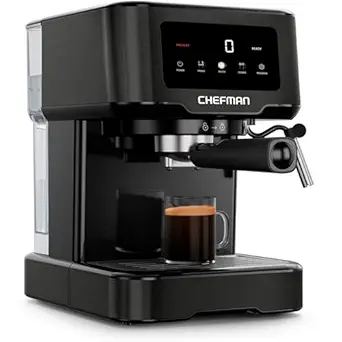
Chefman CraftBrew Digital Espresso Machine with Steam Wand
The Chefman keeps the beginner formula stripped to essentials: a 15-bar pump, a steam wand, and touch controls that adjust shot volume — a feature the XIXUBX Grey model doesn’t offer, letting you dial in a stronger or milder cup without touching your grinder. The single- and double-shot baskets included in the box mirror what pricier machines provide, and the removable 1.5-liter tank refills without sliding the whole unit forward. Compared with the Aromaster, though, it lacks temperature finesse — there’s no PID here — so consistency depends more on your routine. Its biggest limitation is accepting ground coffee only, unlike the bean-to-cup AMZCHEF, meaning you’ll need a separate grinder (or good pre-ground) for the best results. And milk steaming is fully manual, so expect a few watery cappuccinos before it clicks.
Pros:- Adjustable shot volume lets you control brew strength from the touch panel
- Includes both single-shot and double-shot baskets
- Removable 1.5L water tank is easy to refill and clean
- Descale alert helps first-time owners keep up with maintenance
Cons:- Ground-coffee-only design requires a separate grinder for fresh beans
- Fully manual milk steaming takes practice to master
- No precise temperature control for refining extraction
Best for: Casual beginners focused on lattes and cappuccinos who already own a grinder or are happy with quality pre-ground coffee
Not ideal for: Anyone wanting freshest-possible flavor from whole beans — there’s no built-in grinder
- Machine Type:Semi-automatic espresso machine
- Pump Pressure:15 bar
- Water Tank Capacity:1.5 liters
- Wattage:1350 watts
- Dimensions:10.8 x 8.9 x 11.9 inches
- Coffee Input:Ground coffee
- Included Baskets:Single-shot and double-shot
Our verdict“A sensible, low-friction entry point for milk-drink lovers, as long as you’re fine buying ground coffee.”
20 Bar Espresso Machine with Milk Frother, Compact Stainless Steel Cappuccino Maker
At roughly the size of a sheet of paper, this machine answers the question most roundup rivals don’t: what if your counter is already full? While the AMZCHEF demands serious counter real estate, this one squeezes into dorms, offices, and studio kitchens. It doesn’t sacrifice power for size — the 20-bar pump and visible pressure gauge let you actually watch extraction pressure, a feedback tool the XIXUBX Grey model omits entirely, and genuinely useful for learning what a good shot looks like. The 20-second preheat beats nearly everything in this lineup. The catch is workflow: unlike the Aromaster’s dual-circuit system, you’ll face a cool-down period between frothing and brewing, which slows morning routines when making back-to-back lattes. Preheating before every use is also non-negotiable for decent results.
Pros:- A4-sized footprint fits where standard machines can’t
- Visible pressure gauge helps beginners see whether extraction is on track
- 20-second preheat is among the fastest in this lineup
- 20-bar pump produces rich crema and balanced flavor
Cons:- Requires a cool-down period between frothing and brewing
- Must be preheated before each use for best results
Best for: Apartment dwellers, dorm residents, and office users who need real espresso pressure in the smallest possible footprint
Not ideal for: Households making multiple milk drinks in a row — the cool-down between frothing and brewing slows you down
- Pressure:20 bar
- Power:1450W
- Water Tank Capacity:34 oz
- Dimensions:5.3 x 12.2 x 11.5 inches
- Material:Stainless Steel
- Preheat Time:20 seconds
- Type:Semi-automatic espresso machine
Our verdict“The best choice when counter space is the deciding factor, provided you’re patient with its froth-then-brew workflow.”
XIXUBX Compact Espresso Machine with Milk Frother, White
Of the three XIXUBX machines in this roundup, this white model earns its spot because it pairs PID temperature control with a gentle pre-infusion stage — the two features that most directly reduce beginner frustration. Instead of guessing whether your water is too hot or too cold, the machine holds a stable temperature so a bad shot is usually a grind problem, not a machine problem. The included stainless steel frothing pitcher is a nice touch that the CASABREWS CM5418 doesn’t fully match, letting you pour lattes from day one. Compared with the KEENSTAR 3.5-bar, the 20-bar pump here produces noticeably richer crema. The tradeoff is that one-button simplicity still can’t compensate for a poor grind, and the semi-automatic workflow demands some hands-on practice before drinks taste café-quality.
Pros:- PID temperature control keeps brewing consistent shot to shot
- Steam wand plus included frothing pitcher covers milk drinks out of the box
- Compact footprint fits apartments and dorms
- Single-button single/double shot operation keeps the learning curve gentle
Cons:- Requires proper grind and tamping technique for best extraction
- Semi-automatic workflow still demands hands-on prep each cup
Best for: Style-conscious beginners who want temperature-stable shots and a complete milk-drink starter kit in a small, white-friendly kitchen aesthetic
Not ideal for: Buyers who want zero technique involved — grinding and tamping skill still determine the final result
- Type:Semi-automatic espresso machine
- Pressure:20 bar
- Temperature Control:PID
- Brewing Time:22–30 seconds
- Shot Options:Single and double
- Milk Frother:Steam wand
- Included Accessory:Stainless steel frothing pitcher
- Color:White
- Warranty:1 year
Our verdict“A smart pick for beginners who value shot-to-shot consistency and want everything needed for milk drinks included in one box.”
Arecovas Espresso Machine with 20 Bar Pressure, Touch Screen, and Milk Frother
This model stands out for piling beginner-friendly features into a 5.2-inch-wide stainless body — the narrowest footprint in this batch. The touchscreen with real-time pressure gauge gives more feedback than the CHULUX Slim offers, which helps new brewers see what’s happening instead of tasting and guessing. Its one-touch Americano mode is unique here: the XIXUBX Compact and CASABREWS CM5418 force you to add hot water manually. Dual NTC sensors holding temps within ±2°C mean fewer sour or bitter surprises compared with simpler machines like the KEENSTAR. The compromises are real, though — the 1.2L tank runs dry fast when making drinks for two, and the 2.6-pound build feels less anchored than heavier rivals when you’re locked into the portafilter. Frothing still takes practice.
Pros:- Touchscreen with LED display and live pressure gauge teaches beginners what good extraction looks like
- One-touch Americano mode plus single/double shots covers most drink orders
- PID control with dual NTC sensors holds brew and steam temps within ±2°C
- Ultra-narrow 5.2-inch stainless footprint fits cramped counters
Cons:- 1.2L water tank needs frequent refills for multi-drink sessions
- Light 2.6-pound body can shift during portafilter use
- Steam wand technique still requires practice despite the tech
Best for: Gadget-loving beginners and office users who want touchscreen feedback, Americano shortcuts, and a machine that fits a sliver of counter space
Not ideal for: Households making multiple milk drinks back to back — the small tank and lightweight body make batch brewing tedious
- Pressure:20 bar
- Wattage:1300 watts
- Water Tank:1.2L / 41oz removable
- Dimensions:12″D x 5.2″W x 11.9″H
- Operation Mode:Semi-automatic
- Interface:Touchscreen with LED display and pressure gauge
- Body Material:Commercial-grade stainless steel
- Special Features:Pre-infusion, steam wand, cup warmer, one-touch Americano
Our verdict“The most feedback-rich beginner machine in this batch, ideal for someone who wants to learn by seeing data rather than trial and error alone.”
KEENSTAR 3.5 Bar Espresso Machine with Steam Wand, 800W Compact 4-Cup Espresso Maker
The KEENSTAR makes this list for one reason: it’s the gentlest on-ramp to espresso-style coffee that exists. Its single-knob operation removes every variable except pressing brew, and four cups in two minutes beats every 20-bar machine here for pure speed when guests arrive. But honesty is required — the 3.5-bar pressure is roughly a third of what the CASABREWS CM5418 or CHULUX Slim deliver, so what you get is closer to strong moka-pot coffee than true espresso, with thinner crema to match. The tiny 240ml tank overfills and leaks from the nozzle if you’re careless, and the steam wand demands immediate wiping to avoid clogs. Compared with the Arecovas, it trades precision and pressure for simplicity and a lower barrier to entry.
Pros:- Single-knob operation is the simplest workflow in the roundup
- Brews up to 4 cups in about 2 minutes
- Steam wand produces micro-foam in roughly 40 seconds
- Compact, lightweight, BPA-free build for small kitchens
Cons:- 3.5-bar pressure falls well short of the 9+ bar needed for true espresso
- 240ml tank leaks from the nozzle if overfilled
- Steam wand and filter require careful cleaning to avoid blockages
Best for: Absolute beginners, students, or casual drinkers who want espresso-adjacent coffee and milk foam with near-zero learning curve
Not ideal for: Anyone chasing authentic crema and café-quality shots — the low pressure simply can’t produce true espresso extraction
- Pressure:3.5 bar
- Power:800W
- Capacity:1–4 cups (240ml)
- Brew Time:About 2 minutes
- Steam Wand:Micro-foam ready in 40 seconds
- Dimensions:13.1″ H x 7.7″ W x 10″ D
- Weight:4.7 lbs
- Material:BPA-free
Our verdict“A reasonable first step for the curious and budget-limited, as long as expectations are set at ‘strong coffee with foam’ rather than real espresso.”
CHULUX Slim Espresso Machine with Milk Frother
For a straightforward first espresso machine, the CHULUX Slim hits the sweet spot between the underpowered KEENSTAR and the more feature-dense Arecovas. Its 40 oz water tank is the largest in this batch, which matters more than it sounds — you can make four or five drinks before refilling, where the Arecovas’ 1.2L tank gives out sooner. The pressure gauge and pre-infusion give beginners the two tools that actually improve shots, without paying for a touchscreen. A 30-second preheat and 25-minute auto shut-off make it genuinely convenient for a grab-a-shot-before-work routine. It accepts ground coffee only, so you’ll need a separate grinder or good pre-ground — a real limitation next to machines like the AMZCHEF with built-in grinder. Plastic-heavy construction at 5.5 inches wide also feels lighter-duty than the CASABREWS.
Pros:- 40 oz tank is the largest in this batch, reducing refill interruptions
- Pressure gauge plus pre-infusion helps beginners dial in balanced shots
- 30-second preheat and automatic shut-off fit busy routines
- Slim 5.5-inch width suits tight counters
Cons:- Ground coffee only — no built-in grinder option
- Lighter build quality than stainless rivals like the CASABREWS CM5418
Best for: First-time buyers who want real 20-bar extraction, a big tank for multiple drinks, and low-fuss daily operation
Not ideal for: Buyers wanting to grind fresh beans at home — there’s no grinder, so an extra purchase is required
- Pump Pressure:20 bar
- Power:1350 watts
- Preheating Time:About 30 seconds
- Width:5.5 inches
- Water Tank Capacity:40 oz
- Auto Shut-Off:After 25 minutes of inactivity
- Milk Frother:Steam wand
Our verdict“The sensible middle-ground purchase: genuine espresso pressure and useful feedback tools without paying for extras a beginner won’t use yet.”
CASABREWS CM5418 Compact Espresso Machine with Milk Frothing Steam Wand
The CASABREWS CM5418 is the machine for beginners whose end goal is pouring latte art, not just drinking coffee. Its steam wand produces genuinely creamy microfoam — the texture that makes pours possible — and the brushed stainless body feels sturdier under daily use than the lighter CHULUX Slim. The built-in pressure gauge mirrors what the CHULUX and Arecovas offer, giving you a read on whether your grind and tamp are in range. Compared with the XIXUBX Compact, the package is more complete for milk-drink practice thanks to the included tamper and both filter baskets. One quirk to plan around: you can’t brew immediately after steaming — a cooldown period is required — which reverses the workflow most tutorials teach and slows multi-drink mornings.
Pros:- Steam wand creates true microfoam suitable for latte art
- 20-bar Italian pump with 1350W boiler delivers rich crema
- Pressure gauge helps diagnose grind and tamping errors
- Solid stainless construction with included tamper and two filter baskets
Cons:- Cannot brew immediately after frothing milk due to cooldown requirement
- Sensitive to grind size and tamping — poor technique shows up as low pressure
Best for: Beginners focused on milk drinks and latte art who want a durable stainless machine and are willing to learn proper technique
Not ideal for: Impatient multi-drink hosts — the mandatory cooldown after frothing makes back-to-back lattes slow
- Model:CM5418
- Pump Pressure:20 bar
- Power:1350 watts
- Water Tank Capacity:34 oz removable
- Operation Mode:Semi-automatic
- Material:Stainless steel
- Included Components:Machine, 34 oz tank, one- and two-cup filters, portafilter, tamper with spoon, manual
Our verdict“The strongest choice in this batch for aspiring home baristas who care as much about the foam as the shot.”

How We Picked
I evaluated every machine through one lens: how quickly a complete beginner can pull a drinkable shot and steam decent milk. That meant prioritizing pump-driven systems (ideally 15–20 bar) over steam-driven ones, judging whether the controls are self-explanatory, and checking whether the steam wand can both froth and steam — some budget wands only make bubbly foam. Build materials mattered too, because flimsy plastic portafilters and wobbly tanks are the most common complaints at this price tier.
From there, I ranked by long-term value and growth potential. Machines with consistent temperature stability, removable water tanks, and standard-sized portafilters ranked higher because they stay useful as skills improve. Cheap steam-driven models landed at the bottom not because they are bad appliances, but because they fail the core promise of the category: making real espresso approachable. Where two machines performed nearly the same, the tiebreaker was ease of cleaning, since maintenance friction is what makes most beginner machines end up in a closet.
Factors to Consider When Choosing Espresso Machines For Beginners
Before picking a specific machine, it helps to understand what actually separates a satisfying beginner espresso maker from one that collects dust. These are the factors that shaped my ranking, and they should shape your decision too.Pump vs. Steam: The Decision That Matters Most
The single biggest fork in the road is whether a machine uses a pump (15–20 bar) or steam pressure (3.5–4 bar). Pump machines force water through finely ground coffee at the pressure real espresso requires, producing the thick, crema-topped shots you get at a café. Steam-driven machines like the generic 4-cup model and the KEENSTAR heat water until pressure builds, then push it through the grounds — the result is closer to strong moka-pot coffee. The common beginner mistake is assuming lower pressure means easier learning; in practice, steam machines are simpler but they cap your ceiling immediately. If your goal is genuine espresso, a pump machine is non-negotiable, and every one of my top six picks has one. Steam machines only make sense if you drink mostly milk-heavy drinks and genuinely do not care about authentic espresso flavor.
Steam Wand Quality Determines Your Milk Drinks
Almost every machine in this category advertises a milk frother, but they are not equal. A true steam wand — like the ones on the CASABREWS 3700, Stilosa, and Aromaster — injects steam into cold milk, letting you texture it into glossy microfoam for lattes and cappuccinos. Cheaper implementations simply blow air, producing dry, soapy foam that collapses in minutes. When comparing, look for a wand that swivels and has a steam knob you can open gradually, because that control is what teaches you steaming technique. Also check whether the wand tip is removable for cleaning, since clogged wand tips are the number one maintenance headache on budget machines. If your morning drink is a latte rather than a straight shot, wand quality should weigh more heavily in your decision than pump pressure.
Bar Pressure Numbers Are Mostly Marketing
A pattern worth knowing: nearly every machine here claims 15 or 20 bar, and those numbers tell you almost nothing about shot quality. Nine bars is the standard for espresso, and machines advertising higher numbers simply have pumps capable of exceeding it — what matters is whether the machine regulates that pressure consistently. Temperature stability matters far more, which is why the AMZCHEF’s temperature control and the Chefman CraftBrew’s digital system earned higher rankings than similarly priced competitors with the same pressure claims. Inconsistent temperature produces sour or bitter shots no matter the pressure. Treat bar count as a checkbox confirming it is a pump machine, then judge models on build quality, temperature control, and user feedback about shot consistency instead.
Built-In Grinders: Convenience Now vs. Skill Later
Only one machine in this lineup — the AMZCHEF — includes a grinder, and that forces a genuine tradeoff. Freshly ground beans are the biggest single upgrade to espresso quality, bigger than any machine difference at this price tier. But a built-in grinder adds cleanup, adds failure points, and removes the ability to experiment with a standalone grinder later. Beginners who buy pre-ground espresso (which is ground coarser than ideal) will actually get worse results from a grinder machine if they never dial it in. My advice: choose the AMZCHEF only if you are committed to learning, and otherwise budget a separate entry-level grinder down the road — that path gives you more flexibility than any all-in-one at this price.
Footprint, Tank Size, and Cleanup
Beginner machines live on countertops, so physical design is not trivial. Compact models like the CHULUX Slim and the CASABREWS CM5418 fit tight kitchens and dorms, but slim bodies often mean smaller water tanks and less room to maneuver a portafilter. A removable water tank — like the 34oz tank on the compact stainless steel model — is quietly one of the most valuable features in this category, because refilling under a tap takes seconds while filling a fixed tank with a pitcher makes daily use annoying. Drip trays that pull out fully and portafilters that rinse clean also separate machines you will use daily from ones you will avoid. Before buying, measure your counter space and honestly assess whether you will tolerate a five-minute cleanup after each drink.
When to Spend More (and When Not To)
This roundup sits at the entry tier, and within it, spending more generally buys you stainless steel instead of plastic, better temperature consistency, and a sturdier steam wand — worthwhile upgrades if espresso will become a daily ritual. It does not necessarily buy easier operation; some pricier semi-automatics are actually more demanding because they expect technique. The buyer mistake to avoid is jumping straight to a prosumer machine believing it will produce better coffee as a novice — the opposite is true, since unforgiving hardware punishes inconsistent grind and tamp. Spend up when you know you will use the machine daily and want it to last years. Spend less if you are testing whether espresso at home is a habit at all; a solid pump machine under the cost of a few months of café drinks answers that question cheaply.
Frequently Asked Questions
Is a 3.5-bar espresso machine good enough for a beginner?
A 3.5-bar machine like the KEENSTAR or the generic 4-cup model is genuinely easy to use, but it will not make true espresso — steam pressure simply cannot reach the nine bars needed for proper extraction, so you get a strong, moka-pot-style coffee instead. That can be perfectly fine if you drink milk-heavy drinks and mostly want caffeine and a hot latte-like beverage with minimal technique. The catch is that many beginners buy these machines expecting café flavor and are disappointed, then end up upgrading within months, which costs more overall. My suggestion is to buy a pump machine from the start unless budget or counter space is truly the limiting factor — entry-level pump machines like the Stilosa are only modestly harder to use and deliver a completely different result in the cup.
Do I need a built-in grinder, or can I use pre-ground coffee?
You can absolutely start with pre-ground espresso, and most beginners do — every pump machine in this lineup works with it. The tradeoff is that pre-ground goes stale within days of opening and cannot be adjusted for grind size, which is the main dial you use to fix sour or bitter shots. The AMZCHEF’s built-in grinder with 44 settings solves freshness, but it adds a real learning curve because you must dial in the grind before shots improve. A practical middle path: buy a basic machine now, use quality pre-ground while you learn everything else (tamping, steaming, ratios), then add a standalone burr grinder once you are hooked. That staged approach is usually cheaper and less frustrating than an all-in-one purchase upfront.
How hard is it to learn to steam milk with a beginner machine?
Steaming milk is the steepest part of the learning curve, but a decent steam wand makes it achievable within a week or two of daily practice. The keys are starting with cold milk in a small pitcher, opening the steam knob fully, and positioning the wand tip just below the surface for the first few seconds to stretch the milk before submerging it. Machines with gradual steam control — the CASABREWS 3700 and Aromaster both qualify — make this easier because you can feel the process happen. Wands that only blow air or lack a control knob, common on the cheapest models, never produce the silky microfoam lattes are known for. If milk drinks are your priority, put wand quality ahead of nearly every other spec.
What’s the real difference between the De’Longhi Stilosa and the budget pump machines like CASABREWS or Atatix?
The Stilosa’s advantage is brand backing: De’Longhi has an established parts network, consistent manufacturing, and wide availability of replacement portafilter baskets and seals, which matters when a gasket wears out in year two. The CASABREWS 3700 counters with a fully stainless steel exterior where the Stilosa uses mostly plastic, and the Atatix matches the pressure claim at a lower typical cost. Functionally, all three can pull respectable shots with good grounds and a bit of practice — the differences show up in durability, steam wand stability, and how long the machines stay consistent. My take: choose the Stilosa if you want the safest long-term ownership experience, and the CASABREWS if build feel matters more to you than brand support.
How much counter space and daily time should I budget for a beginner espresso machine?
Most machines in this roundup need roughly the footprint of a large toaster — about 8 to 12 inches wide — though slim models like the CHULUX Slim trim that considerably, and you will want a few extra inches of clearance above the portafilter for filling and locking it in. On time, expect five to eight minutes per drink session once you are practiced: warming the machine, grinding or dosing, pulling the shot, steaming milk, and knocking out the puck. Add another few minutes for cleaning the steam wand and drip tray, because skipping wand purges is what kills milk-frothing performance first. If that routine sounds tedious, a digital machine like the Chefman CraftBrew with preset volumes shaves time off the shot side, but no espresso machine is truly zero-effort. Budgeting honestly for the ritual is often the difference between daily use and an abandoned appliance.
Conclusion
The right pick depends entirely on what kind of beginner you are. For best overall, the CASABREWS 3700 Essential is the strongest balance of build quality, pump performance, and a steam wand you can actually learn on — it is the machine I would hand a friend starting their espresso journey. For best value, the De’Longhi Stilosa delivers real pump-driven espresso with brand-name reliability at the lowest realistic entry point. The AMZCHEF with Grinder earns best premium (and best for growing skills) with its built-in grinder and temperature control, though it belongs with committed learners only. For the easiest possible start, the Chefman CraftBrew and its digital presets remove most of the guesswork from the shot itself. Small-space buyers should choose the CHULUX Slim or the compact CASABREWS CM5418, while the steam-driven 3.5-bar models make sense only for casual drinkers who value simplicity over authentic espresso. Whatever you choose, pair it with fresh, quality coffee — because in this category, the beans matter nearly as much as the machine.
Halloween Picks

Gemmy 5.4 ft The Nun Animatronic Halloween Decoration

8.5 Foot Halloween Inflatable Haunted House Castle with Skeleton, Ghost & Skulls

JOYIN 5-Foot Halloween Animatronic Drinking Skeleton
As an affiliate, we earn on qualifying purchases.