
📊 Full opportunity report: Employee handbook change digest for small employers on IdeaNavigator AI — validation score, market gap, and execution plan.

Get movie nights delivered free with Prime
- Fast, free delivery on millions of items
- Prime Video, Amazon Music and more included
- Member-only deals all year
TL;DR
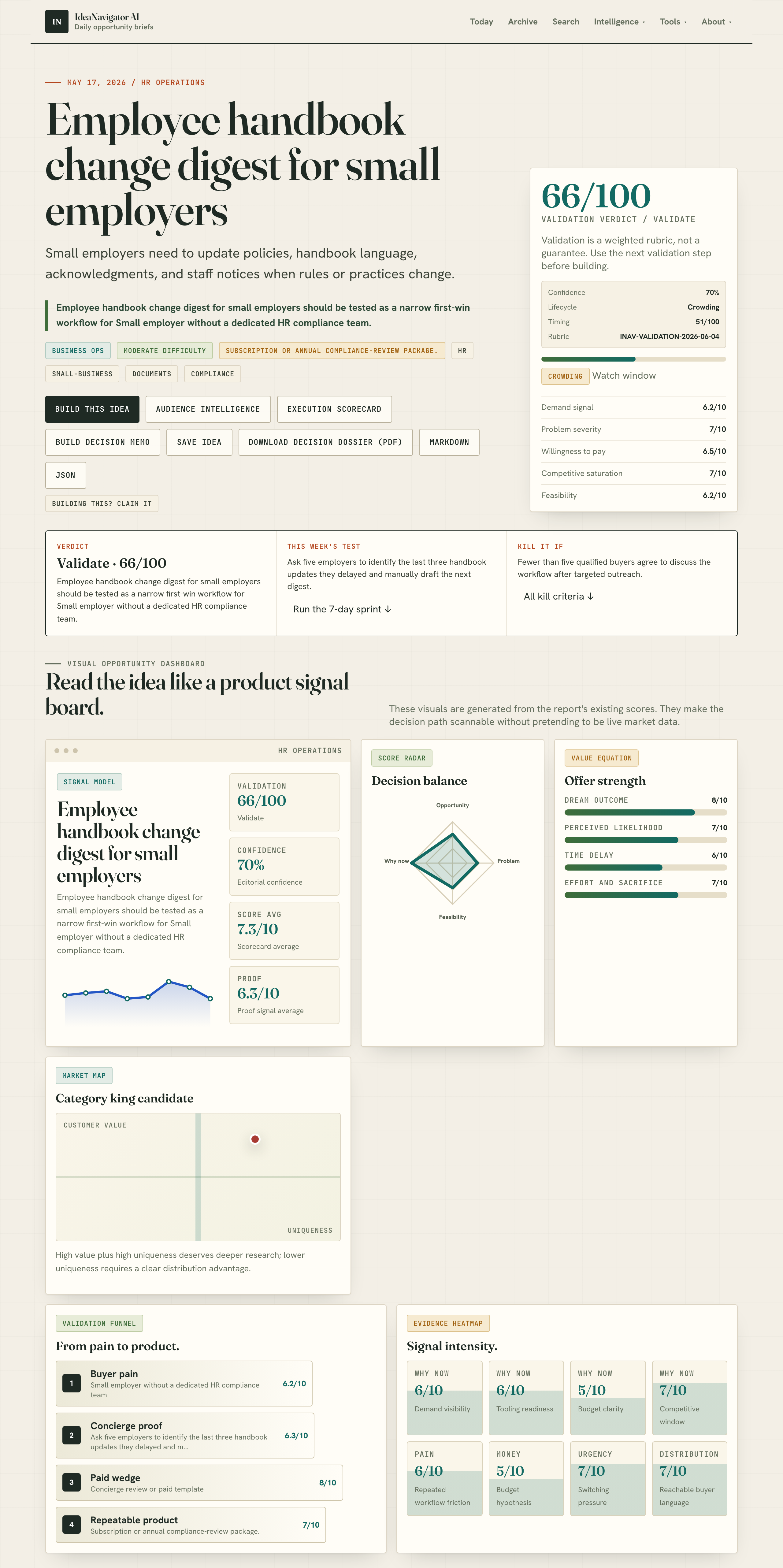
Small employers lacking dedicated HR teams will pilot a new employee handbook digest process to manage policy updates. The initiative aims to address compliance challenges amid remote work and evolving regulations.
Small employers without dedicated HR compliance teams are set to pilot a new employee handbook change digest workflow aimed at simplifying policy updates and tracking employee acknowledgments.
The initiative, developed by IdeaNavigator AI, seeks to help small businesses manage frequent policy changes driven by remote work, AI tools, and state-level employment law updates. The workflow involves logging policy topics, drafting change notes, and tracking employee acknowledgment status, providing a structured approach to handbook updates.
This pilot is designed as a minimal viable product (MVP) to test feasibility and value. It will be validated by asking five small employers to identify recent handbook delays and manually draft upcoming change digests, with plans to offer a subscription or annual compliance review package if successful.
Why Small Employers Need a Policy Update Solution
This development addresses a critical gap for small businesses that lack dedicated HR resources, helping them stay compliant amid complex and frequent policy changes. Effective tracking and communication of handbook updates can reduce legal risks and ensure staff are informed of current policies, particularly in a rapidly evolving regulatory environment.
Popular right now

De'Longhi Rivelia Fully Automatic Espresso Machine with Milk Frother, Black

Bose QuietComfort Wireless Noise-Cancelling Headphones, Twilight Blue

Hisense 55-Inch E6SR Series 4K UHD Hi-QLED Roku Smart TV (2026 Model)
As an affiliate, we earn on qualifying purchases.
Growing Complexity in Small Business HR Compliance
Small employers often struggle to keep employee handbooks current due to limited staff and resources. Recent trends, including remote work, AI adoption, and state-level employment law changes, have increased the frequency of policy updates. Currently, many small businesses delay or overlook handbook revisions, risking non-compliance and legal exposure. The proposed workflow aims to streamline this process, making it manageable without a dedicated HR team.
“Small employers need a straightforward way to track and communicate policy changes without the overhead of a full HR department.”
— an anonymous researcher
Uncertainties in Workflow Adoption and Effectiveness
It is not yet clear how small employers will respond to the digest workflow, whether it will significantly reduce policy update delays, or how widely it can be scaled. The success depends on user engagement and the accuracy of tracking employee acknowledgments, which remain to be validated in real-world settings.
Next Steps for Pilot Testing and Market Validation
The initial testing phase involves five small employers manually drafting and reviewing their upcoming handbook updates using the proposed workflow. Based on feedback, the developers plan to refine the tool, potentially launching a subscription service. Further validation will determine if the workflow can be adopted broadly and integrated into small business HR practices.
Key Questions
How will the digest workflow improve policy updates for small employers?
The workflow provides a structured process for logging policy topics, drafting change notes, and tracking acknowledgments, making updates more manageable and less prone to oversight.
Will this tool replace existing HR compliance solutions?
It is designed as a lightweight, targeted solution for small employers without dedicated HR teams, complementing broader compliance efforts rather than replacing comprehensive HR systems.
When will the pilot results be available?
Initial results are expected after the completion of the validation phase with five employers, which is currently underway. Further updates will depend on feedback and refinement.
Is this solution suitable for all small businesses?
The pilot targets small employers without dedicated HR staff, but adoption and effectiveness may vary based on business size, industry, and existing compliance practices.
What costs are associated with the new workflow?
Developers plan to offer it as a subscription or annual compliance review package, with exact pricing details to be determined after pilot validation.
Source: IdeaNavigator AI