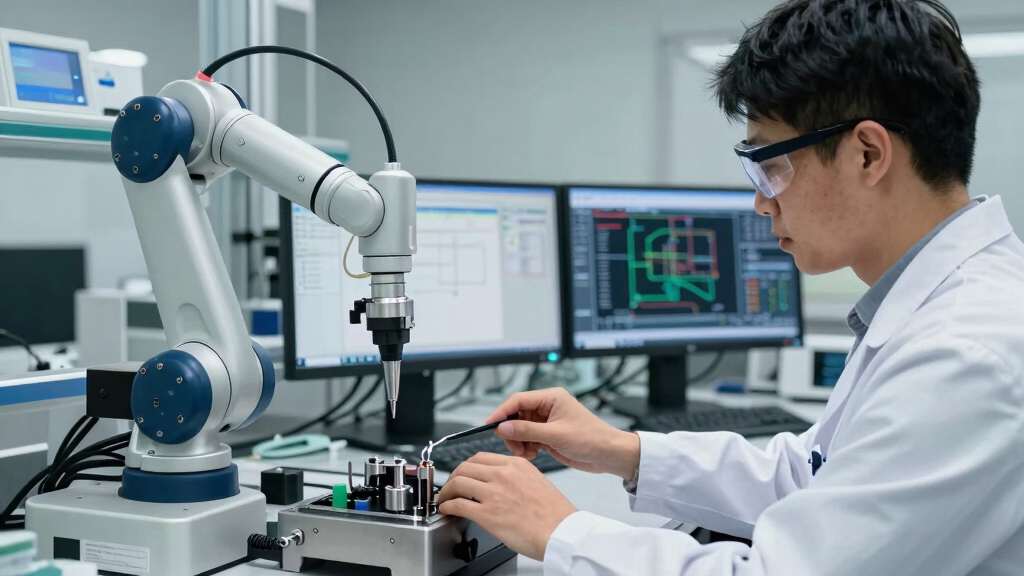

Engineering Is Automated. Research Is the Residual.

📊 Full opportunity report: Engineering Is Automated. Research Is the Residual. on ThorstenMeyerAI.com — validation score, market gap, and execution plan.

TL;DR

AI systems are now capable of automating much of AI engineering, including reproducing research and optimizing kernels. However, AI-driven research itself remains partially human-led, though this may change soon.

Recent advances in AI capabilities demonstrate that large language models and automation tools have reached a point where they can handle most core engineering tasks involved in AI research, effectively automating the engineering side of AI development. Experts say that while AI can now reproduce research and optimize infrastructure with high reliability, the creative and exploratory aspects of research remain less automated, although this gap may narrow rapidly.

Multiple recent benchmarks, including CORE-Bench and MLE-Bench, show AI systems achieving near-complete automation of core engineering skills. For example, CORE-Bench, which measures the ability to reproduce research, has seen performance rise from 21.5% in September 2024 to over 95.5% by December 2025, with the benchmark’s own authors declaring it ‘solved.’ Similarly, in Kaggle competitions, AI agents now reach bronze-medal levels in about two-thirds of tasks, indicating a significant leap in automation of data science and model optimization tasks.

Experts such as Thorsten Meyer interpret these developments as evidence that the bottleneck in AI progress is shifting from engineering to research itself. Clark’s analysis points out that the progress across multiple independent benchmarks suggests a saturation point in engineering capabilities, which are now approaching a plateau. Meanwhile, research—particularly the creative and hypothesis-driven aspects—remains less automated but is likely to be affected as AI systems become more capable of generating novel ideas and experimental designs.

Engineering Is Automated. Research Is the Residual.
DISPATCH / MAY 2026 CLARK EXTENDED · AUTOMATED AI R&D · OUTSIDE READ 02
▲ The Outside Read 02 Engineering / Residual · May 2026
Six Skill Benchmarks · The 99% Perspiration Thesis · Outside Read 02

Engineering is automated.
Research is the residual.

Six skill benchmarks. Edison’s framing. The question Clark leaves open is whether research is just engineering at scale.

Jack Clark’s Import AI #455 catalogs six benchmarks measuring AI capability on AI R&D tasks and concludes “AI can today automate vast swatches, perhaps the entirety, of AI engineering.” The residual question is research. The structural read on the residual: it may not be a permanent moat.

99%
Perspiration
Automated
/
1%
Inspiration
Residual
Edison · 150 years on · still right
The structural read
AI is excellent at the 99% of AI R&D — engineering, optimization, kernel design, fine-tuning. The 1% inspiration may be a permanent moat. Or it may dissolve as inspiration is recognized as compressed perspiration.
52×
AI speedup · Mythos · Anthropic CPU task
vs 4× human in 4-8 hours · 13× faster than researchers
95.5%
CORE-Bench · declared “solved” Dec 2025
Up from 21.5% Sep 2024 · paper reproduction · saturated
6 of 6
Skill benchmarks converging on saturation
CORE · MLE · Kernel · PostTrain · CPU · Alignment
1 / 700
Erdos problems · “interesting” solutions
Inspiration data point · ambiguous reading
CPU SPEEDUP TASK 2.9× → 16.5× → 30× → 52× IN 11 MONTHS · 13× HUMAN BASELINE CORE-BENCH SOLVED 21.5% → 95.5% IN 15 MONTHS · BENCHMARK AUTHOR DECLARED IT COMPLETE MLE-BENCH PAUSED 16.9% → 64.4% · LEADERBOARD PAUSED APRIL 2026 FOR FAIR-COMPARISON REWORK POSTTRAINBENCH AI 25-28% VS HUMAN 51% · HALF HUMAN BASELINE · THE RECURSIVE TRIGGER RESIDUAL QUESTION ERDŐS 13/700 · 1 INTERESTING · MOVE 37 STILL UNREPLACED AFTER 10 YEARS ENGINEERING IS AUTOMATED RESEARCH IS THE RESIDUAL CPU SPEEDUP TASK 2.9× → 52× IN 11 MONTHS · 13× HUMAN BASELINE CORE-BENCH SOLVED 21.5% → 95.5% IN 15 MONTHS
The six skill benchmarks · all converging on saturation

Six skills. One trajectory.

Clark catalogs six benchmarks measuring AI capability on AI R&D-relevant tasks. Each individual benchmark could be noise. Six benchmarks moving together is a curve. The pattern is the cascade observed across the broader Clark series — visible here in the specific R&D-skill domain.

The six skill benchmarks · trajectory data
Five of six saturated or paused; one (PostTrainBench) at half human baseline — the recursive trigger.
CORE-BenchResearch reproduction
21.5% Sep 2024 → 95.5% Dec 2025 (Opus 4.5). Benchmark author declared it “solved.” 15 months. 4.4× improvement. Research replication = solved engineering problem.
SOLVED
MLE-BenchKaggle competitions
16.9% Oct 2024 → 64.4% Feb 2026 (Gemini 3). 16 months. Leaderboard paused April 2026 pending fair-comparison rework. ~Bronze-medal-or-better on 2/3 of 75 Kaggle competitions.
PAUSED
Kernel designGPU optimization
No single benchmark. Multiple production papers across 2025-2026. Meta uses LLMs for Triton kernels in production. AscendCraft for Huawei. From research curiosity to deployment standard.
PRODUCTION
PostTrainBenchAI fine-tuning AI
Opus 4.6 / GPT-5.4 at 25-28% vs human 51%. AI currently at half human baseline. The recursive self-improvement trigger — leading indicator for AI exceeding human on training AI.
HALF-HUMAN
Anthropic CPULLM training speedup
2.9× May 2025 → 16.5× → 30× → 52× April 2026. 11 months. Human baseline: 4× in 4-8 hours. Mythos is 13× faster than a researcher on a full workday’s task.
13× HUMAN
Automated alignmentAnthropic proof-of-concept
Anthropic’s AI agents beat human-designed baseline on scalable oversight. Small-scale, not yet production. The most consequential benchmark — AI doing AI alignment research is the recursive concern.
PROOF-OF-CONCEPT
Engineering is automated. The question is whether research is residual.
The 1% inspiration question · creativity data points
AI Tools for Finance and Accounting Professionals: Automate Tasks, Save Hours, Work Smarter

AI Tools for Finance and Accounting Professionals: Automate Tasks, Save Hours, Work Smarter

As an affiliate, we earn on qualifying purchases.
As an affiliate, we earn on qualifying purchases.
Three data points. Mixed signal.

Clark provides three data points on the creative-spark question. Yes-evidence: Erdős-1051, centaur math discovery, sporadic Move-37-style moments. No-evidence: low yield, framing dependence, absence of acceleration. The mixed signal is the honest read.

The creativity data · three observations
Inspiration data isn’t dispositive; the next 12-24 months produce the empirical resolution.
▲ Move 37 · 2016
AlphaGo’s creative move
10 yrssince · no replacement
Canonical example of AI producing creative-feeling insight. 10 years on, Move 37 hasn’t been replaced by a comparably impressive flash of insight. Capability has risen dramatically; discovery moments haven’t.
Weakly bearish signal · per Clark
▲ Erdős Problems · 2025-26
Math team + Gemini
13 / 7001 “interesting”
Team attacked ~700 problems with Gemini. Got 13 solutions; 1 deemed “interesting” (Erdős-1051). Conservatively framed: “slightly non-trivial,” “somewhat broader,” “mild.” 0.14% rate of interesting insights from massive parallel exploration.
Ambiguous · low yield, real result
▲ Centaur Discovery · 2026
Real math proof
substantialGemini contribution
UBC/UNSW/Stanford/DeepMind paper with “very substantial input from Google Gemini and related tools.” Real proof, real publication. “Centaur” framing — human + AI together — not AI alone. Real research advance through partnership.
Yes-evidence · with caveat

The data supports two readings. Pessimistic: rare moments suggest creative insight is qualitatively distinct from engineering work. Optimistic: rare moments are an artifact of low-volume exploration; more shots on goal yields more discoveries. Both readings are consistent with Clark’s “vast swatches, perhaps the entirety” claim. They differ on the residual.

What Clark doesn’t develop · five strategic dimensions
Claude AI for Beginners Bible: [5 in 1] The Ultimate Guide to Automate Your Work, Save Hours Every Week, and Use AI for Real-World Results

Claude AI for Beginners Bible: [5 in 1] The Ultimate Guide to Automate Your Work, Save Hours Every Week, and Use AI for Real-World Results

As an affiliate, we earn on qualifying purchases.
As an affiliate, we earn on qualifying purchases.

Five dimensions Clark gestures at but leaves underdeveloped.

Clark’s section is rigorous on the empirical evidence. Five strategic dimensions matter for the institutional response that the Clark series synthesis argues is structurally inadequate.

Five strategic dimensions Clark doesn’t develop
Each affects the institutional response calibration for the 32-month window.
01
The competitive lab dynamic
Each lab publishes capability data as competitive positioning. Labs that automate R&D pull ahead structurally — their next model is trained by AI agents more capable than competitors’. No lab can unilaterally slow down without losing the race. Coordination problem at scale.
COMPETITION
02
The interpretability gap
When AI does the R&D, humans understand less about how next models are made. Hyperparameters, training data composition, optimization decisions — all from AI agents. Interpretability of outputs assumes you know how the model was built. The assumption is slipping.
INTERPRETABILITY
03
The brain drain question
Senior researchers move up the abstraction stack. Entry-level apprenticeship through engineering schlep is closed. Same “missing generation” dynamic as software engineering. Remaining human AI talent concentrates at frontier labs with the agent infrastructure.
LABOR MARKET
04
The volume thesis · more shots on goal
If inspiration is volume-derived, more compute for R&D exploration = more rare discoveries. Compute capacity directly translates to research output velocity. Compute geography becomes research geography. Frontier labs with privileged compute capture the volume upside.
COMPUTE = RESEARCH
05
The recursive alignment concern
Automated alignment research means AI produces the alignment knowledge AI is aligned by. Verifier and system are the same generation of AI. Anthropic’s proof-of-concept makes this operational. Current peer review and publication frameworks weren’t designed for this.
VERIFIER-SUBJECT UNITY
The two readings · does inspiration bound the trajectory?
n8n Automation Platform Applications: Workflow Design and System Integration for Experienced Developers and Businesses

n8n Automation Platform Applications: Workflow Design and System Integration for Experienced Developers and Businesses

As an affiliate, we earn on qualifying purchases.

As an affiliate, we earn on qualifying purchases.

Two readings. Different equilibria.

The structural question Clark leaves open: is research a permanent moat that bounds automated AI R&D, or is it engineering at scale that dissolves with more shots on goal? Both readings are consistent with the current data. They differ by orders of magnitude in consequences.

Two readings of the residual question
Both consistent with Clark’s evidence. The next 12-24 months resolve the empirical question.
▲ READING 01 · INSPIRATION IS BINDING
Research is qualitatively distinct.
Creative insight is something AI fundamentally lacks. Rare discovery moments don’t accelerate with capability. Research bounds the trajectory at human-research-pace.
Supporting evidence: Move 37 unreplaced for 10 years. Erdős discovery at 0.14% yield. PostTrainBench at half human baseline. Centaur configuration prevalent — AI not autonomous in research.
Consequence:
Productivity multiplier years
▲ READING 02 · INSPIRATION IS COMPRESSED PERSPIRATION
Research is engineering at scale.
Rare discovery moments are an artifact of low-volume exploration. More shots on goal yields more discoveries proportionally. Research dissolves as automated R&D scales.
Supporting evidence: CPU speedup at 13× human on optimization tasks. Six benchmarks converging on saturation. Vaswani et al. transformer insight emerged from iteration. Inspiration historically inseparable from perspiration.
Consequence:
Recursive loop operational
Stakeholder implications · five audiences
Hands-On LLM Serving and Optimization: Hosting LLMs at Scale

Hands-On LLM Serving and Optimization: Hosting LLMs at Scale

As an affiliate, we earn on qualifying purchases.

As an affiliate, we earn on qualifying purchases.

Five audiences. Asymmetric cost of being wrong.

The institutional response should not bet on inspiration being a permanent moat. If the distinction holds, capacity built is still useful. If it closes, capacity is necessary. Asymmetric cost-of-being-wrong points toward building now.

Stakeholder implications · by audience
Career, research strategy, policy framework, investment thesis, public engagement.
▲ FOR AI RESEARCHERS
IN INDUSTRY
Senior-as-supervisor is the durable role.
Engineering work — kernel design, training optimization, paper reproduction — is being automated. Career value moves up the abstraction stack: research direction setting, supervision of AI agents, validation of AI-produced outputs. Plan for the supervisor role; treat the implementer role as table stakes.
▲ FOR AI RESEARCHERS
IN ACADEMIA
Inspiration-heavy work is the comparative advantage.
Academic labs can’t compete on volume with frontier-lab automated R&D pipelines. Focus on the inspiration-heavy work: theoretical foundations, interpretability methodology, alignment frameworks, evaluation design. 1 deep insight beats 1000 quick experiments in the bounded-academic-compute regime.
▲ FOR
POLICYMAKERS
The framework is built for human researchers.
Current policy treats AI R&D as something done by human researchers in regulated organizations. Framework breaks when AI agents do most of the R&D. Liability for AI-produced research outputs? Corporate disclosure for AI-driven research? Regulation when researcher and subject are both AI? None of these have current answers.
▲ FOR
INVESTORS
Lab competition is productivity multiplier #2.
(a) Labs with the best automated R&D pipelines pull ahead structurally. Anthropic CPU speedup (2.9× → 52×) is the publicly available signal. (b) Compute as research input — the volume thesis means compute capacity translates to research velocity. Compute supply governance is the new AI research moat.
▲ FOR
EVERYONE ELSE
The wedge has produced the recursive loop.
The coding singularity piece argued coding is the wedge into recursive self-improvement. This piece shows the wedge has produced the capability set required for the loop to be operational at the engineering layer. The residual question — research — resolves over the next 12-24 months. What gets built institutionally during that period determines the equilibrium.

Engineering is automated. The residual is the question. The institutional response should not bet on inspiration being a permanent moat.

— The structural read · May 2026

Implications of Automation for AI Development Pace

The ability to automate core engineering tasks dramatically reduces the time and cost required to develop and reproduce AI research, potentially accelerating innovation cycles. This shift could lead to a future where human researchers focus more on hypothesis generation and less on routine implementation, fundamentally changing the landscape of AI R&D. However, it also raises questions about the future role of human creativity and whether AI will eventually automate research itself, not just engineering.

Progression of AI Capabilities in R&D Tasks

Over the past 18 months, multiple benchmarks have shown rapid improvements in AI’s ability to perform tasks traditionally done by human researchers, such as reproducing experiments, optimizing kernels, and participating in competitions. The benchmarks, including CORE-Bench and MLE-Bench, have demonstrated that AI systems are approaching or have reached the upper limits of these measurement scales. The broader research community has noted a pattern of saturation, indicating that AI’s engineering capabilities are nearing full automation, with some experts declaring certain tasks ‘solved.’

While these advances are recent, they follow a trajectory of consistent improvement since 2024, driven by larger models, better training techniques, and increased automation in infrastructure design. The question remains whether research—particularly hypothesis generation, creativity, and exploration—will follow this same rapid progression or lag behind due to its inherently less structured nature.

“The pattern across multiple benchmarks indicates that AI’s engineering skills are approaching saturation, effectively automating most core tasks involved in AI development.”

— Thorsten Meyer

Unclear Extent of AI’s Research Automation Potential

While engineering tasks have shown near-complete automation, it is not yet confirmed how much of the research process—particularly hypothesis generation, experimental design, and creative insight—can be automated. Experts acknowledge that research may itself be a form of engineering at scale, which could accelerate automation in this area, but evidence remains limited and speculative at this stage.

Next Steps in AI R&D Capability Assessment

Researchers and industry leaders will likely focus on developing benchmarks and tools to measure AI’s capabilities in research-oriented tasks, including hypothesis creation and scientific exploration. Monitoring progress over the next 12-24 months will clarify whether AI can fully automate research, potentially transforming the pace and nature of scientific discovery.

Key Questions

What specific tasks in AI research are currently automatable?

Reproducing research experiments, optimizing code and infrastructure, and participating in data science competitions are now largely automatable, as shown by recent benchmarks.

Will AI eventually automate all aspects of research?

It is uncertain. While engineering tasks are approaching full automation, the creative and hypothesis-driven parts of research are less developed in AI, but this may change as capabilities improve.

What are the implications for human researchers?

Automation of engineering tasks could free researchers to focus on high-level hypothesis generation and exploration, potentially accelerating innovation but also raising questions about the future role of human creativity.

Are there risks associated with fully automating AI research?

Potential risks include loss of human oversight, ethical concerns, and the possibility of AI generating unintended or harmful research directions. These issues require careful management as automation advances.

Source: ThorstenMeyerAI.com

You May Also Like

Jack Clark Says It Out Loud — Reading the Co-Founder’s 60%/2028 Estimate on Automated AI R&D

Anthropic’s co-founder Jack Clark publicly estimates over 60% probability that autonomous AI systems capable of building their own successors will emerge by 2028.

The Forecast Is the Plan.

Major AI labs publicly commit to automating AI R&D by 2026, signaling a strategic shift toward automation as a core objective, with broad implications for the industry.

OpenEuroLLM. The third path.

European consortium OpenEuroLLM faces significant compute challenges as it aims to develop open-source multilingual LLMs, highlighting limits of pan-European AI efforts.

Pentagon AI Goes Explicit: The Frontier Labs Move Inside the Classified Stack

The Pentagon has announced agreements with major tech firms to embed advanced AI capabilities into classified networks, signaling a shift towards AI-first military operations.