📊 Full opportunity report: How Marketplaces Match Businesses With Vacant Small-Town Storefronts on IdeaNavigator AI — validation score, market gap, and execution plan.

Get movie-night favorites delivered free — and shop member deals
- Fast, free delivery on millions of items
- Access to Prime Big Deal Days deals on October 6–7
- Prime Video, Amazon Music and more included
TL;DR
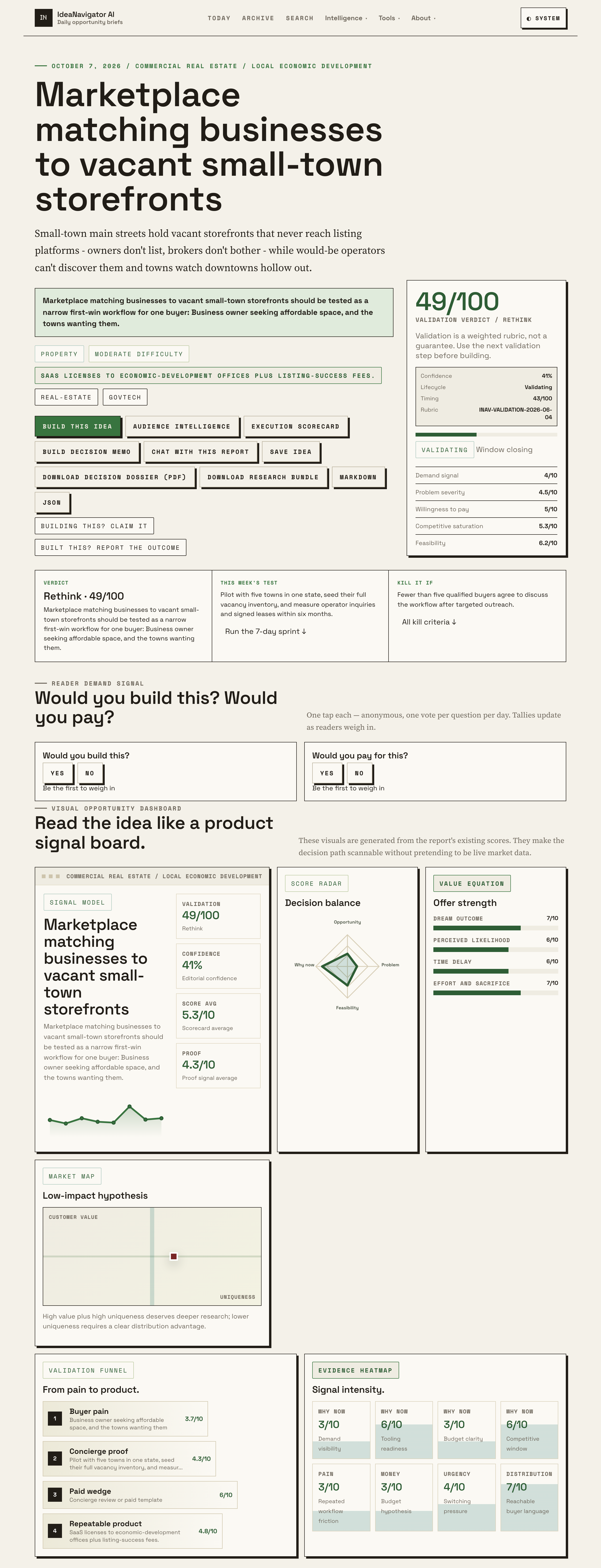
IdeaNavigator AI has outlined a proposed marketplace to help business owners find vacant small-town storefronts and connect towns with potential tenants. The concept calls for a five-town pilot, with inquiries and signed leases measured over six months; no pilot results or confirmed launch are reported.
IdeaNavigator AI has proposed a marketplace that would connect business operators with vacant small-town storefronts, sending prospective matches to local economic-development offices and attaching relevant grant information. In its proposal, IdeaNavigator AI recommends testing the service in five towns in one state and tracking inquiries and signed leases for six months; the proposal reports no launch or pilot results.
IdeaNavigator AI’s proposal describes a discovery gap: storefronts may sit empty without appearing on commercial listing platforms, while prospective operators have difficulty finding available spaces. The proposal says some owners do not list properties and brokers may not pursue them, leaving towns and would-be tenants without a shared way to identify opportunities. These are the proposal’s description of the problem, not quantified findings.
For an initial product, the proposal says town officials and property owners would submit listings with photos, size, rent and available incentives. Operators could browse by town profile and foot-traffic data. When a prospect and property appear to match, the marketplace would route the inquiry to the local development office, along with information about grants that could apply.
IdeaNavigator AI suggests a business model combining software licenses for economic-development offices with fees tied to successful listings. Its proposed validation test is to collect a town’s full vacancy inventory in each of five participating communities, then measure operator inquiries and signed leases over six months. The proposal does not give projected costs, pricing, participating towns or a definition of a successful match.
A Route From Listings to Leases
If tested and adopted, the model could give small-town officials a shared channel for making overlooked commercial spaces visible to business operators. A searchable inventory would address one practical obstacle identified in IdeaNavigator AI’s proposal: a prospective tenant cannot pursue a storefront they cannot find. Routing inquiries through a development office could also connect operators with local assistance rather than leaving them to navigate property searches alone.
The idea’s value, however, depends on whether visibility turns into qualified inquiries and signed leases. A listing platform by itself would not establish that a town has the right spaces, rents, incentives or operators to fill vacancies. For public agencies considering software spending, the proposed six-month measures would offer an early test, but they would not by themselves show whether leases endure or whether vacancies fall over the longer term.
small business storefront listing platform
As an affiliate, we earn on qualifying purchases.
As an affiliate, we earn on qualifying purchases.
The Proposed Town-Level Pilot
IdeaNavigator AI frames the marketplace as a focused commercial real estate and local economic-development product for two groups: business owners seeking affordable space and towns seeking tenants. Its proposal says remote-work migration has renewed interest in small-town commercial locations and that economic-development offices have grant funding aimed at matching businesses with property. It provides no supporting figures, specific grant programs or examples of participating towns.
Rather than starting with a broad property platform, IdeaNavigator AI recommends limiting the first test to five towns in one state. Each would seed the system with its full inventory of vacant storefronts. The proposal would then monitor two concrete outcomes—operator inquiries and signed leases—during a six-month period. This is a proposed validation plan, not evidence that a pilot has been approved or is underway.
As an affiliate, we earn on qualifying purchases.
Pilot Scope and Results Unknown
IdeaNavigator AI’s proposal confirms no launch, participating towns or signed leases. It is also unclear how property availability would be verified, how often listings would be updated, what qualifies as an eligible storefront, or how foot-traffic data would be gathered and presented. The proposal does not identify the grant programs or explain how the marketplace would determine whether a business qualifies for them.
Commercial terms and performance measures need more detail as well. The proposal specifies no license price, success-fee rate, operating budget or target number of inquiries. Its six-month test names inquiries and leases as measures but does not set a baseline for comparison or explain how the platform’s contribution to a lease would be distinguished from other causes. Those details would shape whether towns can judge the service’s cost and effectiveness.
As an affiliate, we earn on qualifying purchases.
Evidence Needed From Five Towns
IdeaNavigator AI’s proposed next step is a pilot with five towns in one state, beginning with a complete inventory of their vacant storefronts. If the test proceeds, the proposal sets a six-month evaluation window, with operator inquiries and signed leases tracked as the main indicators. It gives no schedule for recruitment, launch or publication of results.
Before a pilot could support a broader rollout, organizers would need to establish how listings are checked, how local grant details are kept current and how success fees are triggered. Towns and operators would also need clear information about data collection and the terms for submitting or responding to a match. Until those points and the pilot’s results are available, the marketplace remains a proposed approach rather than a demonstrated way to reduce storefront vacancies.
commercial property management software
As an affiliate, we earn on qualifying purchases.
As an affiliate, we earn on qualifying purchases.
Key Questions
Has the storefront marketplace launched?
No launch is reported. IdeaNavigator AI’s proposal describes a marketplace concept and recommends testing it, but does not identify an operating service or launch date.
How would businesses find available storefronts?
Under the proposal, owners and towns would list spaces with photos, size, rent and incentive information. Operators could browse by town profile and foot-traffic data, then send inquiries through the local development office.
What would the proposed pilot measure?
IdeaNavigator AI recommends a test in five towns that would track operator inquiries and signed leases over six months after the towns add their vacant-property inventories.
How would the marketplace make money?
The proposal’s revenue model combines software licenses for economic-development offices and fees tied to successful listings. It specifies no prices or fee rates.
Are grants guaranteed for businesses using the service?
No. The concept would attach information about available grants to relevant matches, but IdeaNavigator AI names no programs or says that any business would qualify. Eligibility would depend on the rules of each grant.
Source: IdeaNavigator AI
Halloween Picks
halloween
As an affiliate, we earn on qualifying purchases.