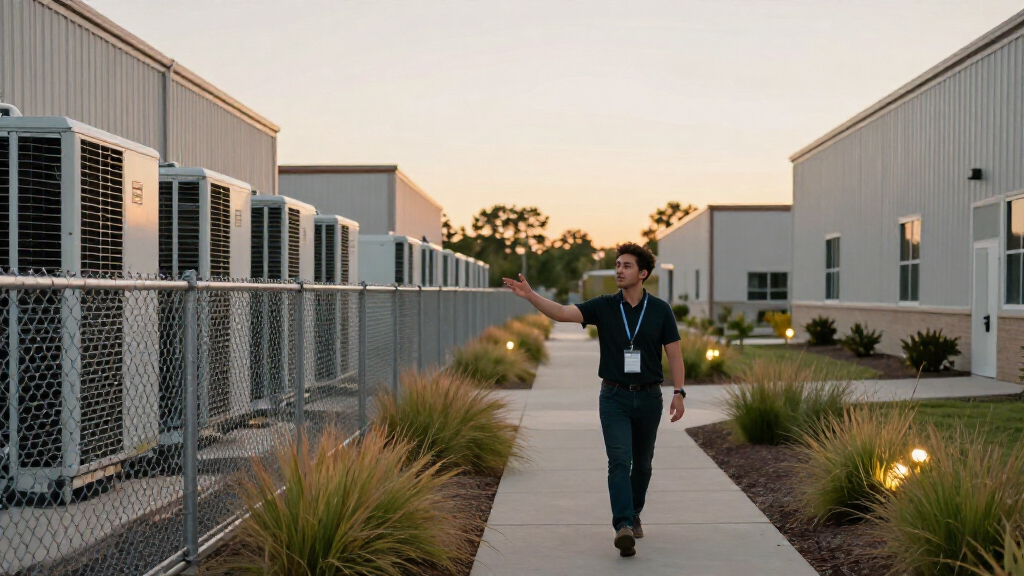

🔍 Read the full analysis: Why OpenAI Wants To Call Data Centers “Compute Campuses” on ThorstenMeyerAI.com

Get movie nights delivered free with Prime
- Fast, free delivery on millions of items
- Prime Video, Amazon Music and more included
- Member-only deals all year
TL;DR
OpenAI confirmed it is using “compute campuses” to describe the AI infrastructure it is building, saying the phrase better reflects its scale and role. A broader post-election public relations campaign was reported by Axios and relayed by TechCrunch, but OpenAI has not announced that campaign. The terminology arrives as energy costs, grid capacity, community impacts and the enforceability of industry pledges remain under scrutiny.
OpenAI has confirmed that it wants to describe the large facilities powering its artificial intelligence systems as “compute campuses,” a change the company says better captures the infrastructure’s scale and role. The terminology comes amid a reported plan for a wider public relations effort after the November 3 US midterm elections, though that campaign has not been officially announced by OpenAI.
OpenAI told Business Insider that “compute campuses” better describes “the scale and role of the infrastructure we’re building for AI.” The company also characterized the projects as long-term investments in computing, energy infrastructure and skilled work, and said it wants communities hosting them to help shape the projects and share in opportunities. Those statements were quoted in coverage by Gizmodo.
The reported communications push has a narrower evidentiary basis. TechCrunch reported on November 1, citing Axios, that OpenAI was preparing a post-midterm “PR blitz.” According to the account relayed by TechCrunch, chief global affairs officer Chris Lehane had discussed renaming data centers “AI compute campuses.” The source report says it could not review Axios’s original article, and OpenAI has not published an announcement launching the broader campaign or establishing the new term as an official policy.
The question behind the naming is practical as well as political: large AI facilities need electricity, grid connections and water, and their effects can reach nearby communities and other utility customers. OpenAI’s choice of phrase does not by itself alter those requirements or establish who will pay for associated infrastructure. The available reporting leaves the project-level costs and the effectiveness of industry commitments as separate questions.
The Costs Behind the New Label
The debate matters because the facilities are tied to electricity demand and grid investment, costs that may be shared or allocated among developers, utilities and other customers. A more favorable name cannot settle how those costs are assigned. The source material describes a substantial grid shortfall in the PJM market, but it also cautions against treating that figure as proof that data centers alone caused household price increases.
Public attitudes add pressure. The source cites a Pew Research Center survey of 10,548 US adults conducted from July 20 to August 9, 2026. In that survey, 50% said data centers were mostly bad for home energy costs, up from 38% in January; 54% said they were mostly bad for the environment, up from 39%. Sixty percent said they would be not too or not at all comfortable with a new data center in their area. These are survey findings about public views, not measurements of a particular facility’s effects.
For residents and local officials, the distinction between a pledge and an enforceable requirement is material. OpenAI and other firms have made commitments about energy costs and infrastructure, but the cited White House fact sheet does not set out a penalty, oversight body, monitoring process or reporting duty. Whether those promises protect customers in practice remains unsettled.
Popular right now

Ninja Foodi 10-Qt DualZone Air Fryer, 6-in-1, Black (DZ302)

TCL 65-Inch QM6K QLED Mini-LED 4K HDR Smart Google TV, 144Hz

KitchenAid Classic Series 4.5-Quart Tilt-Head Stand Mixer, Onyx Black
As an affiliate, we earn on qualifying purchases.
From Stargate to Ratepayer Pledges
OpenAI had addressed community concerns before the proposed terminology change. In January 2026, its Stargate Community plan pledged that the company would pay its own way on energy so its operations would not increase local electricity prices. That is a company commitment; the source material does not establish how it is enforced across projects.
On March 4, 2026, the White House announced a Ratepayer Protection Pledge signed by Amazon, Google, Meta, Microsoft, OpenAI, Oracle and xAI. Its fact sheet says signatories will build, bring or buy new generation resources, cover required power-delivery infrastructure upgrades and pay negotiated rates even if they do not use the electricity. The fact sheet calls the pledge a “first step”; it does not describe a penalty or formal monitoring and reporting system.
The source also cites the International Energy Agency’s April 2026 report, which said recent measures shift some financial risk away from utilities but that the extent of consumer protection is less clear. In the PJM region, an auction for the 2028–29 delivery year cleared at the regulator-approved cap of $325 per megawatt-day, compared with $333.44 the prior year. The supplied material says the auction was 6,831 megawatts short and that the market monitor attributed $6.3 billion of $16.4 billion in costs to data centers. Those figures describe a specific auction and attribution, not a direct calculation of each household’s bill.
Electricity-price changes also have more than one possible cause. The source notes that residential prices rose 11.3% in Virginia and 10.4% in Ohio over a year, while the IEA found no simple state-level relationship between data centers and prices. It also says the US Energy Information Administration attributed a 41% wholesale-price jump in PJM to weather, rather than data centers. These points caution against using regional price movements alone to assign responsibility.
What the Pledges Leave Open
It is not clear whether OpenAI will launch a formal communications campaign after the election, or whether “compute campuses” will become a consistent public label. The account of that wider campaign is based on Axios reporting reproduced by TechCrunch; the company’s confirmation applies to the term itself.
It also remains unclear how the energy pledges will be monitored or enforced. The cited White House fact sheet sets out commitments but, according to the source material, names no penalties, oversight body or reporting requirement. The IEA has warned that consumer protections may be incomplete and that costs could fall on data center operators or other ratepayers.
Water use is another unresolved project-level issue. At OpenAI’s planned Pike County, Ohio, site, the company reportedly expects water use comparable to an office building, but has said it will publish projections when the design is final. Until those projections are released, the facility’s expected water use cannot be independently assessed from the information provided.
The source material also mentions a reported reduction in OpenAI’s funding target, but says OpenAI has not confirmed it. It states that OpenAI owns no data centers and that partners carry the debt; it does not provide enough detail to determine the financing arrangements or costs for each project.
The Next Test Is Local Disclosure
The next concrete information to watch for is whether OpenAI formally announces a communications campaign and how consistently it uses the new term. More consequential for host communities will be project-specific disclosures: expected electricity demand, arrangements for grid upgrades, water-use projections and the terms under which local utilities or residents could bear costs.
For the Pike County project, the company has said water projections will follow once the design is final. The timing and contents of that disclosure are not specified in the source material. At a broader level, implementation of the White House pledge—and whether states establish binding cost-recovery rules—will help determine whether voluntary commitments change who pays.
Key Questions
What does OpenAI mean by “compute campuses”?
OpenAI says the phrase better describes the scale and role of the infrastructure it is building for AI. The company’s confirmation of the term does not change the facilities’ reported need for power, grid connections or water.
Has OpenAI launched a post-election public relations campaign?
Not according to the information provided. TechCrunch reported, citing Axios, that OpenAI was preparing a campaign after the midterms. OpenAI has not officially announced that campaign in the cited material.
Seven companies, including OpenAI, signed the White House Ratepayer Protection Pledge. The cited fact sheet describes commitments to cover required power-delivery upgrades and pay negotiated rates, but it does not specify penalties, an oversight body or reporting requirements.
What is known about water use at OpenAI’s planned Ohio site?
OpenAI reportedly expects water use at its planned Pike County site to be comparable to an office building. It has said it will publish projections once the design is final, so the project’s expected water use has not yet been detailed in the supplied reporting.
Source: ThorstenMeyerAI.com