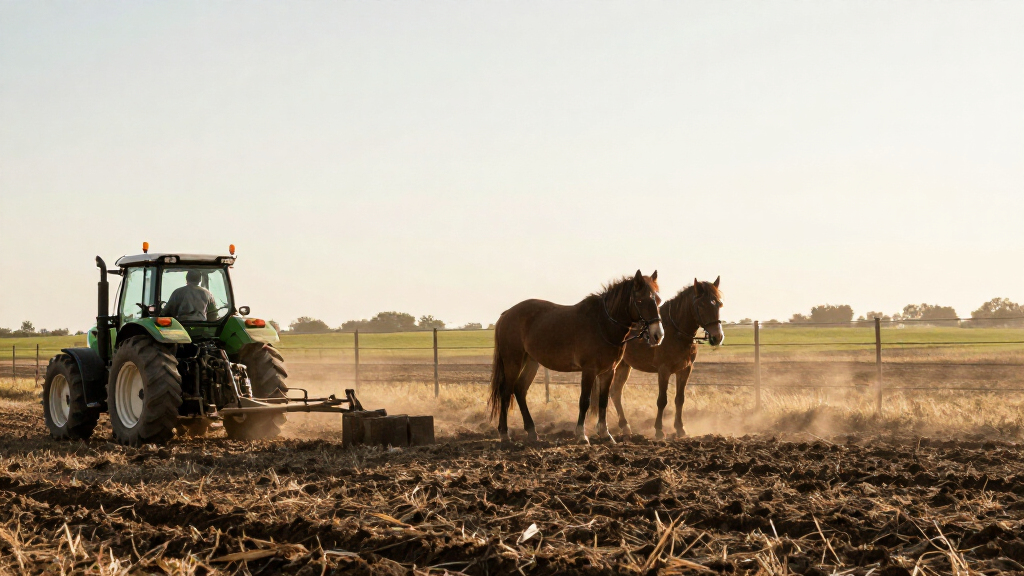

🔍 Read the full analysis: How Tractors Replaced 26.7 Million Working Animals on ThorstenMeyerAI.com

Get movie nights delivered free with Prime
- Fast, free delivery on millions of items
- Prime Video, Amazon Music and more included
- Member-only deals all year
TL;DR
A November 4, 2026, article from ThorstenMeyerAI.com traces how tractors and other machinery displaced working horses and mules on American farms. Their population fell from 26.7 million in 1918 to 3.1 million in 1960, while farm employment also declined as productivity rose and workers moved into other sectors.
ThorstenMeyerAI.com published a report November 4 tracing how tractors and other farm machinery replaced most working horses and mules in the United States: their combined population fell from 26.7 million in 1918 to 3.1 million by 1960. The account uses that shift to examine what happened to farm labor and how far the historical example can inform current debates about automation.
The figures cited in the report come from the U.S. Census Bureau’s Historical Statistics of the United States, Colonial Times to 1970, which reproduces Department of Agriculture estimates. Horses alone peaked at 21.4 million in 1915; mules continued to increase afterward, bringing the combined total to 26.7 million working animals on January 1, 1918. In 1915, about 93 million acres of harvested cropland grew feed for them, out of 340 million harvested acres.
Tractor numbers rose as the animal population declined. The report lists about 1,000 tractors on U.S. farms in 1910, 246,000 in 1920 and 4.69 million in 1960. Around 1955, tractors first outnumbered horses and mules, at 4.35 million against 4.31 million. By 1960, the animal count had fallen by almost 90% from its 1918 peak. The figures use different census dates in some years, and the report notes that the Agriculture Department counted horses and mules together from 1951.
Mechanization extended beyond tractors. Combine harvesters, which cut, thresh and clean grain in one pass, increased from about 4,000 on U.S. farms in 1920 to 1.042 million in 1960, according to the report. It also cites a rise in the estimated number of people supplied by each farm worker, from 7.1 in 1910 to 47.1 in 1970. That last measure includes people abroad supplied through exports.
Farm Output Rose as Labor Fell
The historical shift shows that automation can reshape an entire production system, not just replace one tool with another. Animals required feed throughout the year; the report says the land used to grow their feed dropped from 93 million acres in 1915 to about 5 million in 1960. That land could instead be used to grow crops for people or sale, while machinery helped farms produce more with fewer workers.
The labor consequences were substantial. U.S. farm employment peaked at 13.6 million in 1916 and stood at 4.5 million in 1970, as the overall U.S. labor force doubled, the report says. It describes new employment as increasingly city-based, meaning people often had to move to find work. Those numbers show a broad economic change, but by themselves do not establish what happened to every displaced worker or how individual families experienced the shift.
The report connects this history to modern automation, while cautioning that the horse comparison is an analogy rather than a rule about what will happen to human workers. The difference matters: people can participate in politics and retrain or move between jobs, while animals could not choose new occupations. The historical case can inform debate, but it cannot settle the future effects of AI or robotics.
Popular right now

KitchenAid Classic Series 4.5-Quart Tilt-Head Stand Mixer, Onyx Black

Samsung QN65LS03FAFXZA 65 The Frame QLED 4K Art Mode Vision AI Smart TV (2025)

Ninja Mega Kitchen System Blender and Food Processor, 1500W, 72-oz Pitcher, 8-Cup Bowl, Black (BL770)
As an affiliate, we earn on qualifying purchases.
From Fordson to Farm Robots
Tractors existed before World War I, but the report describes early models as heavy, expensive and better suited to large farms. In 1917, Ford launched the Fordson. The Henry Ford museum describes it as “the first mass-produced and inexpensive lightweight tractor” designed to meet small farmers’ needs, and says it rapidly became the most popular tractor in America. The report says the 100,000th Fordson left the assembly line on February 21, 1920.
The tractor was part of a wider change that included combines, corn pickers, balers and milking machines, as well as improved seed and fertilizer. Together, these technologies raised output per farm worker. In the account’s framing, the fall in working animals was not a single event: farmers stopped breeding replacements, and the population declined over time.
The report also points to current machinery, including John Deere’s 16-camera autonomy kit, announced in February 2025 for tillage on selected large tractors. It says China reported that about 74% of ploughing, sowing and harvesting was mechanized in 2023. These examples concern different places and kinds of machinery; they do not show that today’s autonomous equipment can perform every task a human worker can.
“The Fordson was “the first mass-produced and inexpensive lightweight tractor” built “to meet the needs of small farmers.””
— The Henry Ford museum, as quoted in ThorstenMeyerAI.com’s report
What the Horse Analogy Cannot Show
The figures document changes in animal numbers, farm employment and machinery, but they do not provide a complete account of where displaced farm workers went, what jobs they found or how their incomes changed. The report says employment shifted toward cities and that workers had to move, but it does not quantify those moves or distinguish among workers’ experiences.
The historical data also have limits: the tractor counts reflect census figures taken on somewhat different dates, and the combined horse-and-mule series changed its counting practice in 1951. The source presents the horse-to-tractor transition as a possible comparison for modern automation, not as proof that AI will cause the same pattern. The capabilities and employment effects of current farm robots remain a separate question.
Tracking Automation’s Next Effects
The report does not announce a new policy, product launch or upcoming research milestone. Its next step is analytical: it asks readers to compare the historical shift with the present spread of farm automation while distinguishing what machinery can already do from predictions about future jobs. The examples provided—John Deere’s selected-tractor tillage system and China’s reported mechanization rate—offer snapshots, not a full measure of autonomous farming.
Further evidence would be needed to assess how current agricultural robots affect employment, farm costs and the movement of workers between sectors. For now, the historical record establishes the scale of the earlier change: millions fewer working animals, a major expansion in machinery and a much smaller farm workforce. It does not establish that the human labor transition now under way will follow the same path.
Key Questions
How many horses and mules worked on U.S. farms at the peak?
The report cites a combined peak of 26.7 million on January 1, 1918, including 21.2 million horses and 5.5 million mules.
When did tractors outnumber horses and mules?
The report places the crossover around 1955, when it lists 4.35 million tractors and 4.31 million horses and mules.
What happened to the working animals?
The report says farmers largely stopped breeding replacements. As working animals aged and were not replaced, their population declined; it does not describe a single mass event.
Does the history prove that AI will replace human workers in the same way?
No. The report presents the horse comparison as an analogy, not a prediction or a law. Its historical figures show a major change in farming, but they do not establish how AI will affect people’s jobs.
What can today’s autonomous farm machinery do?
The report says John Deere’s 16-camera autonomy kit, announced in February 2025, performs tillage on selected large tractors. It does not claim that the system can perform all farm tasks without people.
Source: ThorstenMeyerAI.com