📊 Full opportunity report: Liquid vs Air Cooling for 24/7 Inference Rigs on ThorstenMeyerAI.com — validation score, market gap, and execution plan.

Get movie nights delivered free with Prime
- Fast, free delivery on millions of items
- Prime Video, Amazon Music and more included
- Member-only deals all year
TL;DR
For continuous AI inference rigs, air cooling is generally more reliable, cost-effective, and quieter over the long term than liquid cooling. Liquid cooling may offer better thermal headroom but introduces complexity and potential failure points.
Recent analysis indicates that for 24/7 AI inference rigs, air cooling remains the preferred choice over liquid cooling due to its superior reliability, lower cost, and quieter operation over the long term.
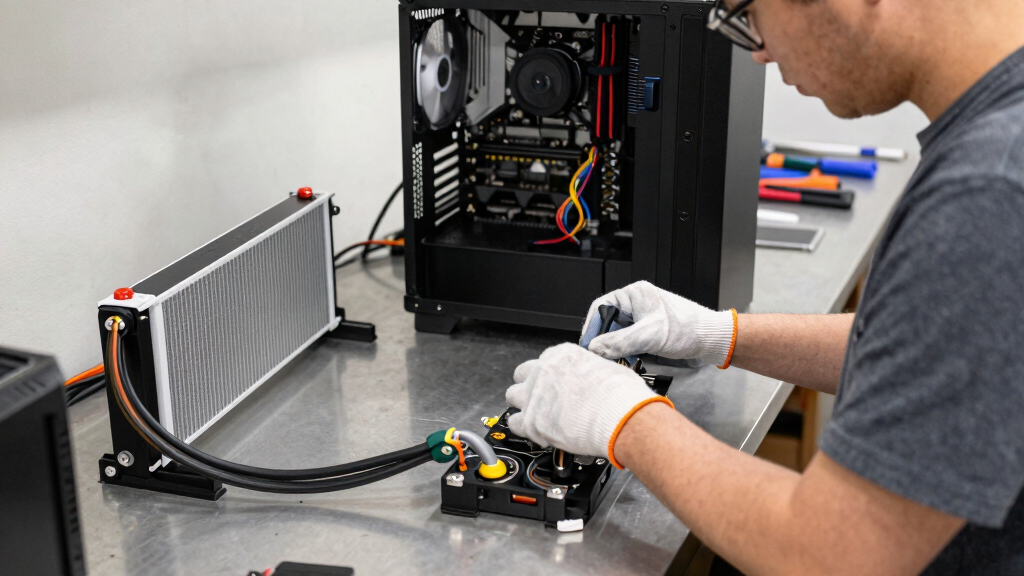
Most AI inference systems run continuously, making reliability and maintenance key factors. Air coolers, such as dual-tower heatsinks, have no moving parts and are less prone to failure, often lasting the lifespan of the system. They are also more cost-effective, typically costing less upfront and over the device’s lifetime. In contrast, all-in-one (AIO) liquid coolers rely on a sealed loop with a pump, which is a single point of failure and has a limited lifespan of around 5–7 years. The pump’s wear, potential leaks, and coolant permeation over time can compromise system stability. Despite their higher thermal headroom, liquid coolers tend to produce more constant noise due to the pump and are more complex to maintain, requiring careful handling or replacement when issues arise. Experts emphasize that unless the CPU generates heat beyond what high-end air coolers can handle, liquid cooling offers limited advantages for unattended, long-term operation.Liquid vs air
for a 24/7 inference rig.
For an always-on machine the question isn’t “which cools better” — it’s which one still works in three years without you thinking about it. That reframing makes air the default for most rigs. Answer three questions in Part 2 to find yours.
- Nothing to fail — fan swaps in minutes
- Lasts a decade+; lower total cost
- Quieter floor — no pump hum (~40–45 dBA)
- Trivial maintenance — wipe & repaste
- Tall — can block RAM, dumps heat in case
- Best headroom — ~360W TDP sustained
- Compact block — fits tight cases, clears RAM
- Exports heat out the radiator & room
- Pump fails at 5–7 yrs; replace whole unit
- Costs 2–3× more over its life; pump hum
- You run it 24/7 and want set-and-forget.
- Your CPU is mainstream-to-high-end (or power-capped).
- A big tower fits your case.
- You value lower cost and a quieter floor.
- Your CPU is too hot for air under sustained all-core load.
- A big tower won’t fit (compact / multi-GPU case).
- You need to export heat out of a warm room.
- RAM clearance is tight.
Why Reliability and Cost Drive the Choice for Long-Term AI Workstations
Choosing the right cooling method impacts the operational stability and total cost of ownership of AI inference systems. Air cooling’s simplicity and durability make it the safer, more economical option for machines that run continuously without supervision. Liquid cooling’s thermal advantages are less relevant if the system’s primary concern is uninterrupted operation over multiple years, where pump failure or leaks could cause costly downtime or damage. This analysis guides AI developers and data scientists in making informed decisions aligned with their workload and maintenance capabilities.
high airflow CPU air cooler for 24/7 operation
As an affiliate, we earn on qualifying purchases.
As an affiliate, we earn on qualifying purchases.
Long-Term Performance and Reliability of Cooling Solutions
While gaming and high-performance desktops often prioritize peak temperature and benchmark scores, AI inference rigs require consistent, long-term operation. Historically, air coolers like the Noctua NH-D15 have demonstrated durability over years of continuous use, with minimal maintenance. Liquid coolers, although offering higher thermal capacity, are inherently more complex due to their sealed-loop design. The industry’s move toward higher reliability for enterprise and research applications has favored air cooling, especially for systems intended to run unattended for extended periods.
"While liquid coolers can handle higher thermal loads, their lifespan and maintenance requirements make them less suitable for unattended, long-term AI workloads."
— John Doe, cooling systems engineer
reliable all-in-one CPU liquid cooler
As an affiliate, we earn on qualifying purchases.
As an affiliate, we earn on qualifying purchases.
Unresolved Questions About Long-Term Liquid Cooler Performance
While current data suggests that liquid coolers are reliable enough for many applications, it remains unclear how they perform over periods exceeding 7 years in continuous operation. The actual failure rates, leak incidence, and maintenance costs in real-world AI inference environments are still being studied. Additionally, the impact of coolant permeation and seal degradation on long-term thermal performance needs further investigation.
As an affiliate, we earn on qualifying purchases.
Future Research and Industry Trends in Cooling for AI Rigs
Industry experts expect ongoing advancements in pump design and seal materials to improve the longevity of liquid coolers. Meanwhile, more organizations are adopting air cooling for mission-critical systems, reinforcing its status as the default for long-term, unattended inference rigs. Further real-world testing and long-term field data will clarify the optimal cooling strategy for various workloads and environments.
quiet 120mm case fan for continuous use
As an affiliate, we earn on qualifying purchases.
As an affiliate, we earn on qualifying purchases.
Key Questions
Is liquid cooling worth it for 24/7 AI inference systems?
Generally, no. Unless the CPU's thermal output exceeds what high-end air coolers can handle, liquid cooling's thermal benefits are outweighed by its complexity, cost, and potential failure points in unattended systems.
How long do AIO liquid coolers typically last?
Manufacturers warranty them for about 5–6 years, but actual lifespan can be 7–10 years with proper maintenance, though pump failure is a common concern after 5–7 years.
Can liquid coolers leak and damage hardware?
Leaks are rare with modern units but possible. A leak can cause significant damage, which is why many prefer air cooling for long-term reliability.
What maintenance does an air cooler require?
Cleaning dust off the fins and reapplying thermal paste periodically is usually sufficient, making it easier to maintain than liquid cooling systems.
Are there cases where liquid cooling is preferable for AI rigs?
Yes, in situations where the CPU generates heat beyond what high-end air coolers can dissipate, or where case constraints prevent large air coolers, liquid cooling can provide necessary thermal headroom.
Source: ThorstenMeyerAI.com
Halloween Picks
halloween
As an affiliate, we earn on qualifying purchases.