
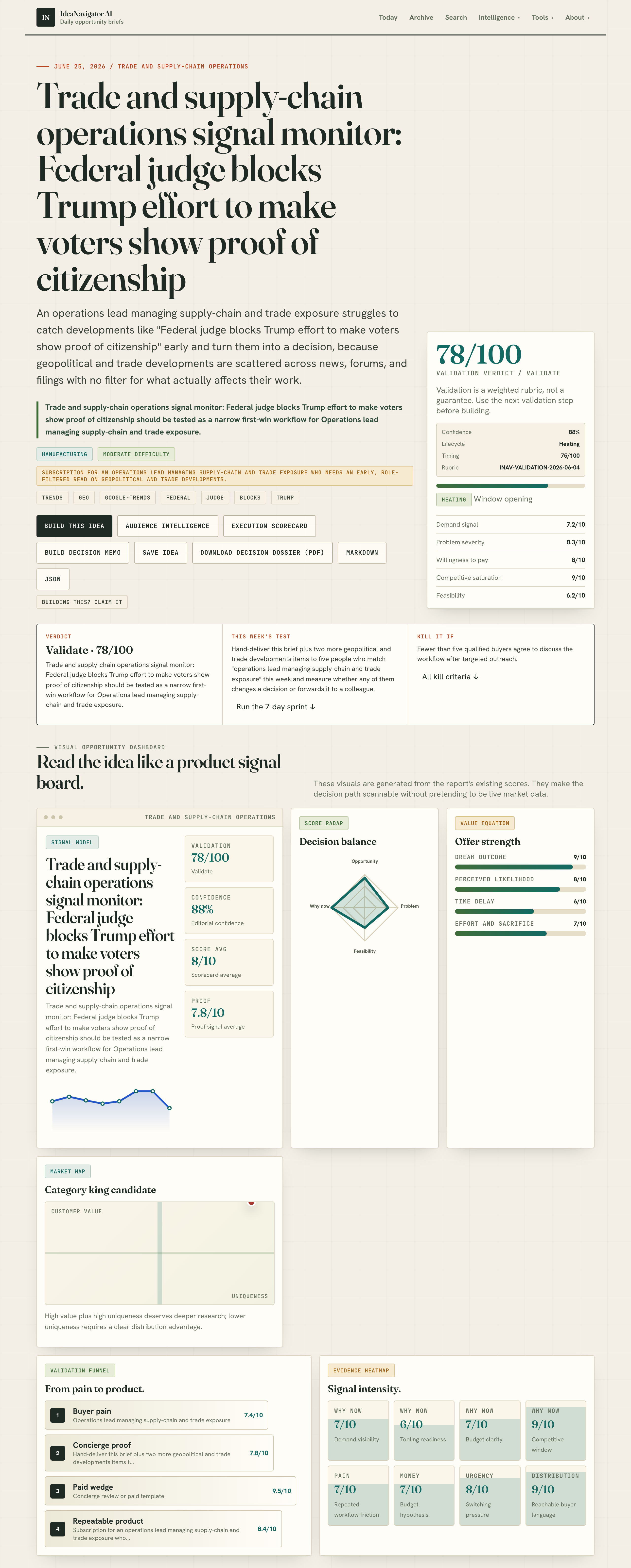
📊 Full opportunity report: Trade and supply-chain operations signal monitor: Federal judge blocks Trump effort to make voters show proof of citizenship on IdeaNavigator AI — validation score, market gap, and execution plan.

Get movie nights delivered free with Prime
- Fast, free delivery on millions of items
- Prime Video, Amazon Music and more included
- Member-only deals all year
TL;DR
A federal court has blocked an effort initiated by Trump to require voters to present proof of citizenship. This development affects ongoing legal disputes over voting requirements and election integrity. The decision is confirmed and has immediate implications for election procedures.
A federal judge has blocked former President Donald Trump’s effort to require voters to show proof of citizenship, a move that could have significant implications for election procedures and voting rights. The ruling, issued on March 2024, is a legal setback for Trump’s efforts to tighten voter identification rules, and it underscores ongoing legal battles over election integrity and voting access.
The court decision was made by a federal judge in a case challenging Trump’s initiative to enforce stricter proof-of-citizenship requirements for voter registration. The judge’s ruling prevents the implementation of this requirement, citing legal concerns related to voting rights and the potential for disenfranchisement. The effort was part of broader initiatives by Trump and his allies to alter voting procedures, which have faced multiple legal challenges nationwide.
Legal experts confirm that this ruling halts the enforcement of the proof-of-citizenship requirement at least temporarily, pending further legal proceedings. The decision is viewed as a victory for voting rights advocates who argued that such requirements could suppress voter turnout, especially among marginalized communities. The case now moves into the appeals process, with both sides expected to argue the legal merits of the requirement.
Legal and Electoral Implications of the Court Ruling
This decision matters because it shapes the legal landscape of voting rights in the United States. Blocking the proof-of-citizenship requirement reduces barriers to voter registration, potentially affecting turnout in upcoming elections. It also signals judicial resistance to efforts aimed at tightening voting restrictions, which could influence future legal battles and legislation related to election security and access.
Popular right now

KitchenAid Classic Series 4.5-Quart Tilt-Head Stand Mixer, Onyx Black

Dyson V15 Detect Cordless Vacuum

Philips 3300 Series Fully Automatic Espresso Machine with Milk Frother, Grinder, Hot and Iced Coffee Presets, SilentBrew, 15-Bar Pressure (E
As an affiliate, we earn on qualifying purchases.
Legal Battles Over Voter Identification Requirements
The effort to enforce proof of citizenship for voters was part of a broader push by Trump and his allies to implement stricter voting requirements, citing concerns over election security. Several states and courts have previously debated similar measures, with courts often striking down restrictions deemed to suppress voter turnout. The legal challenge in this case was filed by voting rights groups and civil liberties organizations, arguing that the requirement violates federal voting laws.
The case gained prominence amid ongoing national debates over election integrity and voting access, especially following the 2020 presidential election. Learn more about supply chain and election-related issues. The judge’s ruling aligns with previous decisions that have emphasized protecting voters’ rights against unnecessary barriers.
“This ruling helps safeguard access to the ballot and prevents suppression of marginalized communities.”
— Voting rights advocate
Unresolved Legal and Political Challenges Ahead
It is still unclear whether the ruling will be appealed or if similar efforts will be pursued in other jurisdictions. The legal process may extend, and future court decisions could modify or uphold the current ruling. Additionally, the impact on upcoming elections remains to be seen, depending on how enforcement and legal challenges evolve.
Next Steps in the Legal Process and Election Impact
The case is expected to proceed to higher courts, where the legality of the proof-of-citizenship requirement will be further examined. Both sides are likely to file appeals, and the outcome could influence voting laws in multiple states. Election officials are monitoring the situation closely to determine how this ruling might affect voter registration and ballot access in upcoming elections.
Key Questions
What was the proof-of-citizenship requirement?
The requirement would have mandated voters to present documentation proving their citizenship before registering or voting, aimed at preventing non-citizens from participating.
Why did the court block this effort?
The court cited concerns about potential disenfranchisement and violations of federal voting laws, which protect voters’ rights to access the ballot without unnecessary barriers.
Could this ruling be challenged further?
Yes, the decision is likely to be appealed to higher courts, and future legal rulings could either uphold or overturn this blocking order.
How does this affect upcoming elections?
The ruling temporarily prevents the enforcement of the proof-of-citizenship requirement, potentially allowing broader voter registration access in the near term, but legal uncertainties remain.
What are the broader implications for voting laws?
This case exemplifies ongoing legal debates over voting restrictions, with potential to influence legislation and court decisions across the country.
Source: IdeaNavigator AI