
📊 Full opportunity report: When One Agent Isn’t Enough: Claude Now Builds Its Own Team Of Agents On The Fly on ThorstenMeyerAI.com — validation score, market gap, and execution plan.

Get movie nights delivered free with Prime
- Fast, free delivery on millions of items
- Prime Video, Amazon Music and more included
- Member-only deals all year
TL;DR
Claude has introduced a new feature called dynamic workflows, enabling the AI to assemble and manage its own team of agents on the fly. This development aims to improve handling of complex, high-value tasks by overcoming limitations of single-agent approaches.
Claude, the AI model developed by Anthropic, now has the ability to build its own team of agents on the fly, a feature called dynamic workflows. This allows the AI to orchestrate multiple specialized subagents for complex, high-value tasks, addressing limitations of single-agent approaches. The development represents a significant step in autonomous AI management and workflow orchestration.
Anthropic’s Claude now writes and executes small JavaScript programs to assemble and coordinate subagents tailored for specific tasks. These subagents can operate in isolated workspaces, use different models depending on their role, and resume interrupted workflows. This approach is designed to mitigate common failures in single-agent tasks, such as agentic laziness, self-preferential bias, and goal drift.
The workflow patterns include classifying tasks, splitting work for parallel processing, adversarial verification, and iterative looping until completion. These patterns mirror practices used by human team leads, such as routing, parallelizing, auditing, and competing solutions. The feature is particularly suited for complex projects like code refactoring, research synthesis, and large-scale verification, where single-agent methods struggle to maintain quality and focus.
Anthropic emphasizes that this capability is resource-intensive, using more tokens and better suited for high-value, complex tasks rather than simple edits or quick fixes. The system can dynamically decide which model to deploy for each subtask and whether to run agents in parallel or sequentially.
When one agent isn’t enough: Claude now builds its own team on the fly
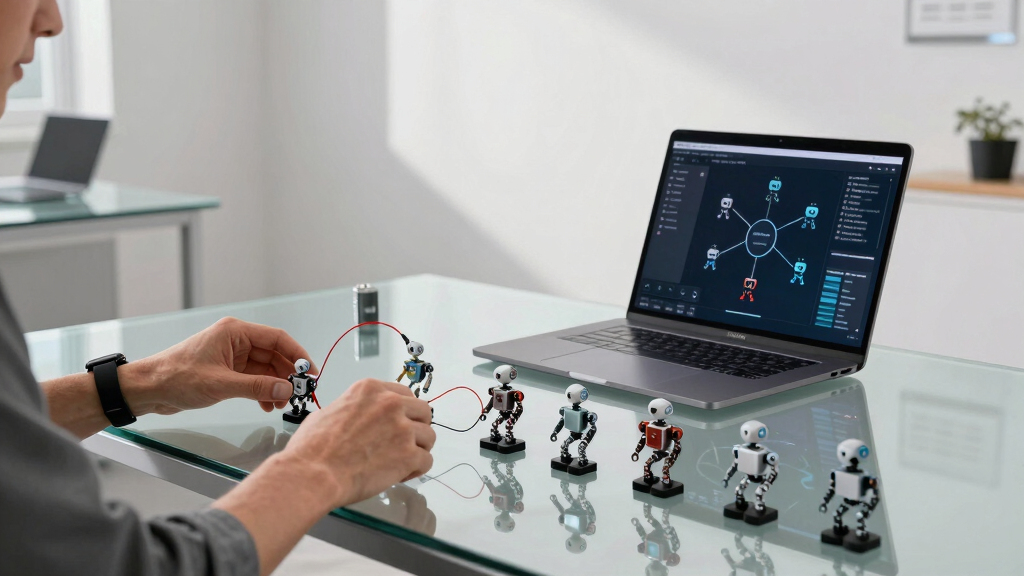
Skills package what you know; loops decide how far you delegate over time. Dynamic workflows are the third axis — within a single task, Claude writes its own harness and assembles a temporary team of subagents. Think of it as Claude drawing an org chart for one job.
The shift is from prompting a worker to commissioning a team — more output, more cost, and a manager’s judgment required. Reach for a workflow when a task is big, parallel, adversarial, or judgment-heavy — and when you can feel a single agent getting lazy, grading its own homework, or losing the plot. Bound it (token budgets, pilot first) — workflows can spawn hundreds of agents and burn far more tokens. For everything else, don’t hire five people to change a lightbulb.
Implications for AI-Driven Project Management
This development could significantly enhance the ability of AI systems to handle complex, multi-step projects without human intervention. By enabling Claude to self-assemble teams of specialized agents, organizations may see improvements in accuracy, reliability, and task scope. It also marks a shift toward more autonomous AI workflows, reducing the need for manual orchestration and oversight in high-stakes environments.
However, the approach demands more computational resources and careful management to avoid inefficiencies. Its effectiveness for routine tasks remains limited, as it is designed primarily for high-value, complex operations where traditional single-agent methods fall short.
As an affiliate, we earn on qualifying purchases.
Evolution of Autonomous AI Workflows
Prior to this feature, Claude operated as a single agent executing tasks within a fixed context window, which proved insufficient for long or complex projects. The concept of dynamic workflows builds on previous innovations in modular AI orchestration, allowing the model to generate and run custom harnesses tailored to specific tasks.
Anthropic’s recent updates, including Claude Opus 4.8, introduced the ability for the AI to reason about tasks and generate custom scripts. The new feature extends this capability by enabling the AI to dynamically create and manage multiple subagents, each with its own context and goal, mimicking human team management practices.
This approach addresses known failure modes of single-agent systems, such as incomplete work, bias, and goal drift, especially in lengthy or adversarial tasks. The development completes a trilogy of skills that enhance AI’s operational complexity and autonomy.
“Claude’s ability to autonomously assemble and orchestrate its own team of agents marks a new era in AI workflow management.”
— Thorsten Meyer, AI researcher at Anthropic
As an affiliate, we earn on qualifying purchases.
Unanswered Questions About Workflow Efficiency and Limits
It is not yet clear how well these autonomous workflows perform in real-world, large-scale deployments over extended periods. The resource demands and cost implications are still being evaluated, and the system’s effectiveness in routine or lower-stakes tasks remains uncertain. Additionally, the potential for unintended interactions or errors among subagents has not been fully explored.
As an affiliate, we earn on qualifying purchases.
Next Steps for Testing and Adoption of Autonomous Teams
Anthropic plans to conduct further testing of Claude’s dynamic workflows across diverse projects to evaluate performance, reliability, and cost-effectiveness. They are also expected to refine the orchestration patterns and develop best practices for deployment in enterprise environments. Wider adoption will depend on demonstrating clear advantages over traditional single-agent methods in real-world scenarios.
As an affiliate, we earn on qualifying purchases.
Key Questions
What types of tasks is Claude’s new team-building feature best suited for?
The feature is optimized for complex, high-value projects such as research synthesis, large-scale verification, and code refactoring, where multiple specialized subagents can improve accuracy and efficiency.
Does this mean Claude can now fully manage entire projects autonomously?
Not yet. While it can assemble and manage teams of agents for specific tasks, human oversight remains important, especially for strategic decisions and resource management.
What are the resource implications of using dynamic workflows?
They require significantly more tokens and computational power, making them more suitable for high-stakes, complex tasks rather than simple or routine work.
Will this feature be available to all users immediately?
It is currently being tested within controlled environments and will be gradually rolled out as Anthropic refines the technology and assesses its performance.
Could autonomous agent teams lead to unintended errors or biases?
Yes, as with any complex system, there is potential for errors or biases to emerge. Proper safeguards, oversight, and testing are essential to mitigate these risks.
Source: ThorstenMeyerAI.com
Evergreen bestsellers Picks
bestsellers
As an affiliate, we earn on qualifying purchases.