📊 Full opportunity report: Vertigo relief app on IdeaNavigator AI — validation score, market gap, and execution plan.
TL;DR
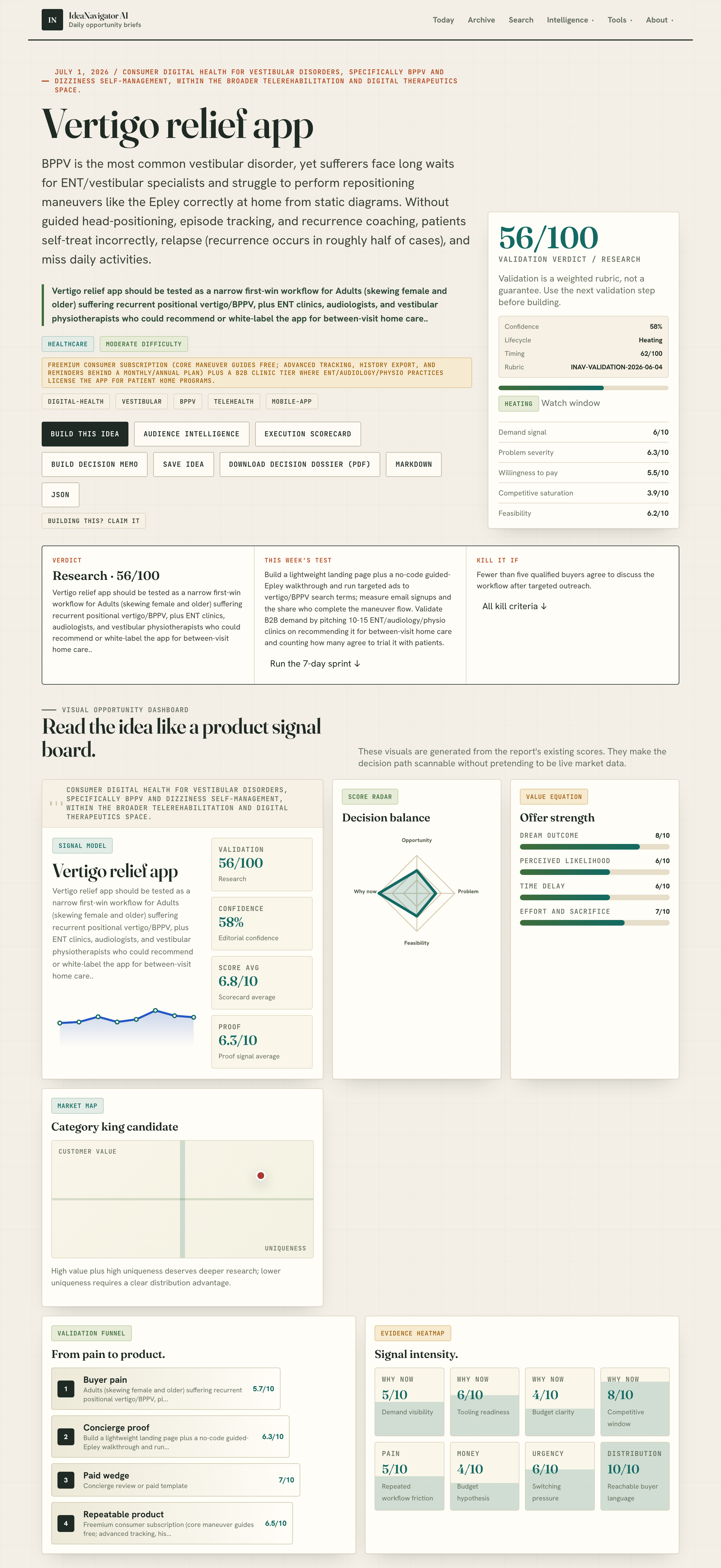
A new vertigo relief app is in development to assist adults with recurrent BPPV in performing repositioning maneuvers at home. It aims to supplement clinical care and is being tested for both consumer and professional use. The project responds to increased telehealth adoption and advances in smartphone sensors.
A new vertigo relief app is being developed to help adults with recurrent benign paroxysmal positional vertigo (BPPV) perform repositioning maneuvers at home, with testing underway for both consumer and healthcare provider versions. This initiative aims to address longstanding challenges in self-treatment and improve patient outcomes amid growing telehealth adoption.
The app is designed for adults suffering recurrent BPPV, a common vestibular disorder that causes dizziness episodes. This trend reflects how digital therapeutics are evolving. It will feature guided, animated instructions for maneuvers like the Epley and Brandt-Daroff, with audio cues and gyroscope-based head-angle feedback using smartphone sensors. The platform will also enable users to log dizziness episodes, triggers, and symptom severity over time, providing valuable data for ongoing management. Learn more about innovative health apps at this guest app.
Developers plan to offer a freemium model, with basic maneuver guides available for free and advanced features such as detailed tracking, history export, and reminders behind a subscription. Additionally, ENT clinics, audiologists, and vestibular physiotherapists could license a version of the app to recommend to patients for between-visit care, integrating digital therapeutics into standard treatment pathways.
The project responds to market trends, including increased telehealth use during COVID-19, smartphone sensors capable of precise motion tracking, and evolving reimbursement policies for digital health solutions. For more insights, see the question no to-do app. The digital vestibular rehabilitation market was estimated near USD 498 million in 2024, with a projected compound annual growth rate of approximately 13.5% through 2033.
Potential Impact on Vertigo Self-Management
This app could significantly improve self-treatment accuracy for BPPV sufferers, reducing relapse rates and enabling more effective home management. By providing guided, real-time feedback, it may lower the need for frequent clinic visits, easing healthcare burdens and increasing patient independence. For clinicians, the app offers a tool to monitor patient progress remotely, facilitating more personalized care.
Its development aligns with broader shifts toward telehealth and digital therapeutics, which are expected to reshape vestibular disorder treatment. If successful, the app could become a standard adjunct to clinical care, expanding access to effective vertigo management for a wider population.
vertigo repositioning maneuver guide app
As an affiliate, we earn on qualifying purchases.
As an affiliate, we earn on qualifying purchases.
Growing Demand for Digital Vertigo Solutions
Benign paroxysmal positional vertigo (BPPV) is the most common vestibular disorder, yet many patients face long waits for specialist diagnosis and treatment. Traditional repositioning maneuvers require precise head positioning, which can be difficult to perform correctly at home from static diagrams. During the COVID-19 pandemic, telehealth adoption accelerated, prompting a shift toward remote management solutions.
Smartphones now incorporate high-precision motion sensors capable of measuring head angles in real time, opening opportunities for digital therapeutics in vestibular care. The market for digital vestibular rehabilitation is estimated to be near USD 498 million in 2024, with strong growth expected as healthcare providers and payers increasingly accept telehealth platforms.
Previous efforts have focused on clinician-guided therapy, but the new app aims to empower patients directly, supported by clinical validation and integration into existing care pathways.
“The app’s guided approach could improve self-treatment accuracy for BPPV, potentially reducing relapse rates.”
— an anonymous researcher
BPPV dizziness relief device
As an affiliate, we earn on qualifying purchases.
As an affiliate, we earn on qualifying purchases.
Uncertainties Around Clinical Validation and Adoption
It is not yet clear how effectively the app will perform in real-world use, or how quickly clinicians will adopt it as part of standard care. Validation studies are still underway, and regulatory approval processes remain to be navigated. Additionally, patient engagement and adherence to app-guided maneuvers are still being evaluated.
vestibular rehabilitation app
As an affiliate, we earn on qualifying purchases.
As an affiliate, we earn on qualifying purchases.
Next Steps Include User Testing and Clinical Trials
The development team plans to launch a lightweight landing page and a no-code guided Epley maneuver demo to gauge user interest and collect feedback. They will also conduct targeted advertising campaigns for vertigo/BPPV search terms, tracking signups and maneuver completion rates. Concurrently, clinical validation studies are expected to commence, assessing the app’s safety, accuracy, and effectiveness in real-world settings. Further integration with healthcare providers will depend on trial outcomes and regulatory considerations.
home vertigo treatment tools
As an affiliate, we earn on qualifying purchases.
As an affiliate, we earn on qualifying purchases.
Key Questions
When will the vertigo relief app be available to the public?
The app is currently in testing and validation phases. A public release date has not yet been announced, but developers plan to gather user feedback and clinical data before broader rollout.
Will the app replace visits to ENT specialists?
No, the app is intended as a supplementary tool for home management and between-visit care. It includes disclaimers emphasizing that it is not a substitute for professional medical advice.
Can healthcare providers prescribe or recommend the app?
Yes, ENT clinics, audiologists, and vestibular physiotherapists may license the app for patient use, integrating it into their treatment plans once it is validated and commercially available.
What features will the app include?
The app will guide users through repositioning maneuvers with animated instructions, audio cues, and gyroscope-based head-angle feedback. It will also log dizziness episodes, triggers, and severity over time, with optional advanced tracking features for subscribers.
How will the app be funded?
The app will operate on a freemium model, offering basic maneuver guides for free and charging subscriptions for advanced features. Clinics can license a version for patient use, creating additional revenue streams.
Source: IdeaNavigator AI