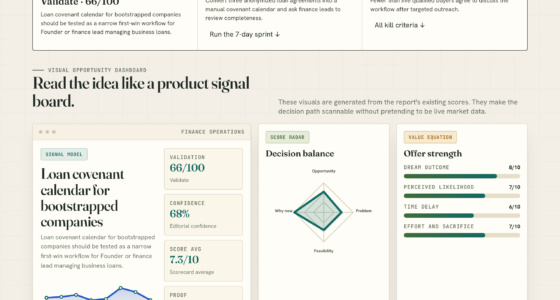

📊 Full opportunity report: Mobilised, Not Spent: What’s Left Of Europe’s €200 Billion AI Offensive on ThorstenMeyerAI.com — validation score, market gap, and execution plan.

Get movie nights delivered free with Prime
- Fast, free delivery on millions of items
- Prime Video, Amazon Music and more included
- Member-only deals all year
TL;DR
Europe’s €200 billion AI investment plan is largely aspirational, with only a small portion of public funds committed and significant delays expected. The initiative relies heavily on private capital that is not yet secured.
The European Commission’s €200 billion AI initiative remains largely unspent and delayed, with only a small portion of the funds actually committed and operational. This plan, meant to position Europe as a major AI player, faces significant implementation hurdles, including delays and a reliance on private capital that has yet to materialize.
The headline figure of €200 billion for Europe’s AI offensive is based on the concept of ‘mobilizing’ funds, not actual expenditure. Of this, only about €50 billion is designated as real public money, with €20 billion earmarked for AI gigafactories that are still in planning or early construction phases. The rest depends on private investment, which is not yet secured, and the timeline for deployment extends into 2027–2028. Currently, only one site in Norway is under construction, with 19 smaller AI factories using existing supercomputers.
In comparison, US tech giants like Amazon, Microsoft, Alphabet, and Meta are investing collectively around $700 billion in 2026 alone, dwarfing Europe’s entire multi-year budget for AI infrastructure. A single Microsoft data center in Portugal costs $10 billion—half of Europe’s entire €20 billion AI budget—highlighting the scale gap. The European plan is delayed, with formal calls for tenders not opening until July 2026, and facilities expected to be operational only in two to three years.
Mobilised, not spent
The EU is selling a €200 billion AI offensive. But the decisive word is “mobilised” — not “spent.” Work through the number and the headline shrinks dramatically before it reaches any effect.
2027–28 data centres expected to run
1 SITE under construction so far (Norway)
Late, slow, and not yet built.
A small, late, partly hypothetical cheque — without touching expensive energy, fragmented capital markets, slow permits, or the talent drain. The EU mistakes a funding pot for a strategy.
Implications of Europe’s Slow AI Investment Push
This situation underscores Europe’s challenge in transforming announced funding into tangible AI infrastructure and innovation. The reliance on private capital that has yet to commit raises questions about the feasibility of Europe’s AI ambitions. Without accelerated investment and structural reforms—such as energy costs, permitting, and capital markets—Europe risks falling further behind US tech giants in AI development and deployment.
As an affiliate, we earn on qualifying purchases.
European AI Funding and Competitiveness Challenges
The €200 billion figure is a headline target, emphasizing Europe’s intention to catch up with US dominance in AI. However, actual public investment is minimal, and the planned infrastructure is years away from completion. Europe’s AI lag is attributed to high electricity prices, slow permitting processes, fragmented capital markets, and talent migration to US companies. The Commission’s accompanying ‘Technological Sovereignty Package’ includes laws and strategies but largely reiterates existing or non-additional funding, with no immediate impact on core issues.
While the US invests heavily in AI infrastructure, Europe’s planned investments are delayed and small-scale. The gap in compute capacity, talent retention, and energy costs remains unaddressed by the current funding framework.
“Taxpayers cannot foot this bill alone — Europe ‘urgently’ needs private capital.”
— Ursula von der Leyen
As an affiliate, we earn on qualifying purchases.
Unresolved Questions About Europe’s AI Funding Effectiveness
It remains unclear whether Europe’s private sector will step up to fulfill the funding expectations, and how quickly the planned infrastructure can be built given current delays. The impact of high electricity costs, permitting issues, and talent migration on the timeline and scale of AI development in Europe is still uncertain.
As an affiliate, we earn on qualifying purchases.
Next Steps in Europe’s AI Infrastructure Development
The formal calls for tenders for AI gigafactories are scheduled for July 2026, with construction expected to begin shortly thereafter. The European Commission and member states will need to accelerate efforts to attract private investment and address structural barriers. Monitoring of private commitments and progress on infrastructure projects over the next 12–24 months will be critical to assess whether Europe can meet its AI ambitions.
As an affiliate, we earn on qualifying purchases.
Key Questions
Is Europe actually spending €200 billion on AI?
No. The €200 billion figure refers to the amount Europe aims to ‘mobilize,’ combining public funds and hoped-for private investment. Only a small part of this is actual public spending, with the rest relying on private capital that is not yet secured.
When will the European AI gigafactories be operational?
The first facilities are expected to come online in 2027–2028, with formal tenders opening in July 2026. Currently, only one site in Norway is under construction.
How does Europe’s AI infrastructure compare to the US?
US tech giants like Microsoft and Amazon are investing hundreds of billions annually in AI infrastructure, far exceeding Europe’s planned investments. A single US data center can cost $10 billion, roughly half of Europe’s entire €20 billion AI budget.
What are the main barriers to Europe’s AI development?
High electricity prices, slow permitting, fragmented capital markets, talent migration, and dependence on US cloud services are key obstacles that the current funding does not address.
Does the European plan include measures to fix structural issues?
The ‘Technological Sovereignty Package’ includes laws and strategies, but critics say it largely reiterates existing frameworks and does not directly resolve core issues like energy costs or market fragmentation.
Source: ThorstenMeyerAI.com
Halloween Picks
halloween
As an affiliate, we earn on qualifying purchases.