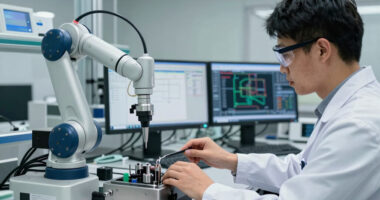
Engineering Is Automated. Research Is the Residual.
Recent developments show AI can automate core engineering tasks, but research still relies on human creativity. What this means for AI progress and industry.
European consortium OpenEuroLLM faces significant compute challenges as it aims to develop open-source multilingual LLMs, highlighting limits of pan-European AI efforts.
Italy’s Minerva-3B, trained from scratch on 2.5 trillion tokens, scores only 4.9% on Italian exams, raising questions about native-language investment needs.
Major AI labs publicly commit to automating AI R&D by 2026, signaling a strategic shift toward automation as a core objective, with broad implications for the industry.
Portugal’s €5.5M AMÁLIA LLM, launched in 2025, outperforms many models in Portuguese tasks but prompts key questions about openness, native data, and goals.
The Post-Labor Transition Atlas is a new empirical framework analyzing AI-driven labor displacement, policy responses, and structural alternatives as of 2026.
The Compounding Error Problem — Why 99.9% Alignment Decays to 60% in 500 Generations
Research shows that even 99.9% per-generation alignment accuracy drops to 60% after 500 generations, raising concerns over recursive self-improvement safety.
The Co-Founder’s Black Hole — A Structural Read on Jack Clark’s Automated AI R&D Essay
Jack Clark predicts over 60% chance that autonomous AI research systems could emerge by 2028, raising concerns about institutional readiness and future risks.
Jack Clark Says It Out Loud — Reading the Co-Founder’s 60%/2028 Estimate on Automated AI R&D
Anthropic’s co-founder Jack Clark publicly estimates over 60% probability that autonomous AI systems capable of building their own successors will emerge by 2028.