📊 Full opportunity report: GLP-1 Pharmacy Index: Compare Stock, Doses, And Cash Prices on IdeaNavigator AI — validation score, market gap, and execution plan.

Get movie nights delivered free with Prime
- Fast, free delivery on millions of items
- Prime Video, Amazon Music and more included
- Member-only deals all year
TL;DR
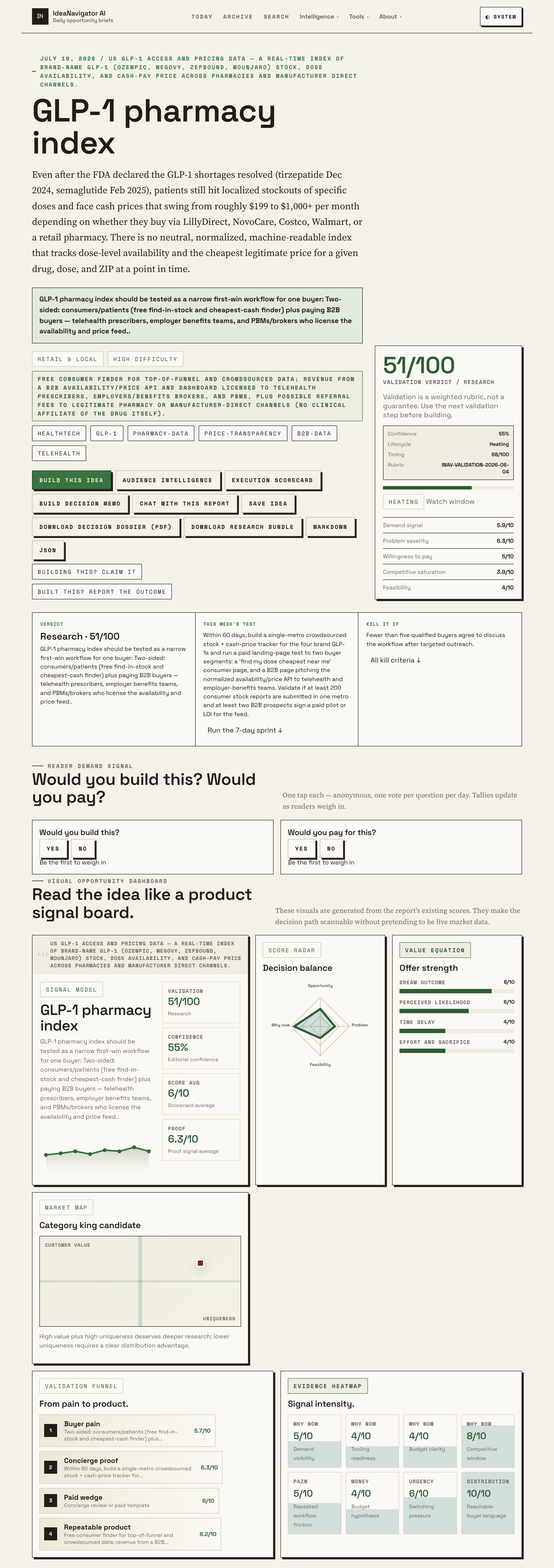
IdeaNavigator AI has proposed a GLP-1 pharmacy index that would help patients compare dose availability and cash prices by ZIP code, while selling normalized data to business buyers. The proposal describes a product opportunity and a 60-day validation plan; it does not report that the index has launched or that buyers have signed on.
IdeaNavigator AI has proposed a pharmacy index for brand-name GLP-1 drugs that would let patients search for a specific dose and cash price by ZIP code, while offering the underlying data to business customers. The proposal addresses fragmented stock and price information, but it does not establish that a service has launched, secured customers, or verified the listed prices and availability.
The proposed tool would cover Ozempic, Wegovy, Zepbound and Mounjaro. Patients could use it without charge to look for a dose in stock and compare cash prices across manufacturer-direct channels and participating retailers. The plan identifies LillyDirect, NovoCare, Costco and Walmart among the channels whose public pricing could be normalized, alongside a discount-price layer similar to those offered by price-comparison services. The proposal does not describe agreements with these companies or pharmacies.
For an initial version, the plan calls for a single-metro pilot using crowdsourced reports of stock and publicly available price data. It also proposes alerts for dose availability. A separate paid product would provide the normalized availability and price feed through an API or dashboard to telehealth prescribers, employer benefits teams, pharmacy benefit managers and brokers. The proposal suggests starting with one or two design partners, but names no prospective buyer.
IdeaNavigator AI sets out a 60-day validation target: collect at least 200 consumer stock reports in one metro and seek either a paid pilot or a letter of intent from at least two business prospects. Those figures are proposed tests of demand, not results. The material does not give a pilot location, a start date, a budget, or evidence that development has begun.
The Search for Dose-Level Data
For patients, a search organized by drug, dose and ZIP code could make it easier to compare options when a particular dose is not available nearby or cash prices differ across channels. That comparison could matter to people paying out of pocket, especially if they need to check several pharmacies or direct-purchase programs. The proposal does not show that the index would guarantee stock, reserve medication, or provide clinical advice; its described role is to report availability and prices.
For employers and other buyers, a normalized feed could offer a clearer view of local availability and cash prices when evaluating pharmacy costs or helping members find access options. The proposal says employers report that GLP-1s account for roughly 20% of pharmacy spending, but gives no survey, date, sample or other basis for that figure. It should be treated as a claim in the proposal, not as a verified market-wide measure. Whether buyers would pay for the feed remains a central question the proposed pilot is meant to address.
Top picks for "pharmacy index stock"
As an affiliate, we earn on qualifying purchases.
From Shortages to Scattered Prices
The proposal frames the opportunity as a shift from broad shortage concerns to more localized problems with particular doses and prices. It says the FDA declared tirzepatide shortages resolved in December 2024 and semaglutide shortages resolved in February 2025. Even after those decisions, it argues, patients may still encounter local stock gaps. The material does not provide pharmacy-level data to measure how often that happens or establish that the FDA shortage status itself predicts availability at a particular location.
It also points to a changing mix of purchase channels. Manufacturer-direct programs and retailer cash-pay options can make prices differ by product and channel, while the proposal estimates monthly cash prices range from about $199 to more than $1,000. It does not attach those figures to a specific drug, dose, date, or matched set of pharmacies, so they show the range asserted in the proposal rather than a current like-for-like comparison. The plan further cites compounding deadlines and a TrumpRx portal launch in February 2026 as developments behind the expanding mix of options; it supplies no details about their effect on local supply.
Coverage, Accuracy and Buyer Demand
Several practical details remain unsettled. The proposal does not identify a metro, participating pharmacies, data-refresh frequency, or a method for checking crowdsourced reports. Without those details, readers cannot judge how current or representative a listing would be. Stock can change quickly, and the plan does not explain how it would label reports that are old, conflicting or unverified.
It is also unclear how the index would compare prices that may depend on eligibility, payment terms, product and dose. The stated range does not specify whether it includes every fee or reflects the same purchase conditions across channels. No pricing for the proposed business feed, signed customer, pharmacy partnership, referral arrangement or consumer usage data is reported. The material is a product proposal, so it does not establish that the opportunity has been independently validated.
The Proposed 60-Day Test
The next step described is to test a consumer search page and a business-facing pitch for the data feed. The consumer test would ask whether people submit enough stock reports in one metro to support a useful local index. The business test would present the API to telehealth and employer-benefits prospects and look for paid pilots or letters of intent. The proposal sets thresholds of 200 consumer reports and two business prospects, but does not specify when the clock starts or how results would be independently checked.
If the thresholds are reached, the proposal could support a case for expanding coverage or refining the feed for paying buyers. If they are missed, it would leave open whether the cause was weak demand, limited awareness, difficulty collecting reliable reports, or the test design. No outcome or later milestone is available in the material.
Source: IdeaNavigator AI
Key Questions
Has the GLP-1 pharmacy index launched?
No launch is reported. IdeaNavigator AI describes a proposed product and a plan to test it in one metro; the material does not say development or a pilot has begun.
Which medicines would the index cover?
The proposed first version would cover Ozempic, Wegovy, Zepbound and Mounjaro, with searches by drug, dose and ZIP code.
How would the index get availability and price information?
The plan combines crowdsourced stock reports with normalized public pricing from manufacturer-direct programs and retailers. It does not specify data checks, refresh intervals or confirmed pharmacy participation.
Who would pay for the service?
Patients would use the finder for free under the proposal. Potential paying customers include telehealth prescribers, employers, benefits brokers and pharmacy benefit managers; no signed buyers or agreed prices are reported.
What would count as a successful test?
The proposed 60-day test would seek at least 200 consumer stock reports in one metro and paid pilots or letters of intent from at least two business prospects. These are targets, not achieved results.
Source: IdeaNavigator AI
Fall Picks
fall essentials
As an affiliate, we earn on qualifying purchases.